
TikTok Shop Fulfillment in 2026: 6 Options and How to Ship from Walmart WFS
Reading Time: 14 minutes TikTok Shop fulfillment in the US now comes down to six…
Running short of time? Get PDF of the blog in your mail.
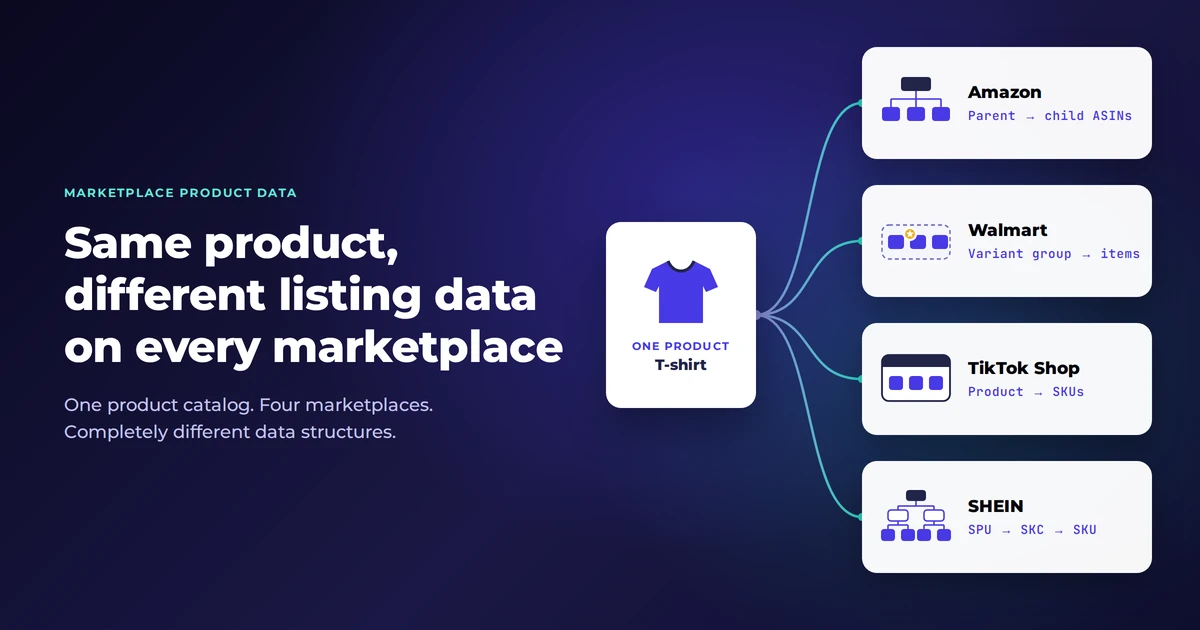
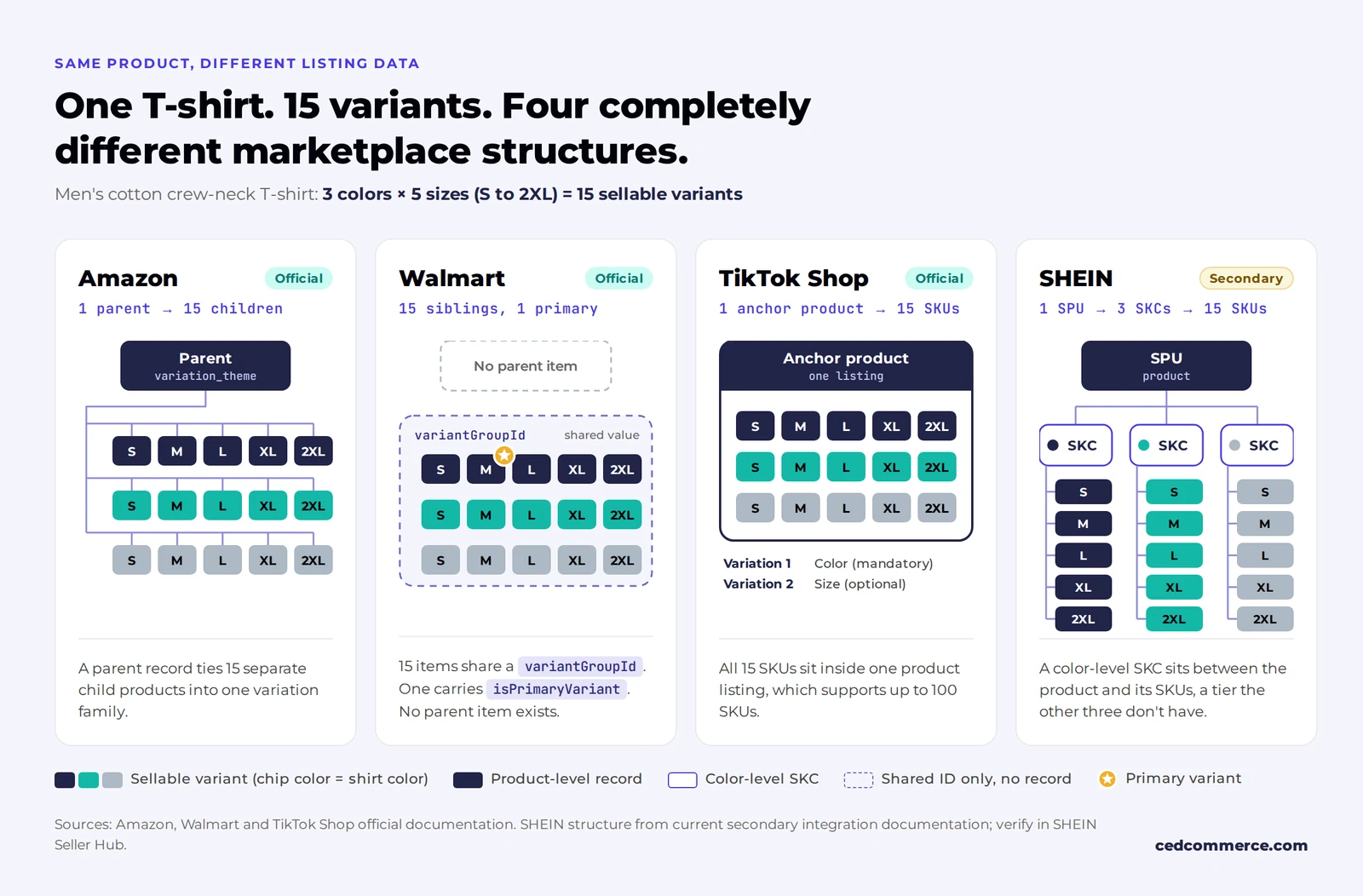
The same physical product can require a different listing structure on every marketplace. Take a T-shirt with five sizes and three colors. Amazon can organize those 15 sellable variants through parent and child relationships. Walmart groups them as sibling items using a shared variant group. TikTok Shop places SKUs under an anchor product. However, SHEIN describes another layer between the product and SKU. That’s why marketplace product data requirements become complicated when you take a catalog across multiple sales channels.
The challenge goes deeper than renaming a few fields. Each marketplace has its own taxonomy, variation model, accepted attribute values, content rules and validation process. A catalog that works perfectly on Amazon can therefore arrive at Walmart, TikTok Shop or SHEIN with missing information, incompatible relationships or values that the destination marketplace doesn’t accept.
However, if you do not want product listing data requirements to hold you back in the last quarter of 2026, this guide breaks down what you need to map correctly when going multichannel. Be it Amazon, Walmart, TikTok Shop, or SHEIN, learn how to structure product data differently.
A marketplace listing is shaped by the category the product sits in. Amazon uses Product Type Definitions to determine the attributes associated with a product type. More importantly, Amazon says those requirements can be dynamic. Filling one attribute can affect which additional attributes become required.
In an Amazon Selling Partner API discussion, a member of Amazon’s Selling Partner Developer Services team explained:
“The required attributes on a product type are dynamic.”
However, Walmart handles requirements differently. Its item setup is tied to versioned item specifications, while TikTok Shop uses leaf-level categories and also evaluates listing quality. Now these different systems explain a common seller experience: the source catalog appears complete, yet a destination marketplace still asks for more information.
One Shopify seller encountered exactly this kind of gap when Amazon introduced a required age_range_description field that wasn’t available through the connected channel’s product data. The destination marketplace isn’t simply reading the source listing and changing its labels. It is trying to fit that data into its own product model.
Variation structure is one of the clearest examples. Consider a men’s cotton T-shirt sold in five sizes, S through 2XL, and three colors. That gives the hypothetical seller 15 sellable variants.
| Marketplace | How the 15-variant T-shirt is represented |
|---|---|
| Amazon | Parent-child relationships connect the variation family. The example becomes 15 child products associated through variation data. |
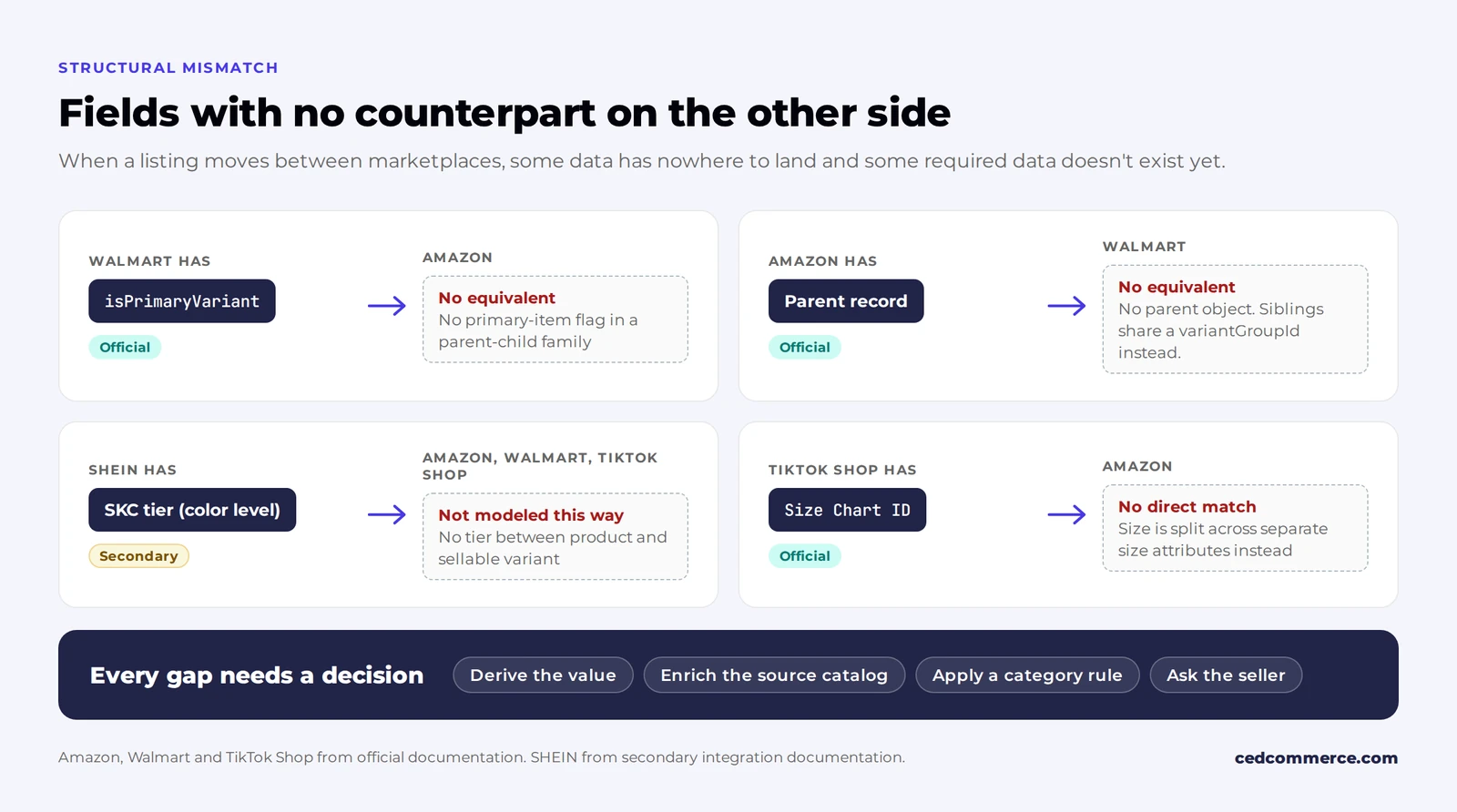
| Walmart | 15 sibling items share a variantGroupId, with one item identified through isPrimaryVariant. There is no Amazon-style parent item in Walmart’s documented variant structure. |
| TikTok Shop | 15 SKUs sit under an anchor product. TikTok documents Variation 1 as mandatory and Variation 2 as optional, with a maximum of 100 SKUs. |
| SHEIN | Available third-party integration documentation describes an SPU → SKC → SKU structure. For this example, the structure can introduce a color-level SKC between the product and individual SKUs. |
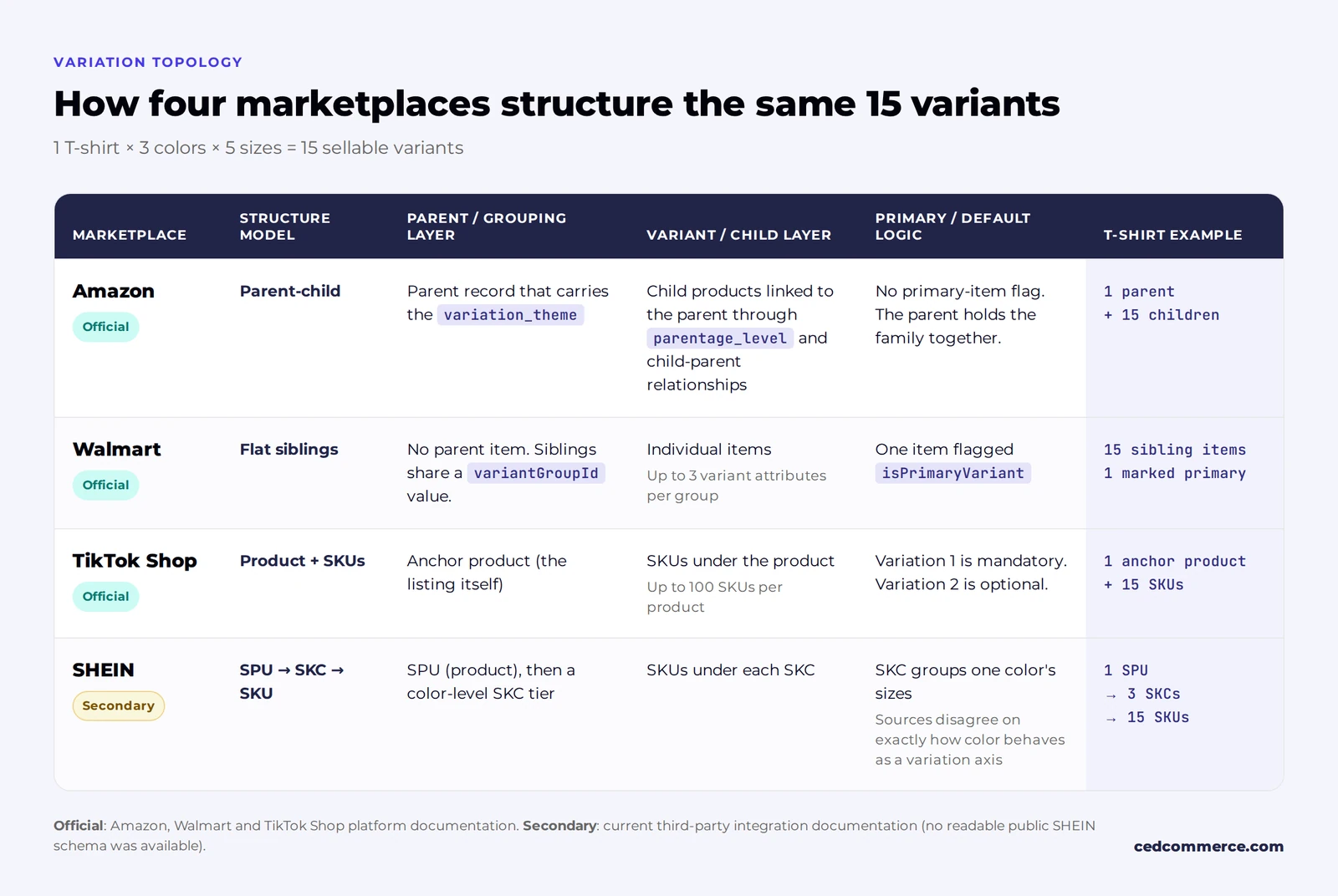
The Problem: An Amazon parent record doesn’t have an equivalent Walmart parent object. Walmart needs information such as isPrimaryVariant that an Amazon catalog doesn’t need in the same form. SHEIN integration documentation introduces an SKC layer that Amazon, Walmart and TikTok Shop don’t model in the same way.
Even when two marketplaces ask for something that sounds identical, they may expect the value in different forms.
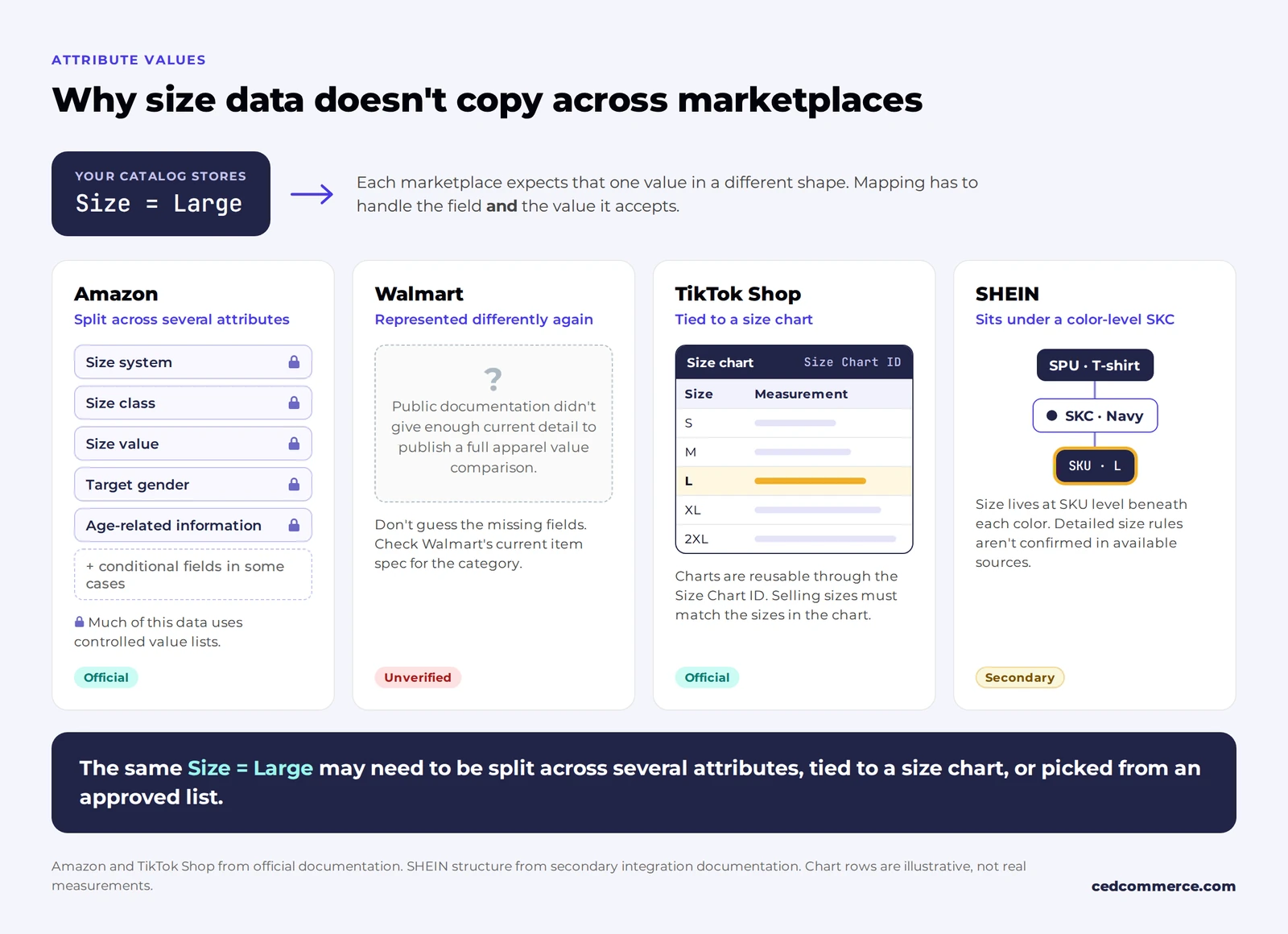
Apparel size is a useful example. Amazon’s apparel sizing system uses multiple components, including size system, size class, size value, target gender and age-related information, with additional conditional fields in some cases. Amazon also uses controlled value lists for much of this data.
TikTok Shop handles apparel sizing through size charts that can be reused through a Size Chart ID. Selling sizes must correspond with the sizes represented in the chart.
Walmart, whereas, represents apparel sizing differently again. Unfortunately, public Walmart does not provide enough current detail for a full apparel value comparison.
Yet, this distinction matters because attribute mapping has to account for both the field and the accepted value.
A seller may store: Size = Large but the destination marketplace might instead need that information distributed across several attributes, associated with a size chart, or selected from an approved list.
Closed values create another failure point. Seller forum discussions show products being rejected even when the submitted wording appeared logically correct, because the value didn’t match the marketplace’s expected enumeration or the underlying product type was wrong.
Now we can put the pieces together. Our example is a men’s short-sleeve cotton crew-neck T-shirt with five sizes and three colors.
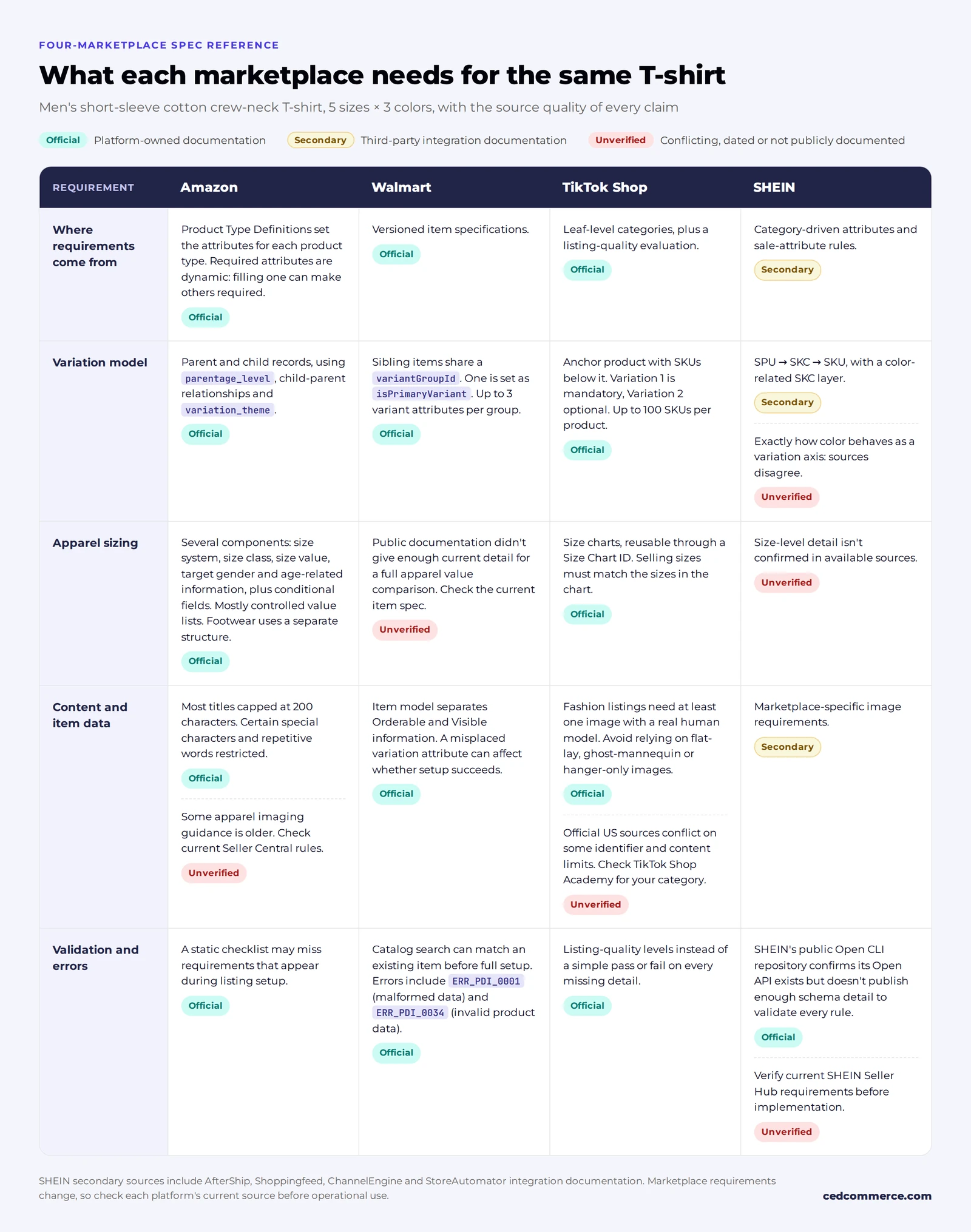
Amazon assigns products to product types and exposes their requirements through Product Type Definitions.
For variation families, its Listings Items documentation includes fields such as parentage_level, child-parent relationships and variation_theme. Apparel introduces its own sizing requirements. These differ from other categories, including footwear, which has a separate sizing structure.
Amazon also notes that required attributes can change depending on other attribute values. That means a static checklist may not represent every requirement that appears during listing setup. For titles, Amazon’s current policy caps most product titles at 200 characters and restricts certain special characters and repetitive words.
Source quality: Official Amazon documentation and Amazon-owned resources.
Walmart’s variation model uses sibling items. Items in the same variant family share a variantGroupId. Walmart also requires one item in the group to be designated through isPrimaryVariant, and its documentation supports up to three variant attributes for a variant group.
Its item model also distinguishes between Orderable information and Visible product information. A variation attribute placed incorrectly can therefore affect whether item setup succeeds. Before full item setup, Walmart’s catalog search can also determine whether the product already matches an existing catalog item.
That introduces another decision into a catalog migration workflow. Walmart documents errors including ERR_PDI_0001 for malformed data and ERR_PDI_0034 for invalid product data.
Source quality: Official Walmart Marketplace developer documentation.
TikTok Shop uses an anchor product with individual SKUs below it. Its bulk listing documentation specifies Variation 1 as mandatory when variations are present and Variation 2 as optional. TikTok Shop supports up to 100 SKUs under a product.
Fashion also introduces media requirements that can affect whether existing marketplace assets are reusable. TikTok Shop’s US documentation tells fashion sellers to include at least one image featuring a real human model and advises against relying on flat-lay, ghost-mannequin or hanger-only images.
Its listing-quality system can also classify product information into quality levels instead of treating every missing detail as a simple pass-or-fail field error. However, there are certain conflicting official TikTok Shop US sources around identifier and content limits.
‘Those conflicts shouldn’t be resolved by choosing whichever number is more convenient. Instead, you should check the current TikTok Shop Academy requirement for the category you are listing in.
Source quality: Official TikTok Shop Academy US documentation.
SHEIN is the marketplace where public documentation requires the most caution. Current documentation describes an SPU, SKC and SKU structure, category-driven attributes, sale-attribute rules and marketplace-specific image requirements. The sources also describe an additional color-related layer through SKCs and constraints around sale attributes.
Yes. Apparel makes the structural difference easy to see, but category-specific product data requirements exist throughout marketplace catalogs. Amazon alone illustrates why category matters: apparel uses one sizing attribute structure, while footwear uses a different set covering concepts such as footwear size system, age group, gender, class and width.
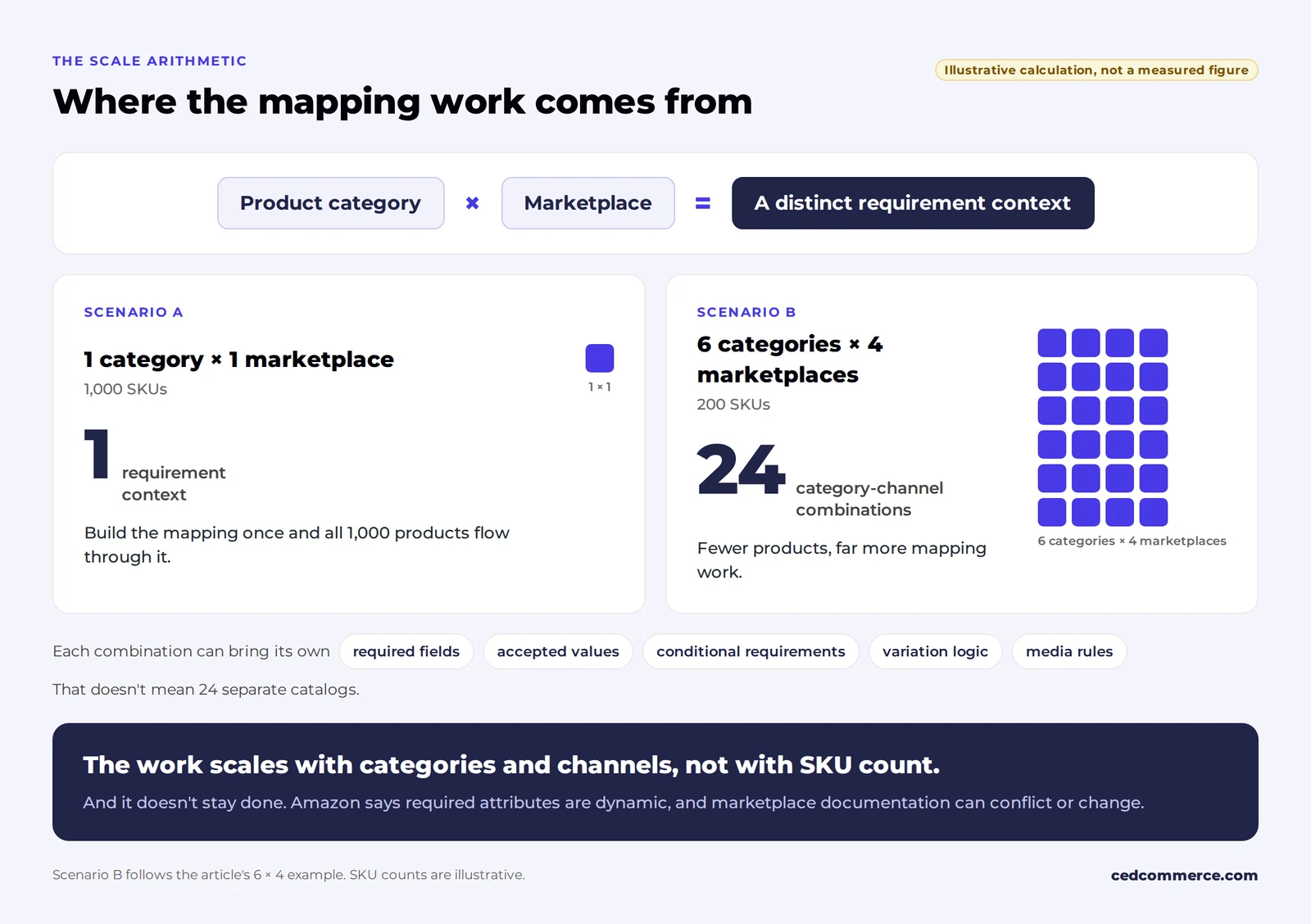
A useful way to think about marketplace expansion is therefore: Marketplace × product category = a distinct requirement context
The more categories and channels you add, the more of these contexts the catalog has to support.
For 15 variants, the translation can still be reviewed item by item. For thousands of SKUs across multiple product categories, the number of mapping decisions grows quickly.
Illustrative example: suppose you have products across six categories and want to sell on four marketplaces.
That creates up to: 6 categories × 4 marketplaces = 24 category-channel combinations. This doesn’t mean you need 24 completely independent catalogs. It shows why a single universal attribute template quickly becomes insufficient. Each combination can introduce its own required fields, accepted values, conditional requirements, variation logic and media rules.
The operational cost appears when exceptions start accumulating. A Shopify seller describing a migration to eBay, Etsy and Amazon reported that uploading the Shopify CSV didn’t recreate the marketplace categories. Another eBay seller reported 1,922 listings being rejected through a generic bulk-listing error and having to work through items individually.
The language may vary, but the underlying problem sellers are facing is consistent: bulk product data can be reusable while still being incomplete for the destination marketplace.
Marketplace attribute mapping is the process of connecting fields and values in your source catalog with the fields and accepted values required by a destination marketplace for a particular product category.
For example, your source catalog (Walmart/Amazon) might contain Color, while the destination (SHEIN/Tiktok Shop)category expects its own color attribute and accepted terminology. Mapping also has to handle cases where a destination field has no direct source equivalent. That might require deriving a value, enriching the source catalog, applying a category rule or asking the seller for missing information.
Hence, before this process, Category mapping helps you decide where the product belongs in the destination marketplace’s taxonomy. Meanwhile, attribute mapping decides how the product data fills the requirements created by that category. Choosing the wrong category can therefore expose the wrong attributes and create errors that appear to be data problems.
Explore UniCon’s channel-wise attribute mapping if you’re preparing one catalog for multiple marketplaces.
Some product fields are reusable throughout a catalog. Others only make sense after the destination category is known.
| Mapping type | What it handles | Example |
|---|---|---|
| Global attribute mapping | Common product information reused broadly across categories | Title, description, price, brand, images and package information |
| Category-level attribute mapping | Fields exposed by a particular category on a marketplace | Apparel size fields, category-specific characteristics and marketplace-specific product attributes |
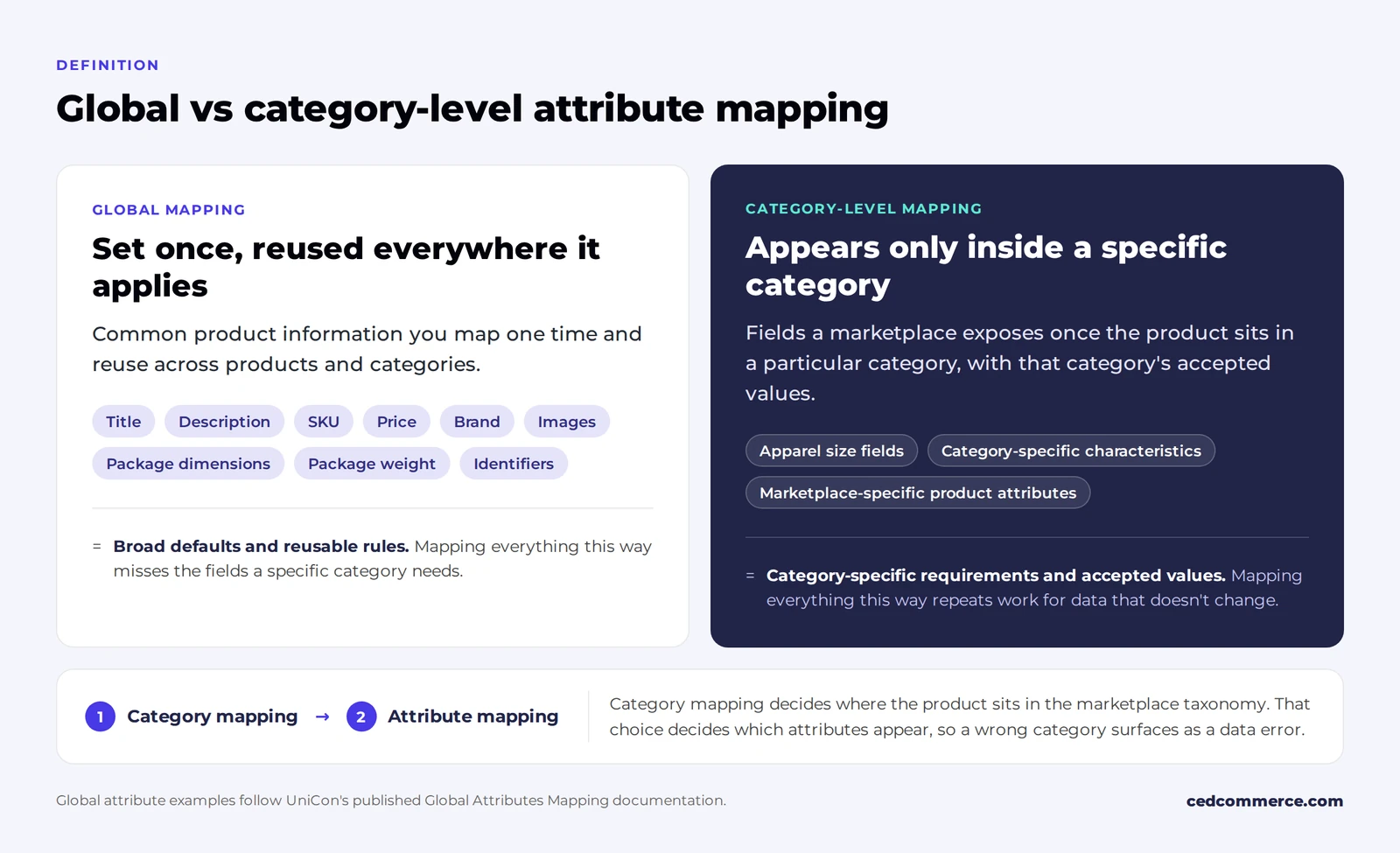
UniCon separates Global Attributes Mapping from Category Attributes Mapping. Its global attributes include fields such as title, description, SKU, price, brand, images, package dimensions, package weight and identifiers. Afterwards, category-level mapping is then used for attributes attached to selected product categories.
This distinction matters because mapping everything globally can miss the fields a specific category needs. Mapping everything manually by category creates unnecessary repeated work for information that doesn’t change.
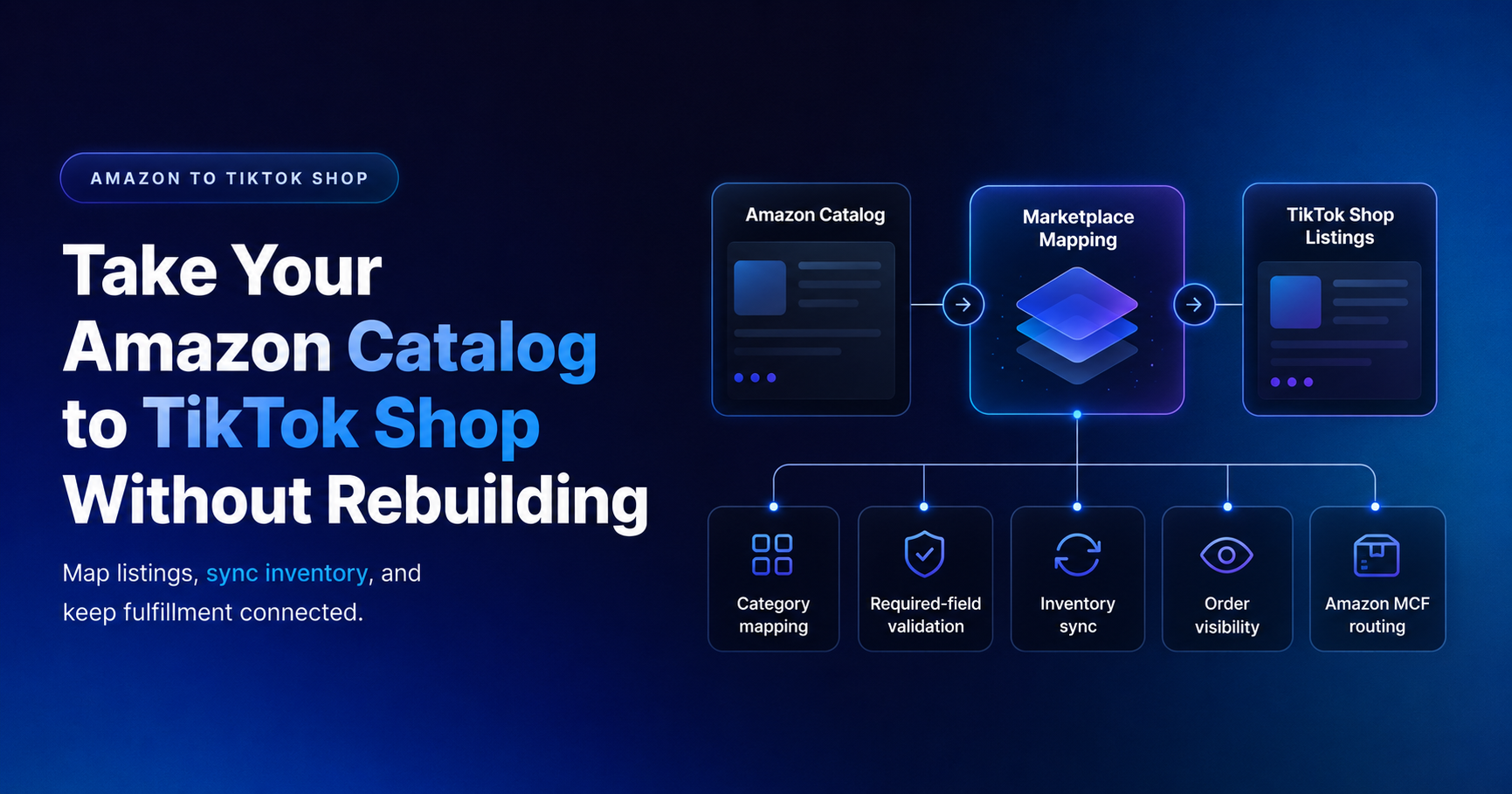
UniCon provides a mapping layer between the you source catalog and the marketplaces where that catalog needs to be listed. Its capabilities include global attribute mapping for reusable product information and category-level attribute mapping for marketplace and category-specific fields.
UniCon also documents Native attributes, which are attributes synced directly from connected marketplaces. This helps expose destination-channel requirements alongside the seller’s existing product data. For repeated configuration, it includes a Clone Attribute function that can replicate mapping logic across categories where appropriate. AI-assisted mapping can further help with category and attribute matching, while the seller reviews the marketplace setup before publishing.
When a listing or sync problem still occurs, UniCon’s product listing interface surfaces listing errors and can mark products as incomplete when required details are missing. That should be understood as error visibility, rather than a guarantee that every marketplace rejection will be prevented before submission.
The practical goal is to keep one source catalog while maintaining the channel-specific mapping required to turn that catalog into marketplace-ready listings.
Each marketplace runs its own product taxonomy, and attributes are attached to categories inside that taxonomy. Amazon uses Product Type Definitions, Walmart uses versioned item specifications, and TikTok Shop uses leaf-level categories. Because these systems were built separately, the same product can trigger different data requirements.
You can reuse substantial product information, but the variation structure may need to change. Amazon supports parent-child variation relationships, while Walmart groups variants as sibling items through a shared variantGroupId and requires one item to be designated as the primary variant.
The outcome depends on the channel and issue. Walmart may return a feed error, Amazon can accept data while still surfacing listing issues later, and TikTok Shop may lower listing quality when important information is missing. A successful data submission therefore doesn’t always mean the product is live and complete.
A valid product identifier doesn’t normally change simply because the sales channel changes. What can differ is each marketplace’s identifier policy and exemption process, so an exemption granted by Amazon shouldn’t be assumed to apply on Walmart or another marketplace.
Attributes are often attached to categories rather than applied uniformly across the marketplace. Amazon’s apparel sizing requirements differ from its footwear requirements, for example. Expanding across both marketplaces and categories therefore creates multiple requirement sets that the source catalog must support.
Preparing your catalog for additional marketplaces? Explore UniCon to map product data across connected channels and manage marketplace-specific listing requirements from one place.
Explore more UniCon guides for expanding and managing your catalog across marketplaces:

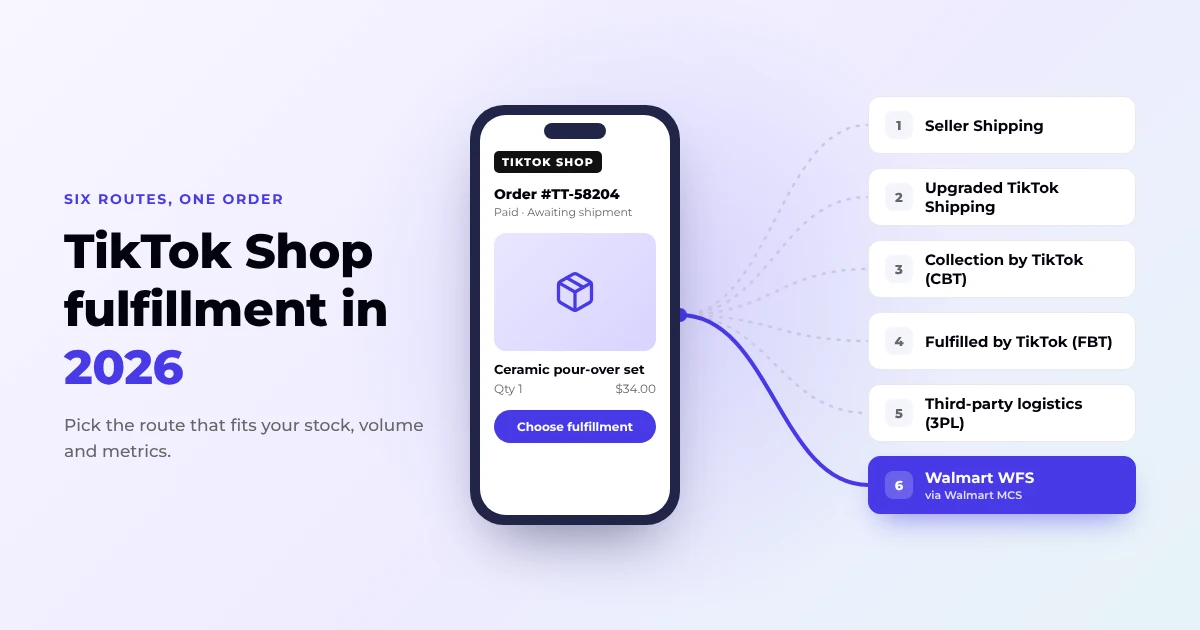
Reading Time: 14 minutes TikTok Shop fulfillment in the US now comes down to six…
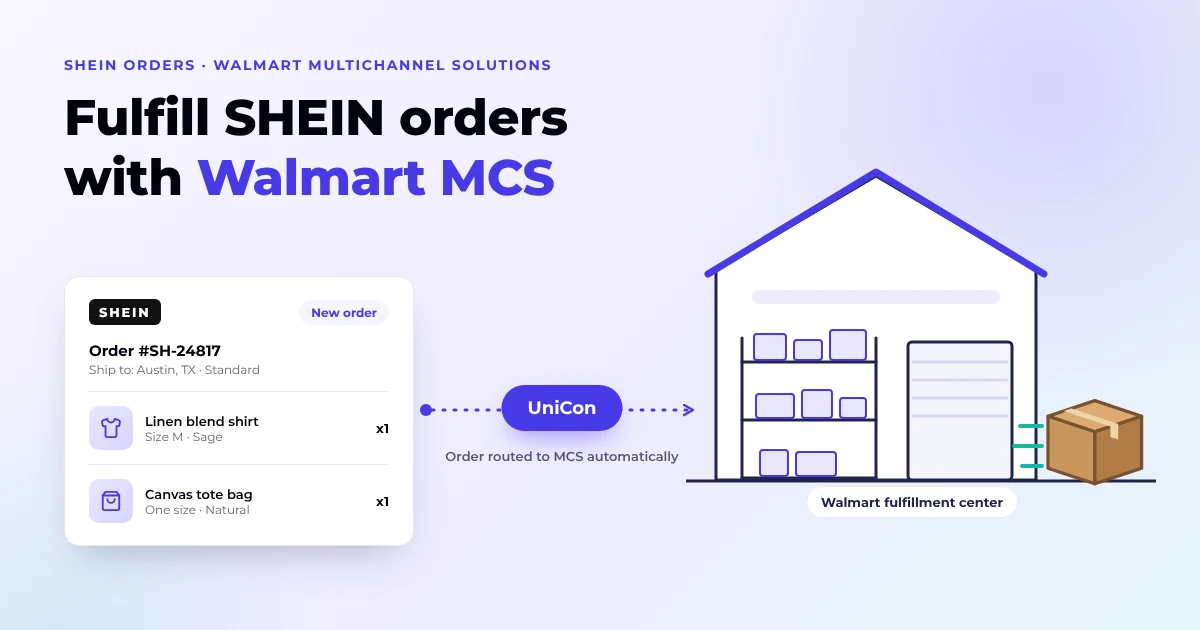
Reading Time: 13 minutes Q4 is a bad time to discover that expanding to another…
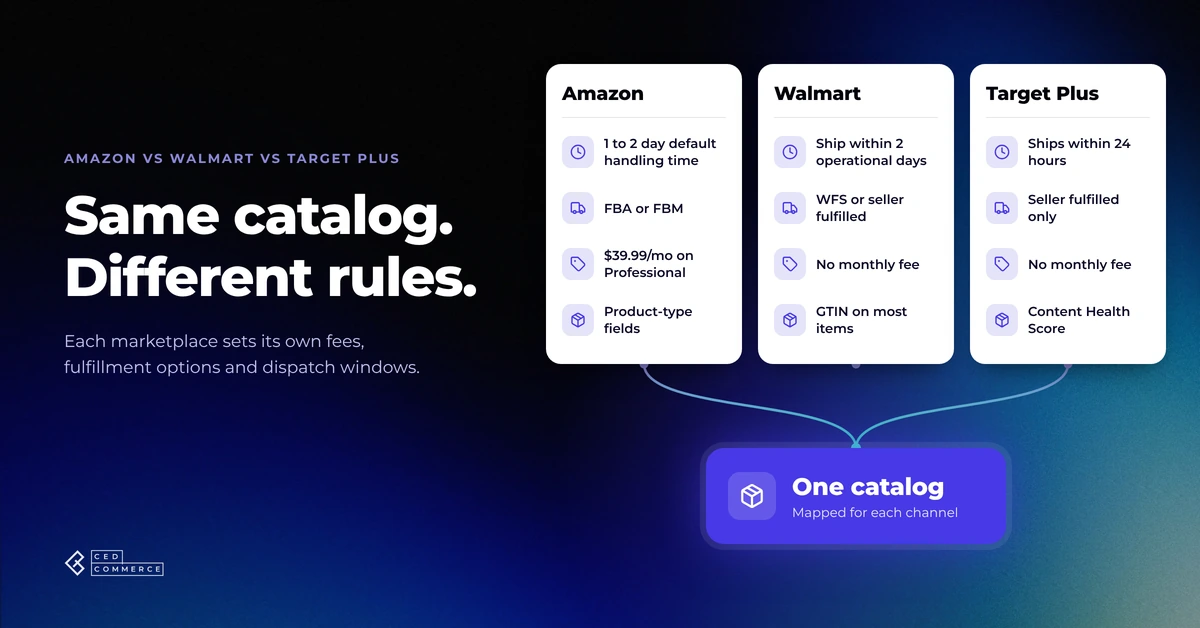
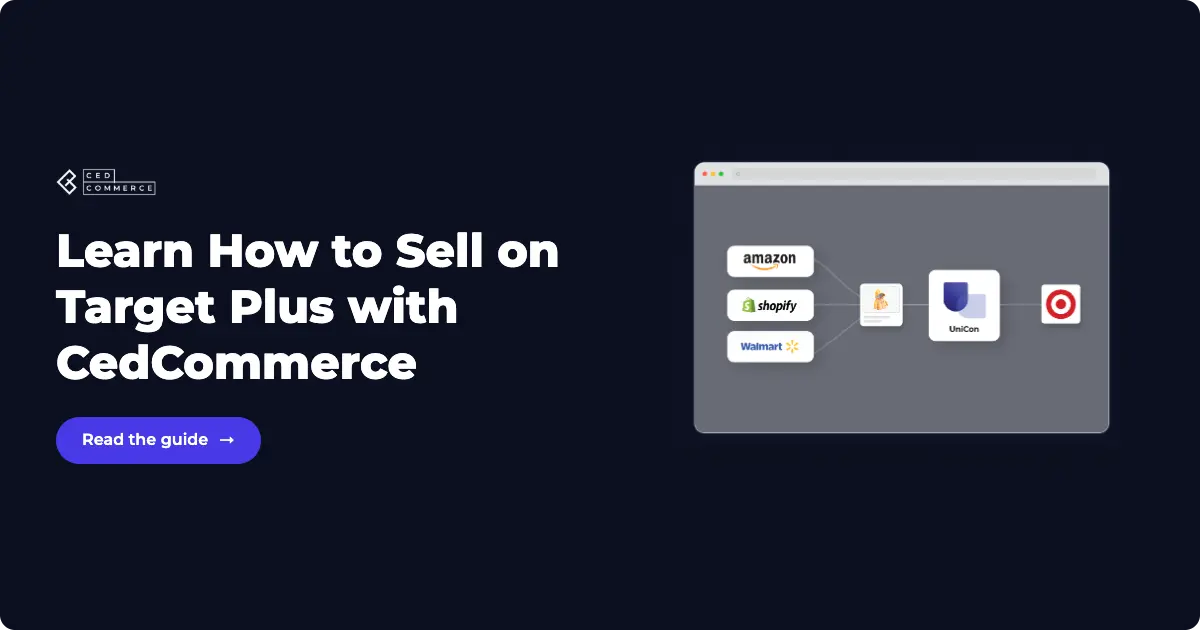
Reading Time: 11 minutes If you already sell on Amazon, adding Walmart or Target Plus…
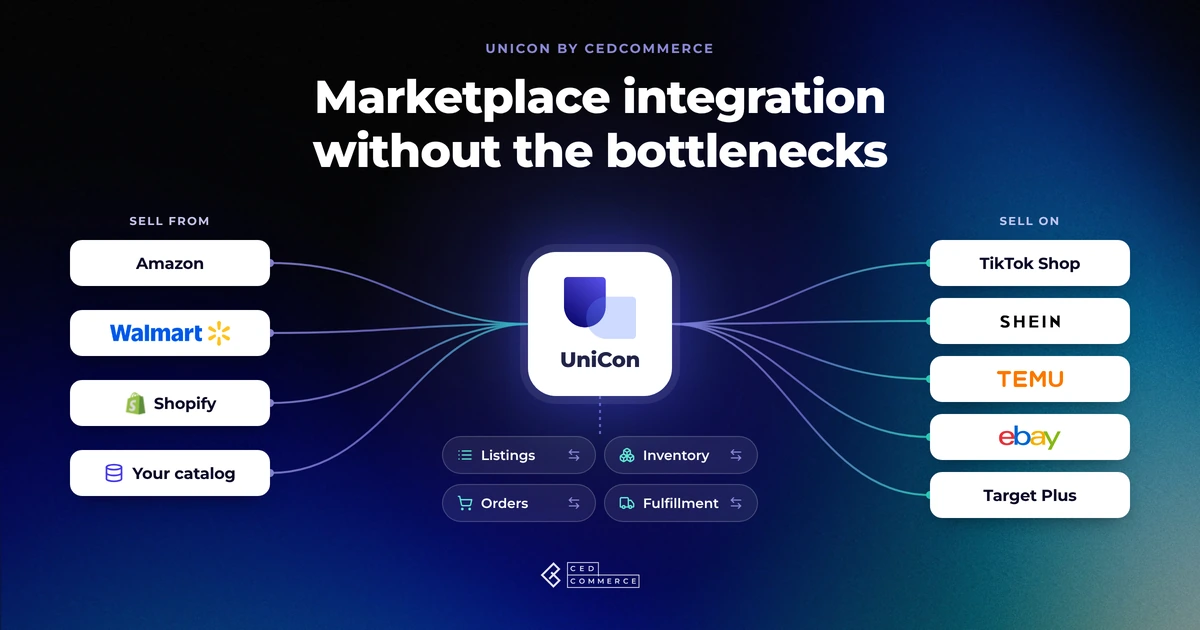
Reading Time: 13 minutes Selling on another marketplace sounds straightforward when you already have a…
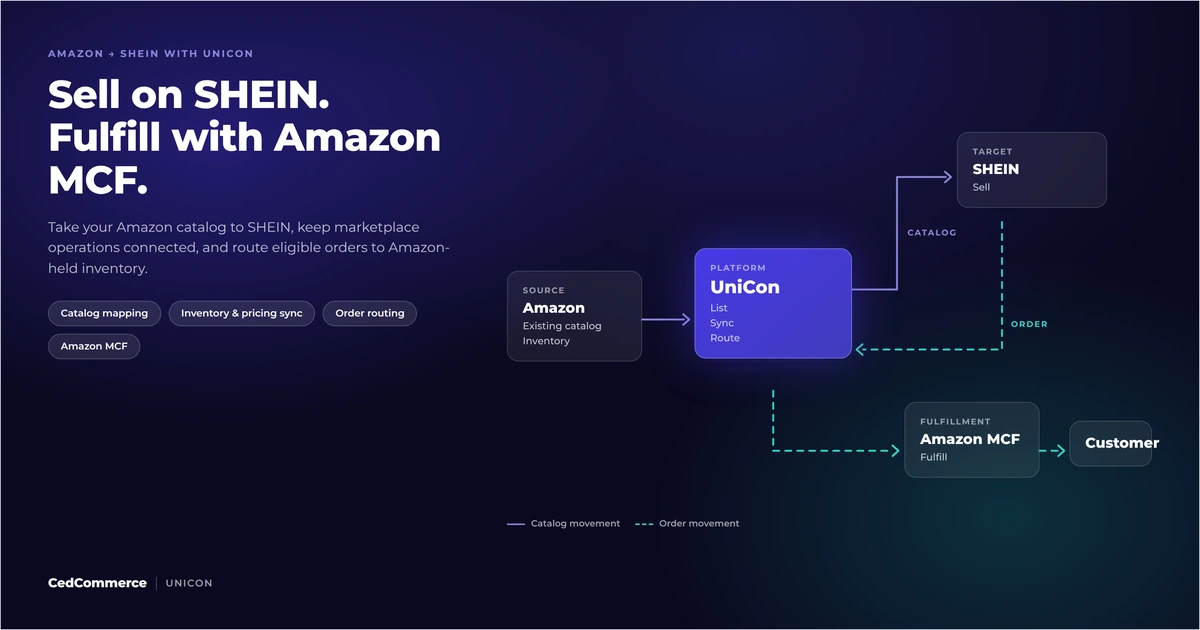
Reading Time: 12 minutes Looking to sell on SHEIN from Amazon? You could potentially tap…
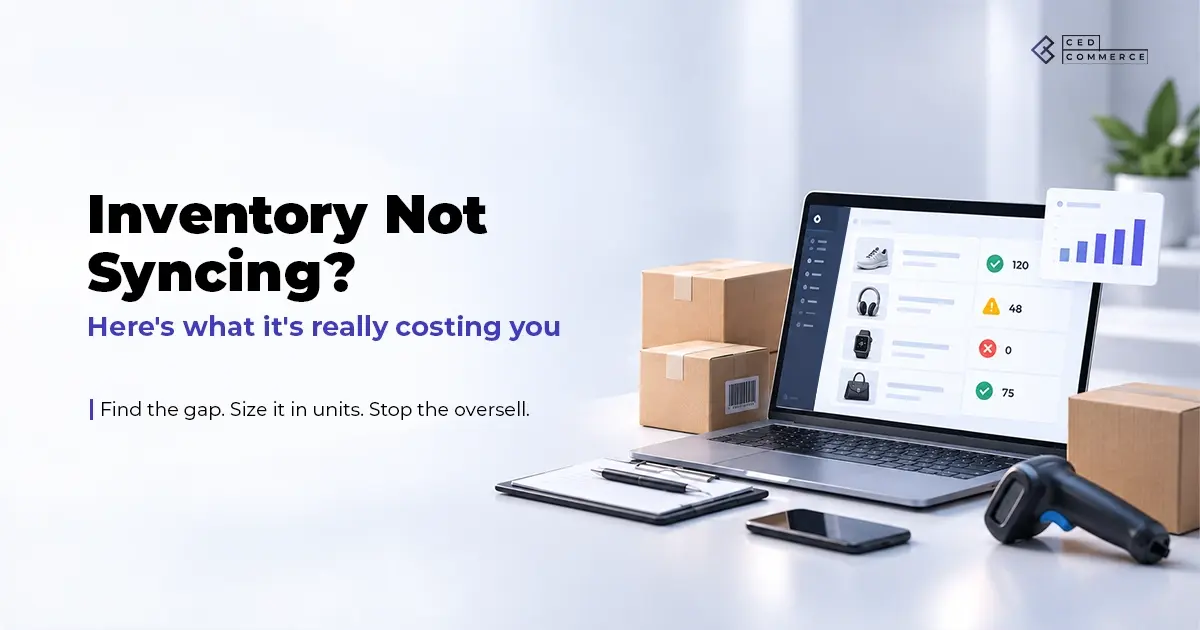
Reading Time: 15 minutes Your marketplace app does not sync continuously. It syncs on a…
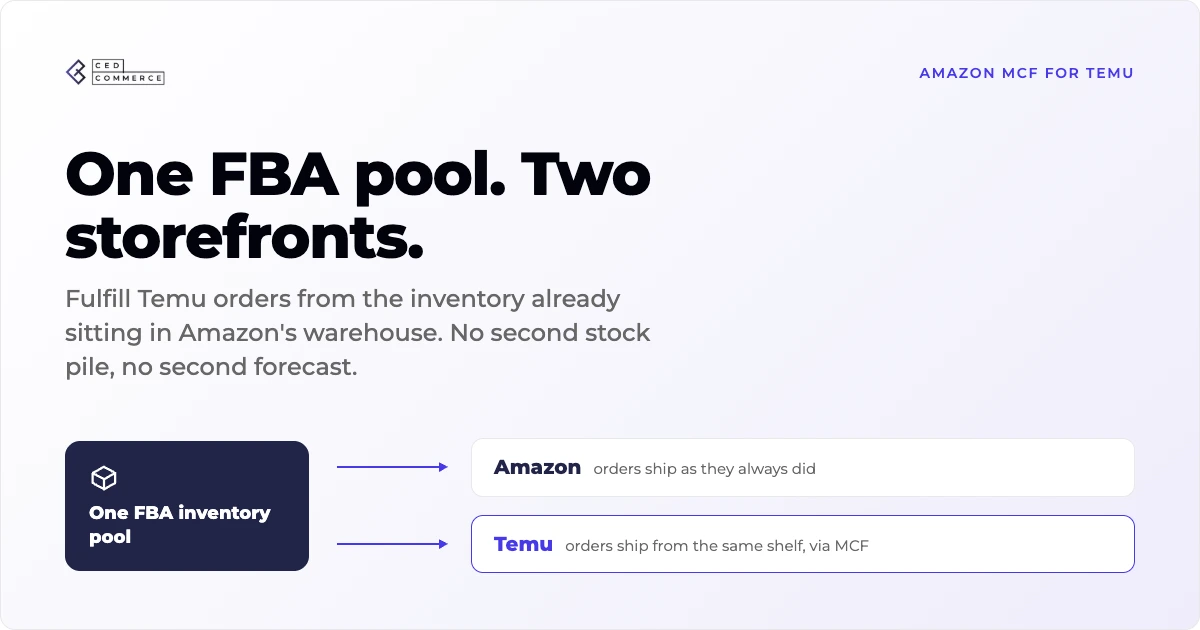
Reading Time: 19 minutes Ever wondered if your FBA inventory could turn Amazon into a…
Reading Time: 18 minutes If you’re an established third-party brand or authorized reseller looking for…
Reading Time: 13 minutes Your Amazon catalog already sells. The question is whether it can…
Reading Time: 11 minutes The eCommerce shift you actually need to act on Multi-channel fulfillment…