
At first glance, multichannel expansion can look like publishing the same catalog somewhere else.
But the moment the same SKU starts selling across Amazon, Walmart Marketplace, and Target Plus, the product may stay the same while the operating rules around it change.
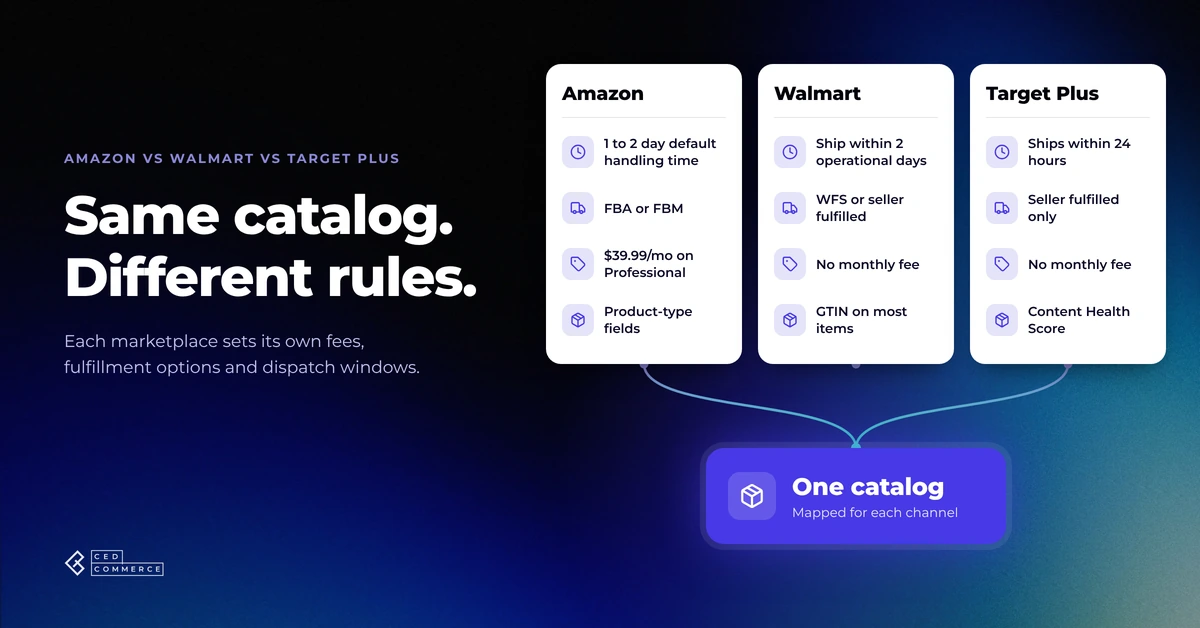
Each marketplace has its own catalog structure, tracking expectations, fulfillment model, pricing controls, performance standards, and service requirements. What works on Amazon may need to be adapted before it works on Walmart or Target Plus.
That is why the real Amazon vs Walmart vs Target Plus comparison is not just about fees or audience size. It is about what your team has to do differently once one catalog is expected to sell across multiple marketplaces.
The more channels you add, the less this becomes a listing problem and the more it becomes an operations problem. The bigger question is whether each marketplace needs a separate workflow or whether one catalog can support expansion across them.
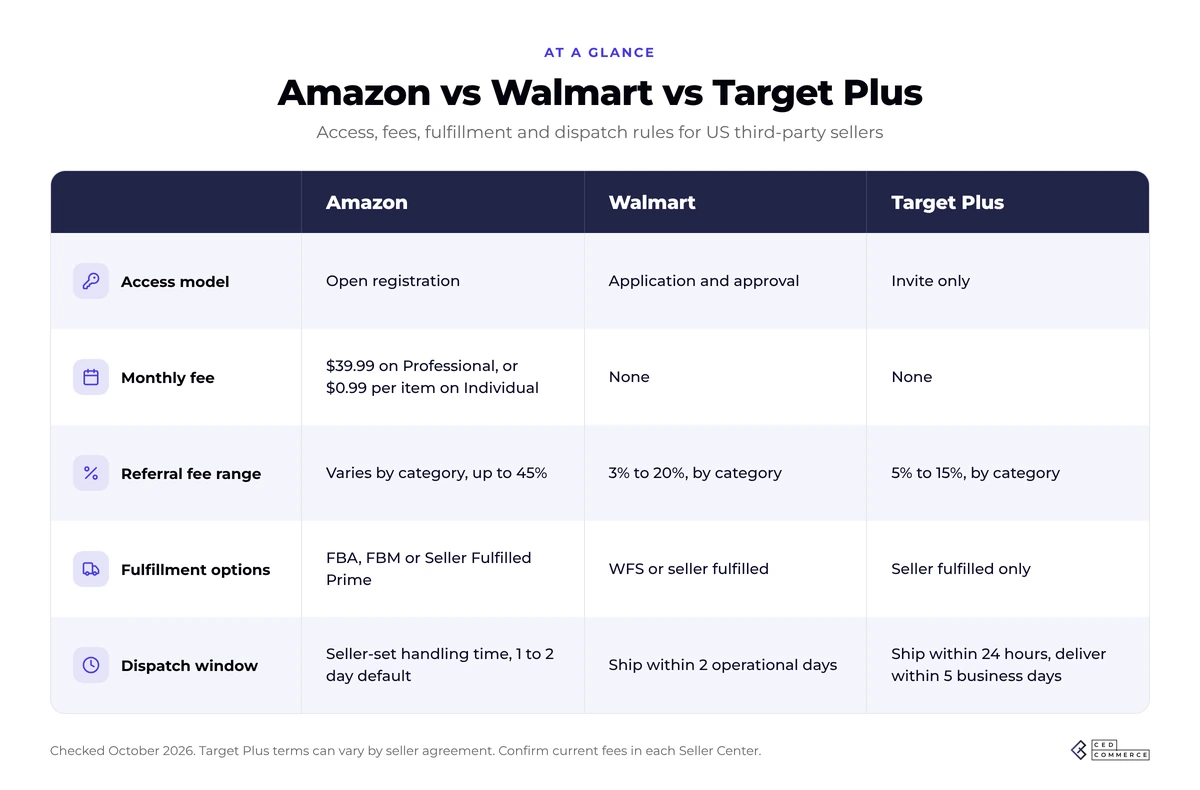
Amazon vs Walmart vs Target Plus at a glance
| Area | Amazon | Walmart Marketplace | Target Plus |
|---|---|---|---|
| Access | Open registration | Application and approval | Invite-only |
| Monthly fee | $39.99 Professional plan | $0 | $0 |
| Referral fees | Mostly 8% to 15% by category | Mostly 6% to 15% by category | Commonly 5% to 15% by category |
| Fulfillment | FBA, FBM, Seller Fulfilled Prime | WFS or seller-fulfilled | Seller-fulfilled |
| Tracking | Valid Tracking Rate above 95% | Valid Tracking Rate at or above 99% | Supported carrier and fulfillment requirements apply |
| Catalog model | ASIN-based catalog | GTIN and marketplace attributes | Marketplace-specific content requirements |
| Pricing | Fair Pricing Policy | Competitive pricing checks | Price parity requirement |
| Main operational pressure | Account health and delivery performance | Tracking, delivery, cancellations, response rate | Dispatch speed, content quality, pricing consistency |
The differences look manageable one by one. The challenge starts when the same team has to satisfy all of them at once.
Adding another marketplace can also add another catalog workflow, inventory checks, fulfillment processes, and rules to monitor. A more scalable approach is to keep a common source catalog and adapt it for each destination instead of rebuilding the operation each time.
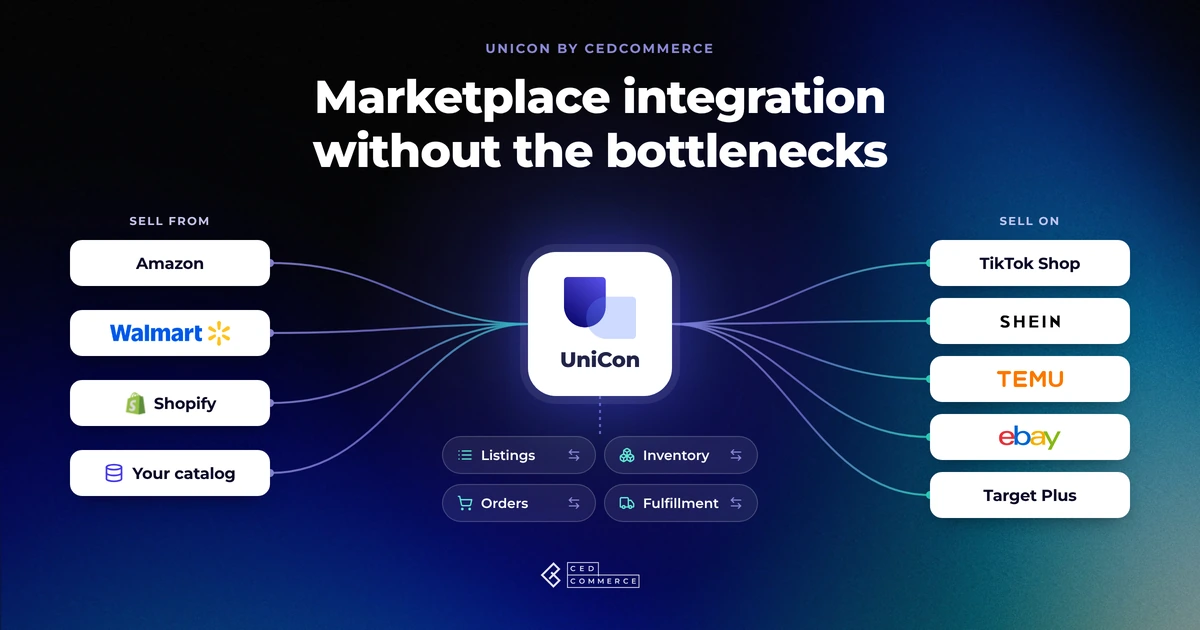
UniCon is designed around that model: use Amazon, Walmart, or Shopify as a source, prepare channel-ready listings for additional marketplaces, synchronize operations, and manage marketplace activity from one system.
How does getting approved differ on each marketplace?
Amazon has the lowest barrier to entry: sellers can register, complete verification, configure their account, and begin preparing products for sale.
Walmart Marketplace adds an approval step, so access has to be factored into the expansion plan before catalog preparation and launch dates are finalized.
Target Plus is more selective again. It is invite-only, so access depends on whether the seller and assortment fit the marketplace.
The planning sequence changes: Amazon begins with account setup, Walmart with application readiness, and Target Plus with marketplace and operational fit.
But approval is only the beginning. If every new channel requires manual product rebuilding, attribute mapping, inventory updates, and another order workflow, the operational cost starts after access is secured.
What does it cost to sell on Amazon, Walmart, and Target Plus?
Amazon charges $39.99 per month for its Professional plan, along with category-based referral fees that commonly fall between 8% and 15%. For 2026, Amazon kept US referral fees unchanged, while Fulfillment by Amazon fees increased by an average of $0.08 per unit from January 15.
Walmart Marketplace does not charge a monthly subscription fee. Its referral fees commonly range from 6% to 15%, and Walmart reduced referral fees in 14 categories in June 2026.
Target Plus also has no standard monthly marketplace subscription fee. Third-party seller guidance generally places referral commissions between 5% and 15%, depending on category.
But the cheaper marketplace on paper is not always the cheaper marketplace to operate.
The real cost of expansion also includes catalog preparation, inventory coordination, fulfillment, pricing control, returns, service, and the time spent resolving marketplace-specific errors.
For sellers with thousands of SKUs, every failed validation, manual stock update, and pricing mismatch becomes repeated work at scale.
So the better question is not only, “What does this marketplace charge?” It is also, “How much new operational work will this marketplace create?”
Expand without rebuilding your catalog workflow
Use Amazon, Walmart, or Shopify as your source catalog in UniCon, then prepare products for additional marketplaces from one operating layer.
How do fulfillment and shipping rules change?
Fulfillment is one of the first places where “same products, same process” starts to break.
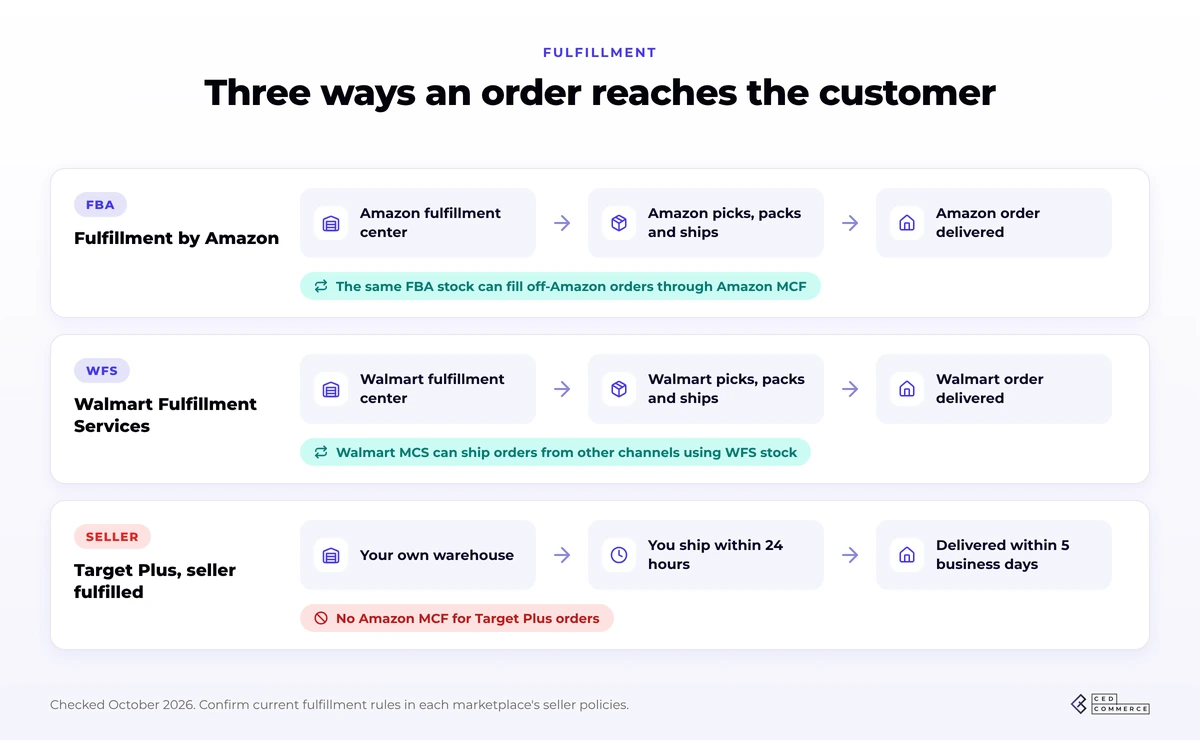
Amazon sellers can use Fulfillment by Amazon, fulfill orders themselves, or use Seller Fulfilled Prime when eligible.
Walmart offers Walmart Fulfillment Services alongside seller fulfillment. An Amazon seller entering Walmart can therefore retain more control over fulfillment or move eligible inventory into WFS.
Target Plus is different. Sellers are expected to fulfill orders themselves and meet tight dispatch expectations, including confirming and dispatching orders within 24 hours, seven days a week.
A business built heavily around one marketplace’s fulfillment model cannot assume the same setup will carry over unchanged.
Amazon Multi-Channel Fulfillment can support eligible off-Amazon orders on supported channels, but it should not be treated as the default route for Target Plus. Each destination still needs to be evaluated against its fulfillment requirements.
A multichannel operating layer should not force every marketplace into the same fulfillment model. It should help coordinate those models without separate manual workflows.
Which seller performance metrics does each marketplace enforce?
All three marketplaces want reliable sellers, but they do not measure reliability in exactly the same way.
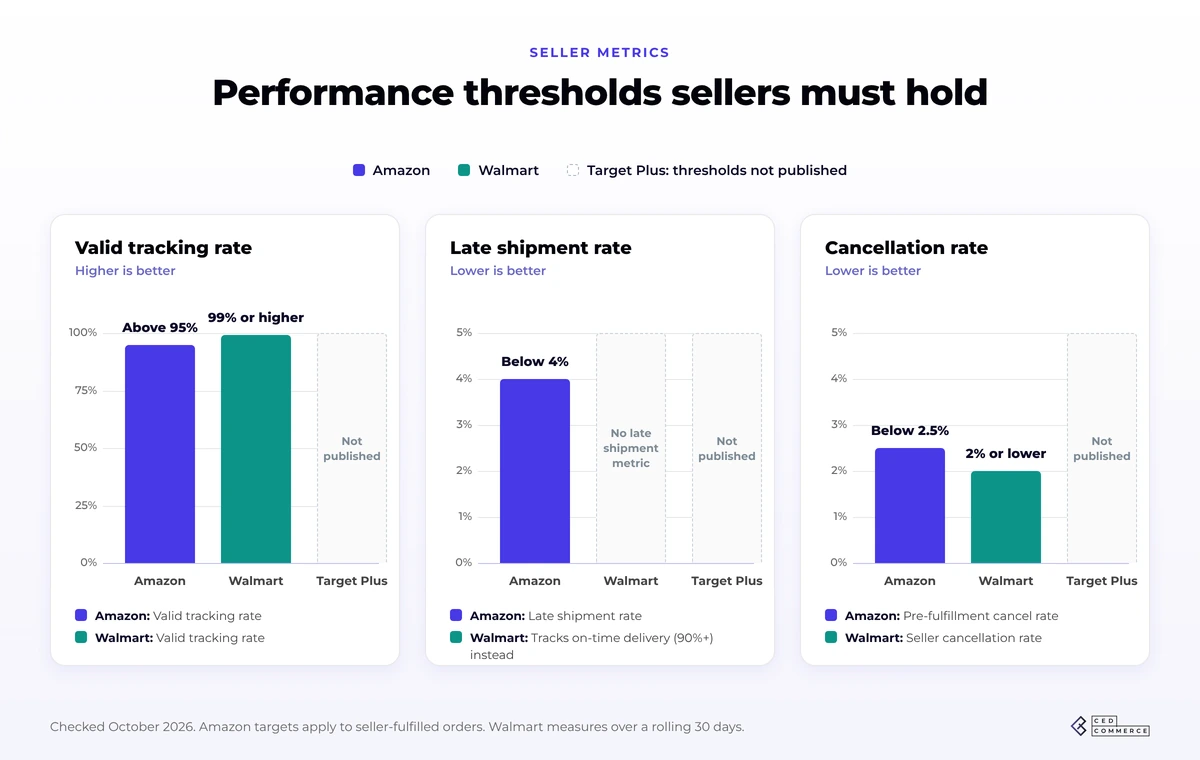
Amazon requires an Order Defect Rate below 1%, a Late Shipment Rate below 4%, and a Pre-Fulfillment Cancellation Rate below 2.5%. Its Valid Tracking Rate should remain above 95%.
Walmart’s current standards include cancellation at 2% or less, on-time delivery of at least 90%, Valid Tracking Rate of at least 99%, late shipment of 5% or less, negative feedback of 2% or less, and seller response of at least 95% within 48 hours.
That 95% versus 99% tracking difference shows why one internal benchmark is not enough. A 96% Valid Tracking Rate may clear Amazon’s threshold while falling short of Walmart’s.
Target Plus also monitors seller performance around dispatch, delivery, cancellation, and customer experience, although the same level of public threshold detail is not available across every metric.
Expansion therefore adds more than order volume. It adds more standards against which the same operation is judged.
How do listing and catalog requirements differ?
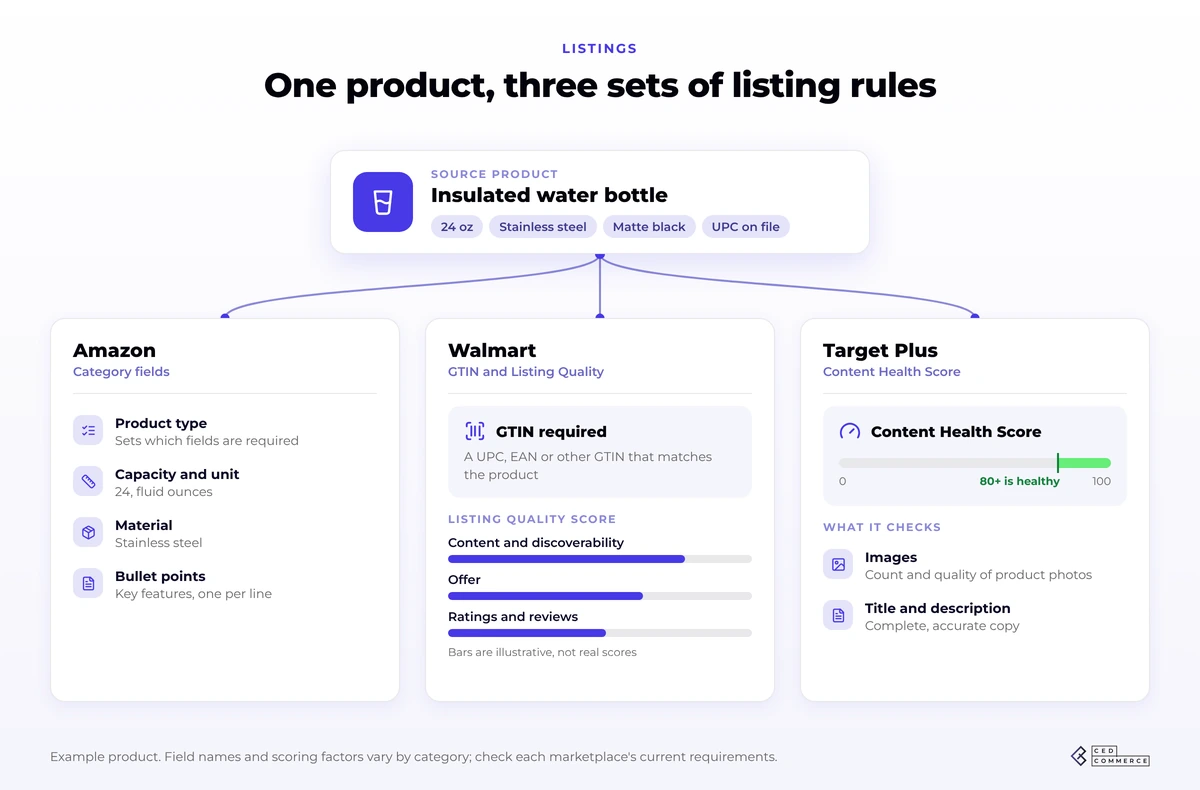
Amazon revolves heavily around its ASIN catalog. If a product already exists, a seller may match an offer to an existing ASIN instead of creating a new product record.
Walmart relies on GTINs, category-specific attributes, and listing-quality requirements. Target Plus adds another set of marketplace-specific content expectations, including its Content Health Score.
So one source product may need three different representations. Titles, attributes, categories, images, descriptions, variations, and identifiers can all need different treatment.
That is why cross-listing is not the same as copying a listing.
If every channel is prepared manually, the seller creates a separate catalog workflow for every marketplace. Every new SKU then creates more mapping work and more chances for a listing to fail.
What this looks like for an Amazon seller adding Walmart
Suppose you already have a working Amazon catalog with titles, images, SKUs, prices, inventory, descriptions, and variation data. Now you want the same products on Walmart.
Walmart may require a different category structure and different mandatory attributes. Some values may transfer directly. Others need to be mapped, reformatted, or completed before the listing can publish.
With UniCon, the workflow starts from the catalog you already maintain. UniCon AI predicts category and attribute-value matches for the destination marketplace. Your team reviews the mappings, while pre-publish validation helps identify missing or mismatched information before it becomes a listing error.
Instead of rebuilding the product manually, the existing catalog becomes the source from which the destination listing is prepared.
Turn your source catalog into channel-ready listings
UniCon AI helps map marketplace attributes, identify missing fields, and prepare products for destination-channel requirements before publishing.
How do pricing rules differ across the three marketplaces?
Amazon operates its Fair Pricing Policy. Walmart uses competitive pricing checks. Target Plus adds a price-parity requirement, so pricing needs to remain aligned with what the same product is offered for elsewhere.
Imagine an Amazon seller launches a temporary promotion. The Amazon price changes, but another marketplace still shows the previous price because that channel is maintained through a separate workflow.
What started as a simple promotion now creates a cross-channel pricing inconsistency.
The same problem appears when teams use separate repricing tools, manual updates, or marketplace-specific promotions without a shared process.
On one marketplace, a price change is a merchandising decision. Across several marketplaces, it becomes a synchronization problem.
How do returns and customer service change?
Amazon operates its own return policies and commonly provides prepaid return labels in eligible categories.
For seller-fulfilled Walmart orders, sellers work within Walmart’s returns requirements and can use Walmart’s Returns Shipping Service. Walmart also measures seller responsiveness, requiring a response rate of at least 95% within 48 hours under its current standards.
Target manages the customer-facing returns experience more centrally.
None of these differences is especially difficult in isolation. The difficulty comes from running them together: different return flows, service expectations, fulfillment rules, catalog requirements, and pricing controls for the same products.
What causes bottlenecks when you sell on all three marketplaces at once?
The biggest problems usually appear where marketplace-specific rules meet shared operations.
Inventory is the clearest example. If Amazon sells the last unit before Walmart receives the stock update, Walmart can still accept an order the seller cannot fulfill.
Catalog data creates a similar risk. A field that is optional on Amazon may be required on Walmart or Target Plus, so one SKU can publish successfully on one channel and fail on another.
Fulfillment adds another dependency. A process designed around Amazon handling times may not fit another marketplace’s dispatch expectations.
Pricing can drift too. A promotion or manual edit on one marketplace can leave another channel showing a conflicting value.
These are coordination problems. Adding another marketplace by adding another separate workflow only multiplies the work.
Manual multichannel expansion
- Source catalog
- export product data
- rebuild marketplace attributes
- resolve listing errors
- update inventory separately
- manage orders separately
- monitor pricing separately
- repeat for every marketplace
Multichannel expansion with UniCon
- Amazon, Walmart, or Shopify source catalog
- UniCon
- prepare marketplace-specific listings
- validate product data
- publish to connected channels
- coordinate inventory and orders centrally
- add more marketplaces without rebuilding the workflow each time
That is the operational problem UniCon is designed to solve.
How does UniCon help manage one catalog across different marketplace rules?
UniCon does not remove marketplace rules. Amazon still has Amazon requirements. Walmart still has Walmart requirements. Target Plus still has Target Plus requirements.
What UniCon changes is how much separate work your team needs to build around those differences.
You can use Amazon, Walmart, or Shopify as a source catalog and prepare products for additional connected marketplaces from one system.
UniCon AI assists with category and attribute mapping, while channel-specific listing content can be prepared from the source product data. Sellers remain in control of review and publishing.
Pre-publish validation can help surface missing or mismatched information before the listing reaches the marketplace.
Inventory and warehouse management help coordinate available stock across connected channels, while centralized order management gives teams one operating layer for marketplace orders.
Template rules help standardize how product information is prepared when marketplace requirements differ.
The value becomes clearer as SKU and channel counts grow. At scale, automation helps prevent every marketplace from becoming another disconnected process.
How quickly can UniCon help sellers get started?
UniCon setup can take under 30 minutes.
In one CedCommerce client result, more than 8,000 SKUs were mapped in under 20 minutes, with the first live listing achieved within 48 hours.
Those numbers show the practical difference between rebuilding a catalog and reusing the infrastructure you already have. The goal is to shorten the path from “We already sell this product” to “This product is ready for another marketplace.”
8,000+ SKUs mapped in under 20 minutes
A CedCommerce client used UniCon to map more than 8,000 SKUs in under 20 minutes and achieved the first live listing within 48 hours.
Which marketplace should you add first?
There is no universal winner because the best next marketplace depends on what your operation can support.
An Amazon-only seller may find Walmart a logical next step if the catalog is ready for Walmart’s attributes and the business can meet its tracking and fulfillment standards.
A Shopify-first brand may compare Amazon and Walmart based on category economics, fulfillment strategy, and where its customers already shop.
An established brand with strong retail distribution may find Target Plus attractive if its assortment and operating model fit a more curated marketplace.
A seller already active across several channels should focus less on marketplace popularity and more on operational fit.
Ask whether your existing catalog can be adapted without rebuilding every SKU manually, whether inventory can stay accurate across channels, whether your fulfillment process can meet marketplace-specific requirements, and whether adding another marketplace will create another disconnected workflow.
The best next channel is the one your catalog, fulfillment model, margins, and systems can support without disproportionate manual work.
What should you take away from the comparison?
Amazon, Walmart, and Target Plus can sell the same products, but they do not ask sellers to operate those products in the same way.
Amazon has its own account-health and fulfillment model. Walmart raises the bar in areas such as tracking and seller response. Target Plus adds stricter expectations around access, dispatch, content, and pricing consistency.
One marketplace can often be managed as a channel. Several marketplaces need to be managed as a system.
The objective is not simply to get the same SKU live in more places. It is to keep the catalog, inventory, orders, pricing, and fulfillment working together after the product goes live.
You have already done the hard work of building your catalog and operating your existing marketplace business. UniCon helps you reuse that foundation to prepare listings for additional marketplaces and coordinate the operations behind them without rebuilding the same workflow for every channel.
Run more marketplaces from the catalog you already have.
Connect your Amazon, Walmart, or Shopify source catalog to UniCon, prepare channel-ready listings, coordinate inventory and orders, and expand from one operating layer.