
Product titles
Include the brand, product, key differentiator, and size or count.
Avoid keyword stuffing, promotional language, and symbols that the catalog schema rejects.
Running short of time? Get PDF of the blog in your mail.
If you’re an established third-party brand or authorized reseller looking for the next serious marketplace opportunity, Target Plus deserves a place on the shortlist. The marketplace grew GMV by nearly 60% year over year in Q1 fiscal 2026, and is working toward a $5 billion GMV goal by 2030. For eligible brands researching how to sell on Target Plus, that growth creates a timely opportunity to reach more buyers through Target’s curated digital assortment.
Approved products appear on Target.com and the Target app alongside Target’s own assortment, giving brands access to a trusted retail environment with less reseller crowding around the same SKU.
CedCommerce prepared this guide to help you evaluate the opportunity and prepare for frictionless multichannel expansion, covering Target Plus seller requirements, application, integration requirement, fulfillment, onboarding, and launch readiness.
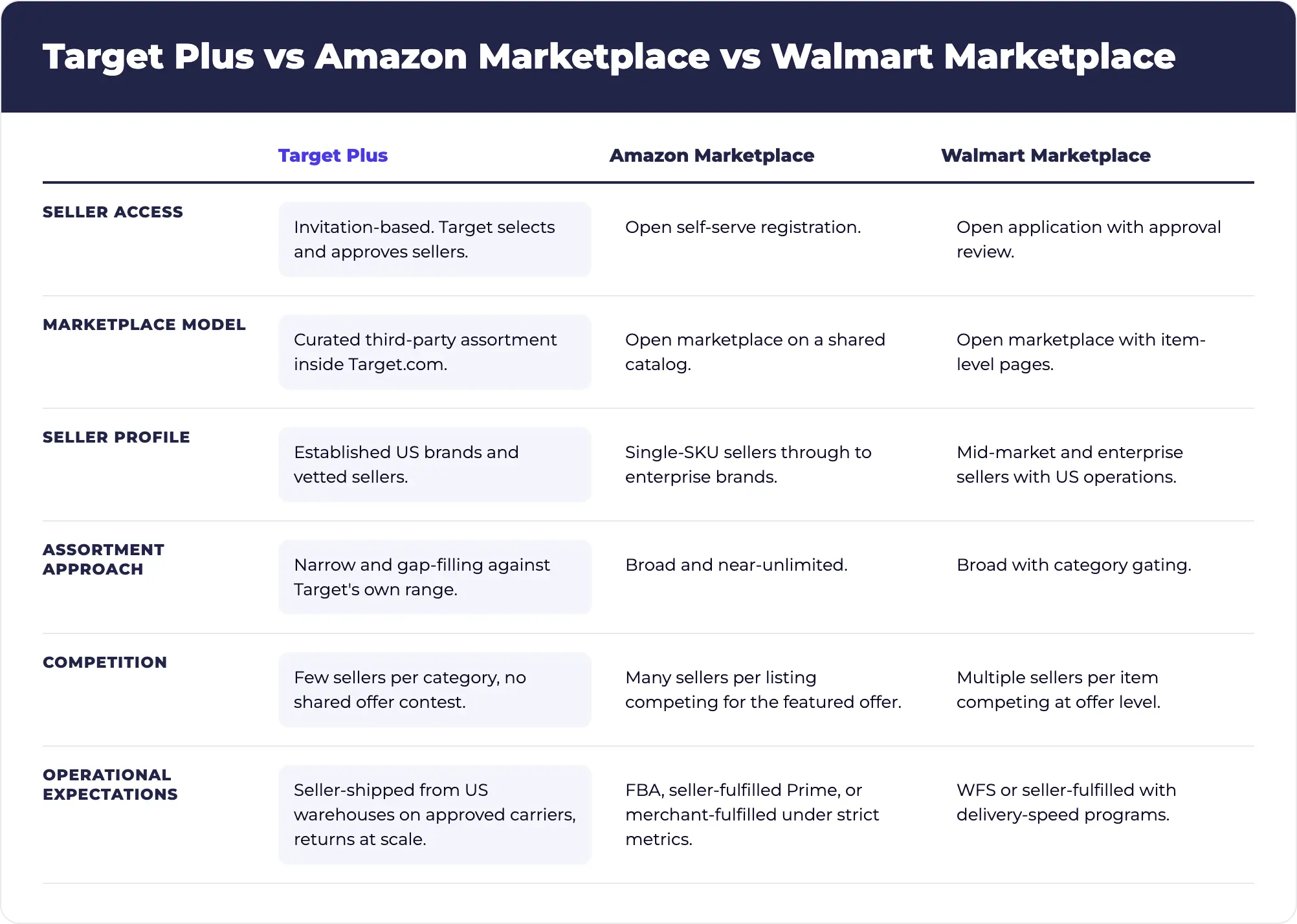
Target Plus, also written as Target+, is Target’s curated third-party marketplace.
Current scale:
Target’s in-house curation team recruits and vets brands to complement the existing assortment. Recent additions include Clarks, Forever 21, JanSport, LovelySkin, Serta, and Hisense.
Chief digital and revenue officer Sarah Travis described the filter as brands that add something meaningful for guests and reinforce what guests expect from Target: style, design and value.
Before you apply:
No. Target Plus is a curated, invite-only marketplace, and Target selects direct brands and authorized resellers based on how well their assortment fits the marketplace opportunity.
For sellers interested in Target Plus, CedCommerce can be your starting point. Share a few business details with our marketplace team, including your website, brand or reseller status, product categories, current marketplaces, and approximate launch assortment. We can review your fit, flag obvious readiness gaps, and, where appropriate, refer your interest for Target Plus consideration.
Interested in selling on Target Plus?
Explore Target Plus support with UniCon →
Target makes the final approval decision, but starting with CedCommerce gives you a clearer path to understand whether your business is ready before you move further into the process.
If selected, CedCommerce can also support Target Plus onboarding and help bring the channel into your wider multichannel operation.
Target shares the Eligibility Checklist and the gating questions on the live application, as below.
| Requirement area | What Target may evaluate | How to prepare |
|---|---|---|
| US business presence |
|
Get a DUNS number from Dun & Bradstreet. |
| Brand ownership or authorization |
|
Collect signed letters first. Omit brands you cannot document. |
| Product assortment |
|
Instead of listing everything you own, aim to fill a gap in the market. |
| Product quality |
|
Optimize your Amazon and Walmart storefronts. |
| Catalog data |
|
Audit the SKUs for the products you want to list. |
| Pricing and value | Price parity is widely reported by partners. | Assume pricing may be reviewed and confirm parity terms in your contract. |
| Inventory reliability |
|
Target warns against submitting SKUs you cannot stock. It “might result in suspension of your account.” |
| Fulfillment capability |
|
Confirm that you can hand orders to the carrier by the next business day. |
| Returns and customer service |
|
Verify that your facility accepts palletized semi-truck deliveries. This may disqualify some smaller operations. |
| Marketplace experience |
|
Prepare a report covering your marketplace sales track record. |
| Compliance documentation |
|
|
Not publicly disclosed by Target: commission rates, payout terms, numeric performance thresholds, a prohibited products list, insurance requirements, advertising terms. These may be provided during onboarding.
A strong Target Plus candidate is an established US seller with brand authorization, clean product data, dependable fulfillment, competitive pricing, and the operational capacity to meet Target’s marketplace standards.
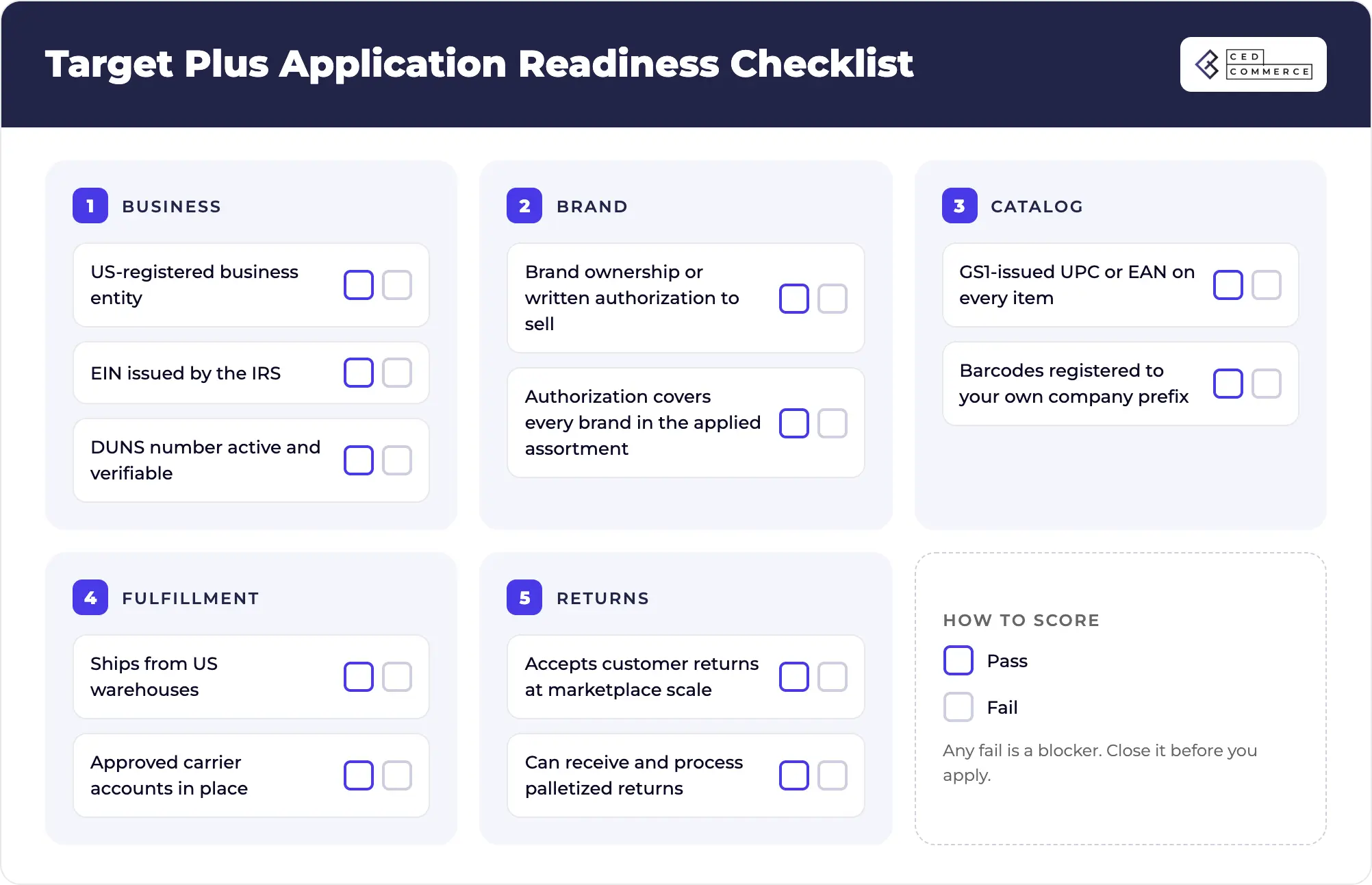
Use this readiness check before you apply. Each “no” points to something worth fixing first.
| Fit level | What it means | What to do next |
|---|---|---|
Strong potential fit |
Most readiness checks are already in place, especially brand authorization, fulfillment, catalog quality, inventory accuracy, and returns capability. |
Prepare your application and supporting operational details. |
Good fit, with preparation |
Your business has the core foundation, but gaps remain in areas such as catalog data, inventory synchronization, returns, fulfillment, or marketplace track record. |
Fix the operational gaps first, then apply. |
Not ready yet |
Key requirements such as brand authorization, US-based fulfillment, reliable inventory control, or marketplace operations are not yet in place. |
Strengthen these fundamentals before entering Target’s review process. |
Need help preparing your Target Plus application? CedCommerce can review your submission details, identify gaps, and support qualified sellers through the consideration process.
See how CedCommerce supports Target Plus sellers →
Use this checklist as a benchmark that helps you identify avoidable readiness gaps before entering the review process.
Once you have confirmed the Target Plus seller requirements, the application itself is straightforward: submit your business details, proposed assortment, and supporting documents for Target’s review.
Have these ready before you start:
Target states that the legal business name cannot be changed after submission.
Target asks for your product categories, top 5 to 10 items, total catalog size, proposed launch SKU count, and preferred launch date.
Keep the submission focused on products you can realistically stock and launch within the onboarding window.
Target also requests an Excel file containing:
Authorized resellers should be ready to provide Letters of Authorization or other documentation confirming their right to sell the brands in the proposed assortment.
Target reviews the business, assortment, and supporting information before deciding whether to move the seller forward.
Need help preparing your Target Plus application? CedCommerce can review your submission details, identify gaps, and support qualified sellers through the consideration process.
Talk to a Target Plus expert →
If approved, you move into contracting, Target Plus onboarding, integration, testing, and launch preparation, all covered later in this guide.
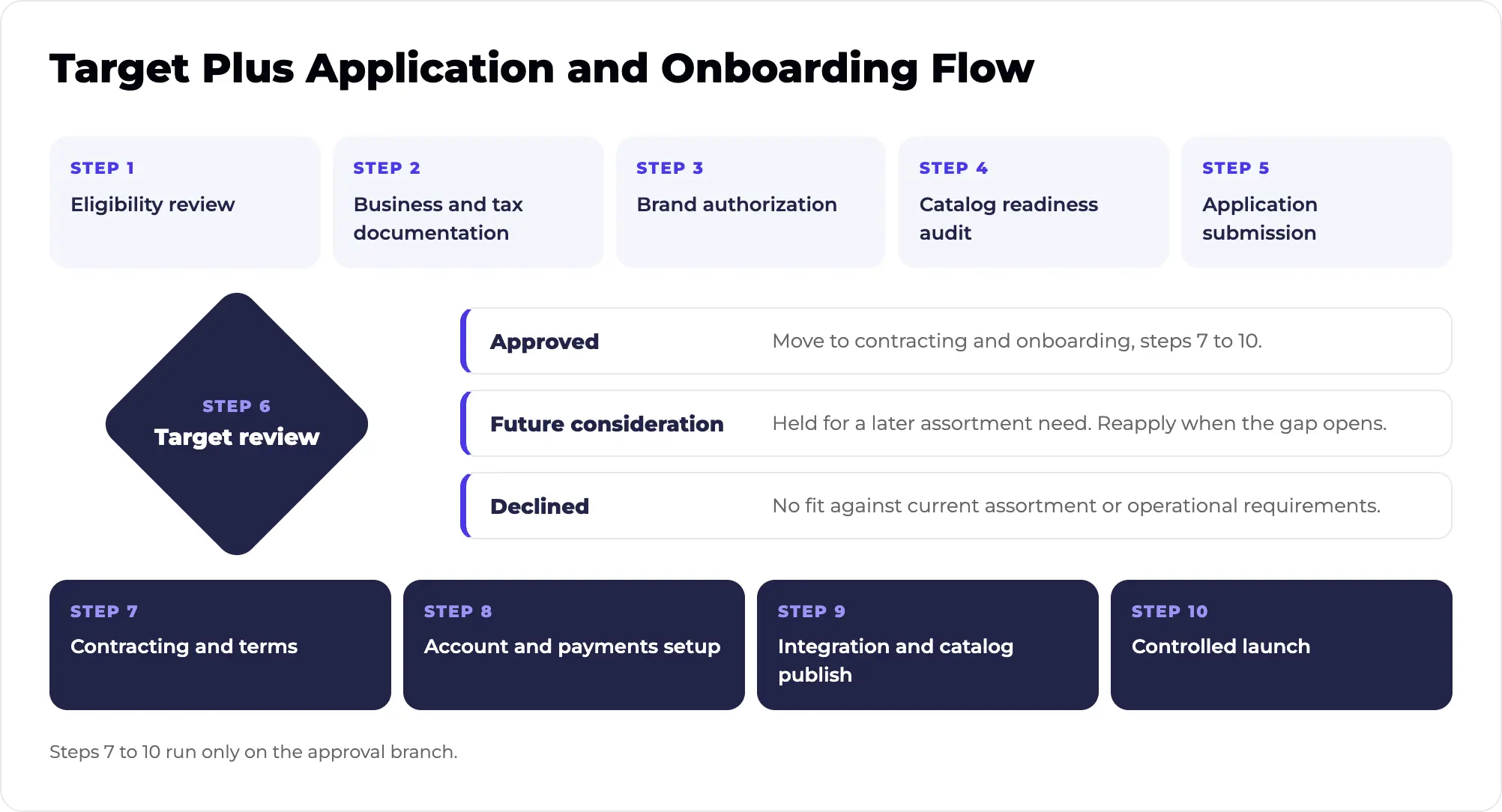
Target says it aims to give applicants a status update within 30 days, and its typical acquisition process takes 3 to 6 weeks before transitioning to onboarding, depending on business complexity.
Confirm the applicable launch milestone with your Target Plus onboarding team during contracting.
Before expanding the catalog, validate the workflows that will keep the Target Plus operation running.
Test:
Launching with a controlled assortment allows your team to confirm these workflows before adding more SKUs.
To prepare a clean, validation-ready catalog before Target Plus onboarding begins, follow this guide.
Start with the fundamentals:
Required product data includes brand, description, GTIN, main image, package dimensions, package weight, import designation, and Proposition 65 information where applicable.
| Catalog element | Guidance |
|---|---|
| Titles | 21 to 100 characters recommended, 150 maximum |
| Descriptions | 50 to 20,000 characters, no HTML |
| Images | JPG/JPEG, RGB, square 1:1, minimum 1,200 × 1,200 pixels, 2,400 × 2,400 preferred, 3+ images |
For variations, parent titles and descriptions should stay generic, while child content should identify differences such as size or color.
These specifications are web sourced rather than publicly published by Target, so confirm them in the Target Plus Portal before preparing a catalog at scale.
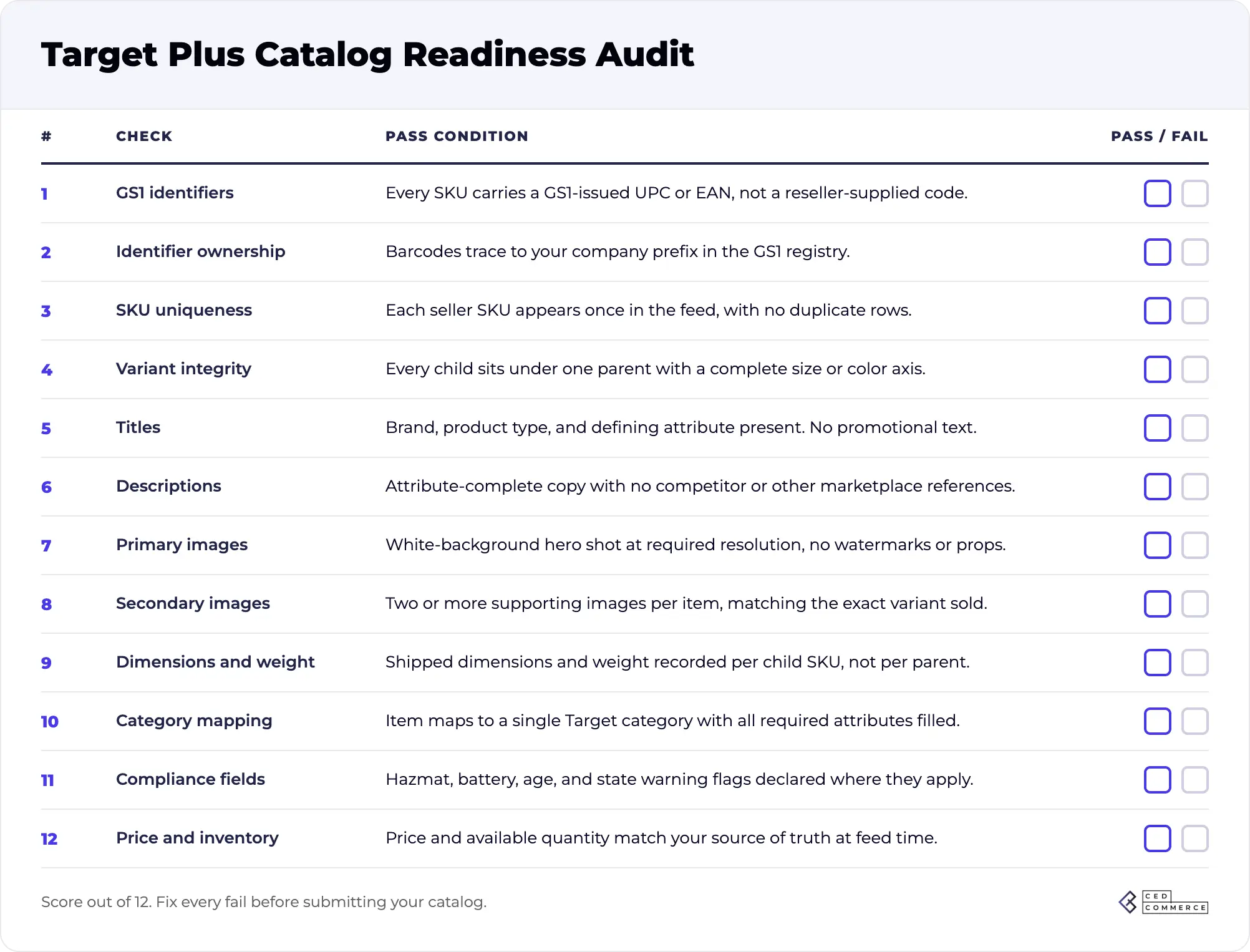
Target curates its marketplace, so your product pages need to fit that standard. Focus on accurate, consistent, and complete product information.
Include the brand, product, key differentiator, and size or count.
Avoid keyword stuffing, promotional language, and symbols that the catalog schema rejects.
Use square, clean, and well-lit images with the product filling the frame.
Three or more images are better than relying on the one-image
minimum.
Provide complete package dimensions, weight, materials, and care information.
These details help customers understand the product and reduce avoidable returns.
Keep color and size naming consistent across each variant family.
Variation values may be restricted by category, especially in apparel, electronics, and home.
Keep descriptions benefit-led and factual.
Avoid claims you cannot substantiate, particularly for supplements, beauty, and wellness products.
Add Proposition 65 warnings and hazmat classifications to the required structured fields instead of burying them in the product description.
Many returns result from expectation gaps rather than product defects. Accurate dimensions, honest color representation, proper size charts, and clear material details can prevent those gaps before the customer orders.
Target Plus charges zero setup fees and zero monthly subscription fees. Instead, you only pay a referral commission fee ranging from 5% to 15% per item sold, depending on the product category. It also reports weekly payouts every Tuesday.
However, treat this as directional since your actual rate and commercial terms come from your contract and the Target Plus Portal, so confirm them in writing during onboarding.
Apart from this, you also need to budget for shipping, returns, catalog preparation, integration, and ongoing operational support.
Target Plus sellers manage fulfillment themselves. Target does not operate a marketplace fulfillment service, so sellers are responsible for shipping orders from US-based facilities and meeting Target’s delivery expectations.
Target’s Eligibility Checklist and seller application confirm these requirements:
These are not published Target Plus requirements, but they can help sellers build a more reliable fulfillment workflow:
While a 30-minute cancellation window for pending orders is mentioned in some sources, your order-routing workflows should allow for that period before fulfillment begins.
Confirm applicable service-level expectations, cancellation handling, and performance requirements with your Target Plus onboarding team before launch.
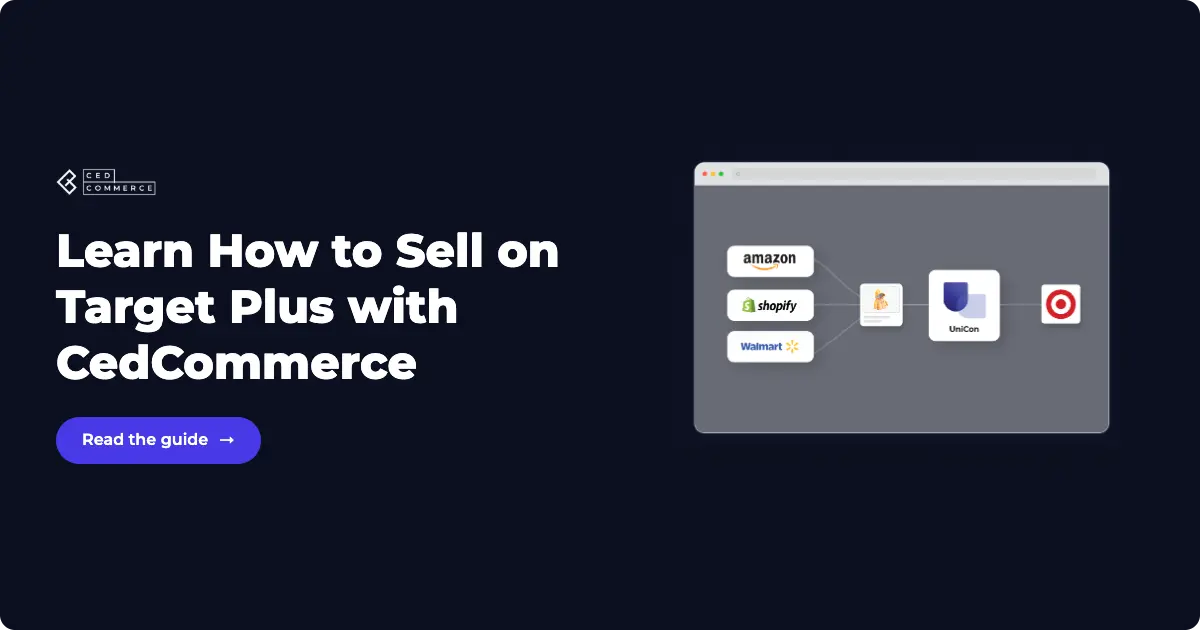
UniCon by CedCommerce helps sellers keep inventory, orders, and fulfillment workflows synced across marketplaces from one dashboard, supporting frictionless multichannel expansion without adding manual operational work.
Explore UniCon for multichannel fulfillment →
Target Plus returns follow Target’s customer-facing return experience, while sellers remain responsible for the operational impact behind those returns.
According to Target’s return policy:
For shoppers, Target keeps returns inside a familiar retail experience.
While for sellers, those returns become an inventory, margin, and logistics consideration. Store returns can be consolidated and sent back to sellers on pallets, making return-handling capacity an important part of Target Plus readiness.
Important: Track return reasons closely after launch. Repeated complaints can expose gaps in product content, sizing, packaging, or the product itself and give your team a clear signal on what to fix.
Yes. Eligible US-based Shopify sellers can apply to sell on Target Plus, but Target reviews and approves every seller based on business eligibility, assortment fit, catalog quality, fulfillment capability, and marketplace readiness.
CedCommerce can help Shopify sellers, brands, resellers and other eCommerce businesses assess their Target Plus readiness, identify application gaps, prepare the required catalog and operational information, and navigate onboarding after approval.
Once approved, sellers can use UniCon by CedCommerce to bring Target Plus into their existing Shopify-led marketplace operation. UniCon helps sellers prepare and cross-list products, synchronize inventory, manage orders, and keep marketplace operations connected from one dashboard.
This allows Shopify sellers to add Target Plus without creating another isolated catalog, inventory, and order-management workflow.
Explore UniCon for your Shopify-led operation →
Target Plus applications usually lose momentum when the business looks ready on paper but the assortment, catalog, or operations are not yet built for Target’s model.
The sequence varies by seller, integration method, and category, and Target doesn’t publish it. Broadly:
Target Plus may be one part of your marketplace strategy. The larger operational question is how you’ll keep your catalog, inventory, orders, and fulfillment controlled as the number of channels grows.
Sellers who clear the Target Plus bar almost always run Shopify, Amazon, or Walmart already. Target’s application screens for exactly that, asking for your existing marketplaces and storefront URLs.
Which surfaces the real problem. Adding a channel shouldn’t mean rebuilding your eCommerce operation, but that’s usually what happens: new taxonomy, new required attributes, new listing rules, another inventory sync point, another order feed, different fulfillment logic.
Once is a project, but five times is a strain on your team.
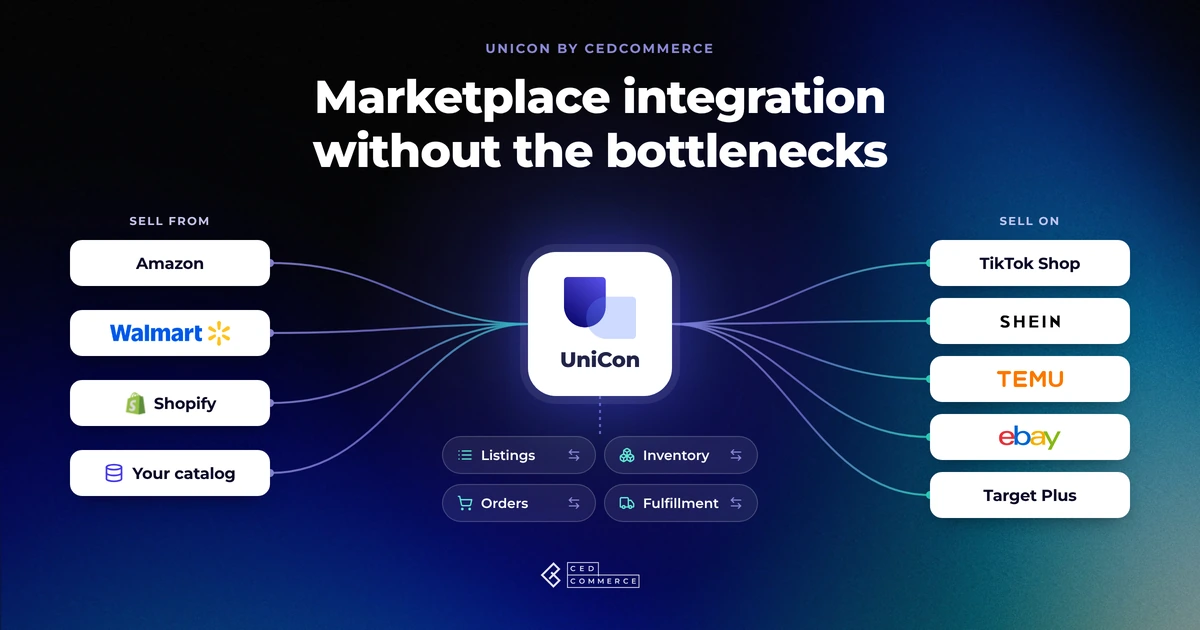
UniCon by CedCommerce is CedCommerce’s cross-listing app built for that problem. Sellers start from an existing Shopify, Amazon, or Walmart catalog and cross-list into Target Plus, Amazon, Walmart, TikTok Shop, Temu, SHEIN, and eBay from one app.
Across those channels it centralizes:
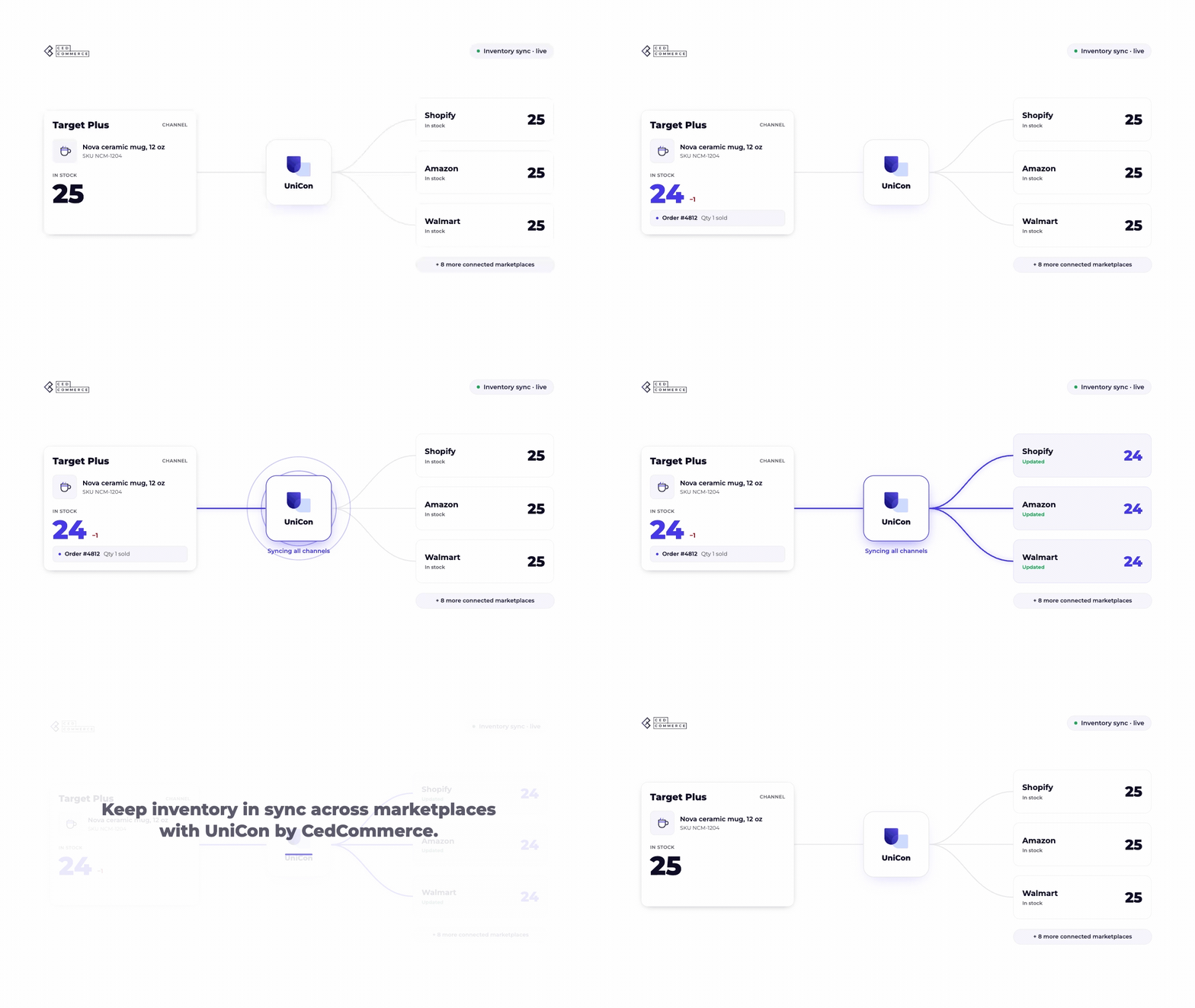
Target Plus is one of those target channels. Once Target approves you as a partner, you can prepare and manage Target Plus listings from the same catalog that already feeds your other marketplaces, instead of building a separate workflow for it.
If you are preparing to apply, explore how UniCon supports Target Plus operations alongside your existing marketplace setup.
With GMV growing nearly 60% year over year and a deliberately selective partner model, the opportunity to sell on Target Plus is meaningful for brands that fit what Target wants to add next.
The strongest approach is to prepare before applying.
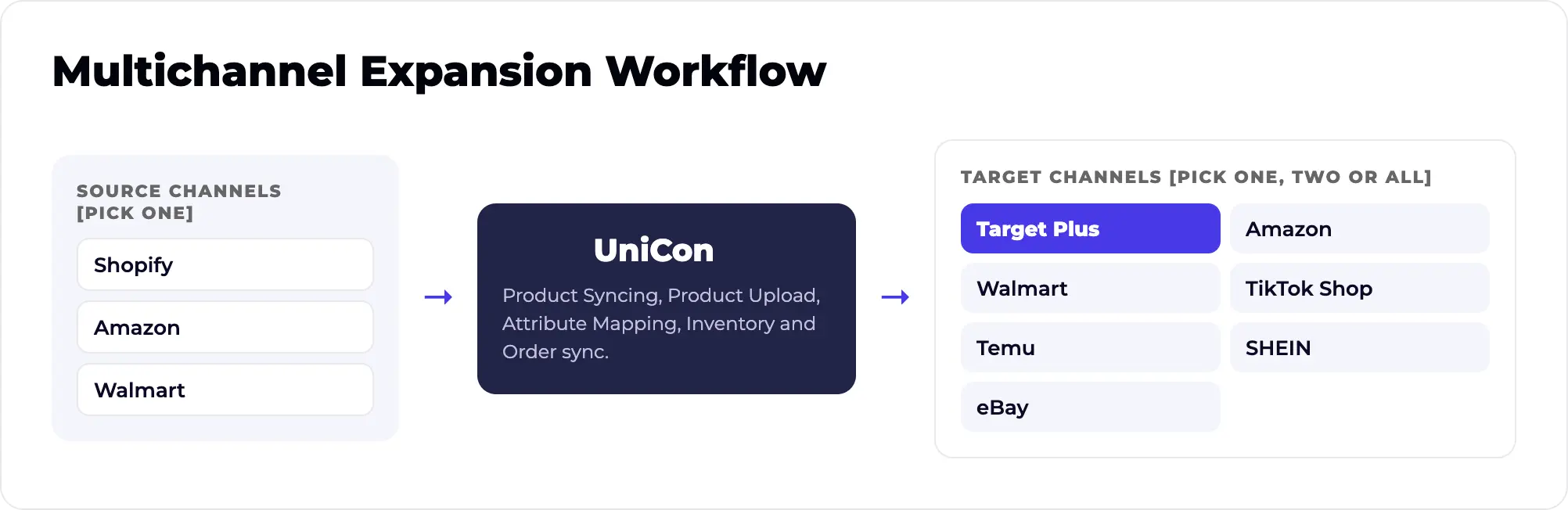
Already selling through Shopify, Amazon, or Walmart and preparing to add more marketplaces? Explore how UniCon by CedCommerce helps supported sellers cross-list, sync inventory, manage orders, and keep multichannel operations connected from one dashboard.
Related reading: How to Cross-List on Every Marketplace with UniCon
Currently, Target Plus is an invite-only, curated marketplace, but interested US businesses can submit the public Seller Application for consideration. Target reviews whether the brand and assortment align with its category strategy and customer priorities before moving a seller forward.
Complete the Target Plus Seller Application and submit your business, marketplace, assortment, and operational details for review. Target aims to update applicants within 30 days. Shopify merchants can begin through Marketplace Connect, while sellers may also identify an existing channel or agency partner like CedCommerce in Target’s application.
Target must select and approve your business before you can sell on Target Plus. However, you do not need to wait for Target to contact you first because Target publishes a public application where eligible sellers can express interest.
Yes. US-based Shopify merchants can apply to Target Plus. Sellers must complete the Target Plus Seller Application and receive Target approval before connecting their account.
No. Shopify does not guarantee Target Plus approval. Shopify requires merchants to complete Target’s application and be approved by Target Plus before they can connect and manage the marketplace through Shopify.
Target Plus accepts products that fit its category strategy, quality standards, and customer expectations. The current application includes categories such as beauty, home, kitchen, grocery, health, apparel, footwear, pets, toys, electronics, and sporting goods. Target also asks applicants to describe their assortment and provide their top 5 to 10 products for review.
Target Plus does not charge a monthly seller fee. Target publicly states that sellers pay competitive referral rates, along with their own shipping, returns, fulfillment, channel-integration, and partner-service costs. Confirm the referral rate and other commercial terms applicable to your assortment during contracting.
Target Plus sellers fulfill their own orders. Target requires US-based fulfillment using UPS, USPS, or FedEx, a 24-hour building lead time, and delivery within 2 to 5 business days after shipment.
Yes. Target Plus Partner items can be returned to Target either in store or by mail. Most unopened Partner items in new condition have a 30-day return window, although some products have modified policies. Target Plus sellers must also be capable of receiving individual and palletized returns.
Target’s typical acquisition process takes 3 to 6 weeks before onboarding, depending on business complexity. It aims to provide applicants with a status update within 30 days of submission. Approval timing and onboarding timing are separate, so plan additional time before launch.
Yes. Target requires product barcodes sourced from GS1 and present on the product itself. UPCs must contain 12 digits and pass checksum validation, while EANs must contain 13 digits and pass checksum validation. Target also specifies which starting digits it accepts.
Yes. Existing Amazon and Walmart sellers can apply to Target Plus. Target asks applicants which third-party marketplaces they currently sell on and specifically requests Amazon and Walmart storefront URLs where applicable.
Prepare a clean, complete, validation-ready catalog before onboarding. Target requires GS1 barcodes, grid-format size charts for wearable products, and UL-WERCSmart registration for applicable ESIM or Hazmat products. Target also asks sellers to submit only SKUs they can set up, stock, and make ready within the onboarding timeline.
Target Plus serves a different role in a multichannel strategy. Its value comes from a curated assortment and Target-led partner selection, while established sellers may continue using Amazon, Walmart, and other marketplaces to reach different audiences and demand. The right channel mix depends on your category, margins, operations, and expansion goals.
Yes. Target Plus is supported as a target channel in UniCon. Once Target approves your seller account, UniCon can help bring Target Plus into a connected multichannel workflow alongside your existing marketplaces, reducing the need to manage another isolated catalog, inventory, and order operation.

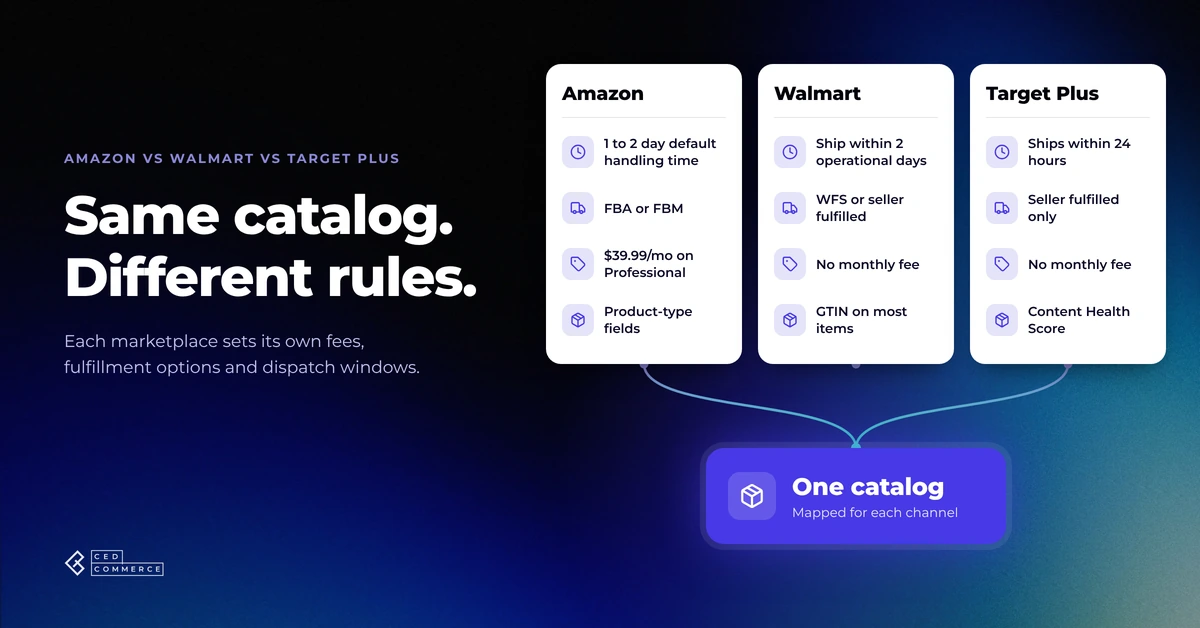
Reading Time: 11 minutes If you already sell on Amazon, adding Walmart or Target Plus…
Reading Time: 13 minutes Selling on another marketplace sounds straightforward when you already have a…