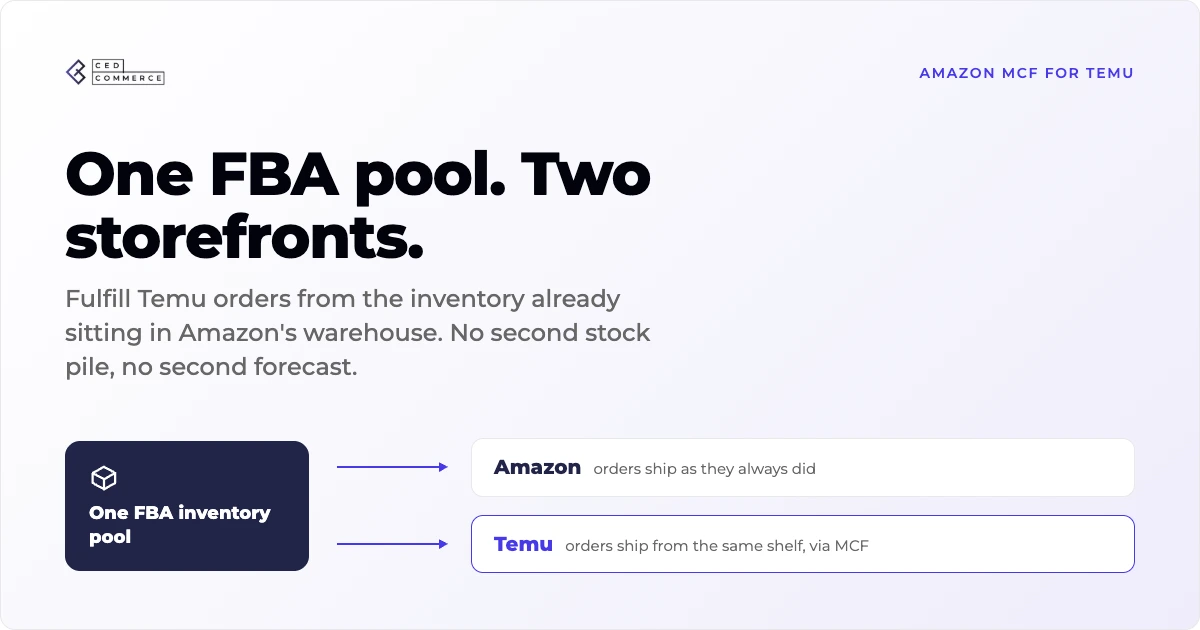

Can you fulfill Temu orders with Amazon FBA inventory?
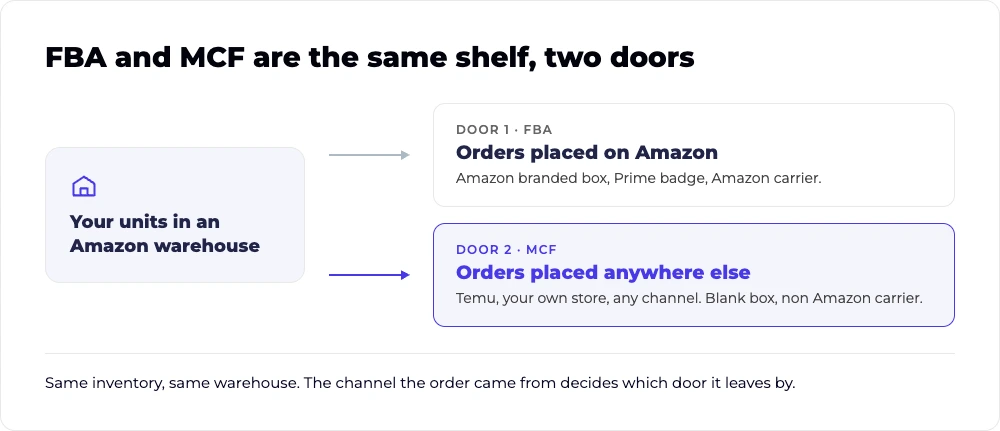
Yes, through MCF. The distinction between FBA and MCF decides whether any of this works, and the highest-ranking page for this exact question gets it wrong by conflating the two.
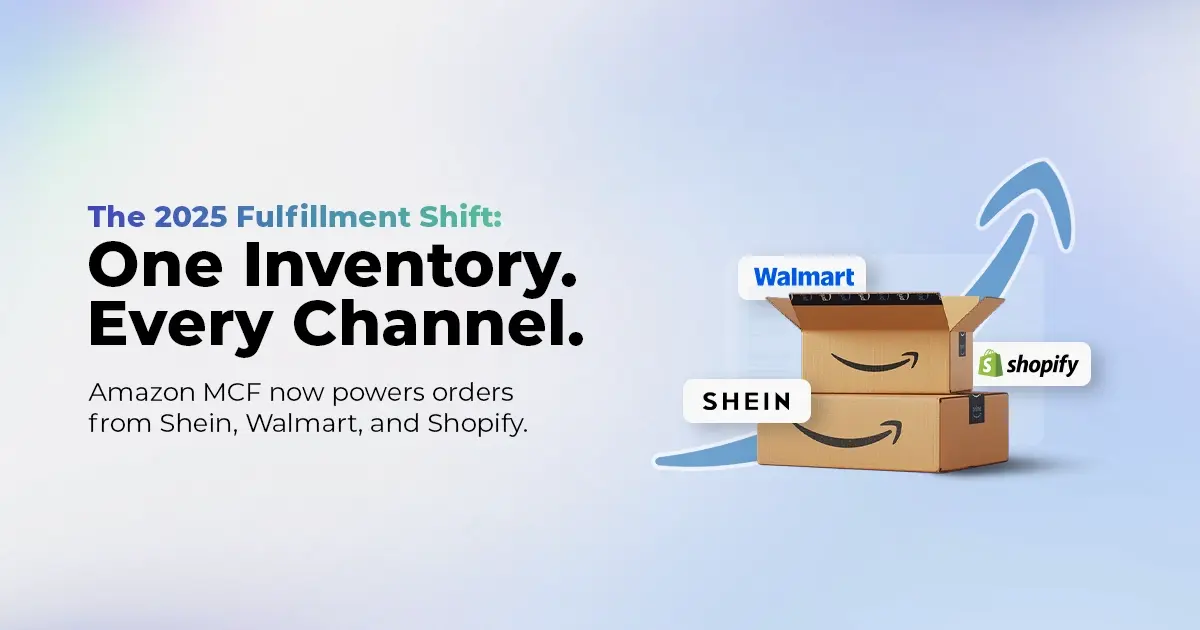
FBA fulfills orders placed in the Amazon store. MCF extends the same fulfillment network, the same warehouses, and the same physical units to orders that originate anywhere else.
You don’t ship anything new to Amazon. You don’t reserve a separate pool.
That last point matters more than sellers expect. Amazon runs MCF from your existing FBA inventory with no separate allocation, which means a Temu sale depletes the same units your Amazon listings are selling from.
The most common objection to MCF is that Amazon deprioritizes non-Amazon orders. Amazon says otherwise, directly: fulfillment decisions turn on “delivery estimates, inventory availability, delivery speed requirements, and proximity to the customer, not the sales channel.” Both order types run through the same fulfillment planning systems.
| Dimension | FBA | Amazon MCF |
|---|---|---|
| Order origin | Amazon store only | Any off-Amazon channel, including marketplaces |
| Inventory pool | Your FBA stock | The same FBA stock, no separate allocation |
| Packaging | Amazon-branded | Unbranded by default, no extra fee |
| Fee basis | Size tier and weight | Size, weight, ship speed, and units per order |
| Referral fee | Yes | None on MCF orders |
| Customer service | Amazon handles it | You handle it |
Talk to a marketplace expert →
What do you need before you start?
Two account states and one inventory position. Check all of them before you map a single category, because the wrong Temu seller model makes the rest of this impossible.
On the Temu side, you need a seller account where you control shipping. That’s the US local or semi-managed model.
Fully-managed consigns your stock to Temu and hands over pricing, which rules out MCF entirely. Temu’s own product documentation confirms US local listings support only the self-delivery option.
On the Amazon side, MCF needs no separate signup if you already sell there. What it does need is inventory physically stowed in fulfillment centers and a Professional seller account in good standing.
| Temu side | Amazon side |
|---|---|
| US local or semi-managed seller account with seller-controlled shipping | Professional seller account, primary Seller Central access |
| US business entity, tax documents, bank account matching the business name | Account active, not suspended, inactive, or in vacation mode |
| Category approvals for what you plan to list | Inventory physically received and stowed in fulfillment centers |
| Product qualification documents where the category requires them, including California Prop 65 warnings | Payment method current |
| Handling time set to 2 days, for reasons covered below | No separate MCF enrollment needed |
Temu’s onboarding is open to US sellers and carries no registration fee. Sellers report approval inside a few business days. A category-dependent security deposit is widely discussed in seller communities, but Temu doesn’t publish the amount, so treat any specific figure you read as unverified.
Check your catalog before you map anything. The two things that stall this workflow are patchy SKU or barcode coverage and SKUs with no FBA inventory position. Both are faster to fix before publishing than after.
See how UniCon connects Amazon as a catalog source, or ask the CedCommerce team to audit your identifier coverage first.
How does the Amazon to Temu MCF workflow actually run?
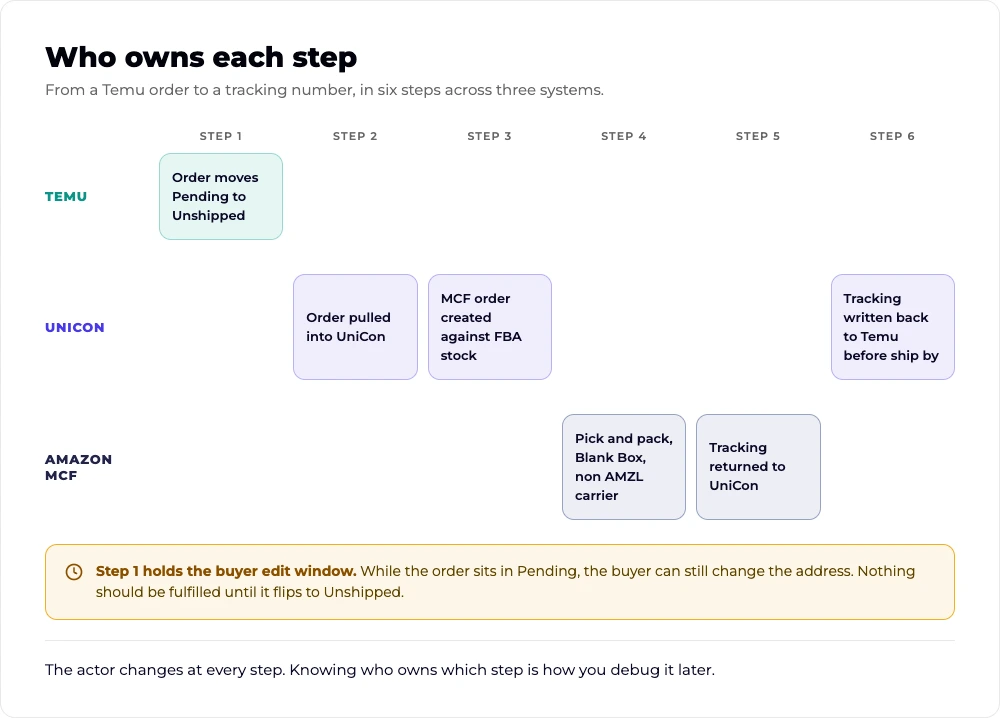
Six steps, and the actor changes at each one. Knowing which system owns which step is how you debug this later.
- A Temu customer orders. The order lands in Pending status.
- The order moves to Unshipped. This is the step sellers get wrong. While an order sits in Pending, the buyer can still change the address or quantity, and Temu tells sellers not to act on it. Pending to Unshipped usually takes minutes but can take hours, and it eats into your handling window.
- Your connector pulls the order and creates a matching Amazon MCF order, applying your chosen fulfillment policy and compliance settings.
- Amazon picks, packs, and ships in unbranded packaging on a carrier that isn’t Amazon Logistics.
- Amazon returns the carrier code and tracking number once the order flips to Shipped.
- The connector confirms shipment to Temu with that carrier and tracking number, inside the ship-by deadline.
Two timing details from Amazon’s own developer documentation are worth building around. Amazon warns that “tracking details may change during the packaging process” and advises against marking an order fulfilled the moment initial tracking arrives. It recommends subscribing to fulfillment order status notifications rather than polling for them.
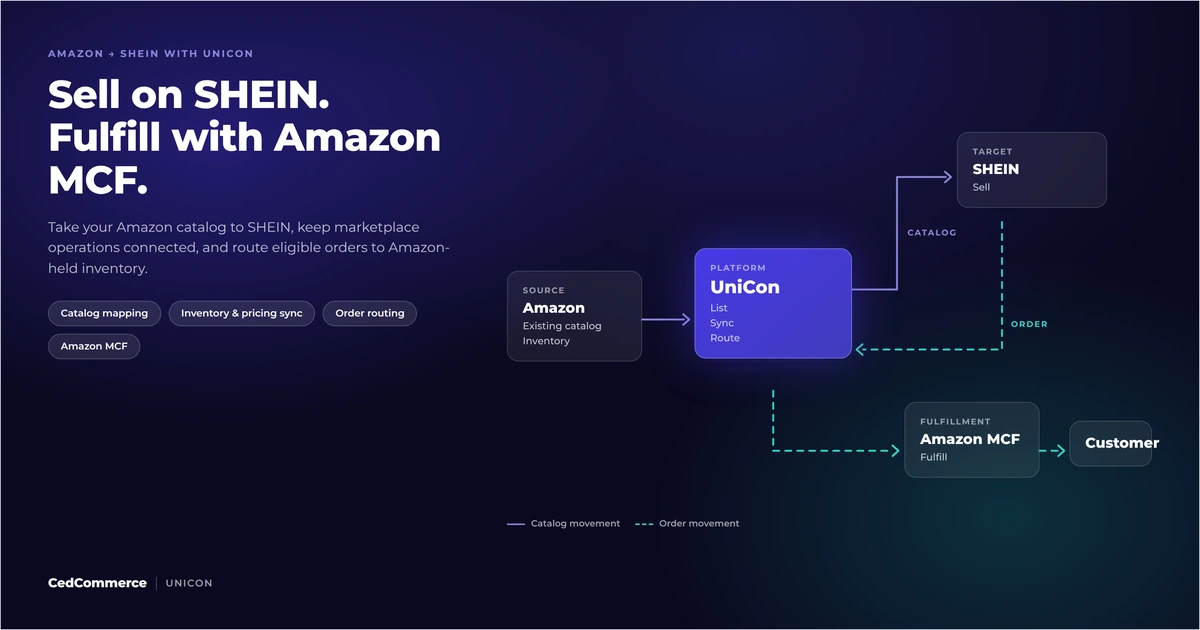
In UniCon, steps 3 through 6 run on one order route. You create a route for the Temu channel account, bind the relevant warehouse to the Amazon MCF fulfillment location, and turn on automatic order fulfillment. One route per channel account, so two Temu accounts get two routes.
Worth knowing: connecting Amazon as a source imports an existing MCF connection automatically. Connecting Temu as a target does not route its orders anywhere by itself. Routing is a deliberate step, which is a feature rather than a gap once you’re running two Temu regions with different warehouses.
How do you get an Amazon catalog onto Temu without retyping it?
Map it once and validate before publishing. Sellers rarely abandon Temu at the listing form. They abandon it in the rejection and rework loop afterwards.
Temu’s listing requirements are specific and they differ from Amazon’s in ways that break naive copy-paste:
| Field | Temu requirement |
|---|---|
| Category | Every product must sit in a leaf category. Non-leaf assignment errors out. |
| Title | Up to 500 characters. English letters, numbers, and permitted symbols only. No decorative characters, no registered or trademark symbols. |
| Description | Up to 10,000 characters, no rich text. |
| Bullet points | Up to 700 characters across a maximum of 6 lines. |
| Images | Up to 50. Minimum 480 by 480 pixels, under 3MB. Carousel images 1:1 and at least 800 by 800 for non-apparel, 3:4 and at least 1340 by 1785 for apparel. |
| Variants | Maximum 2 sale attributes per product. If you run three-option variants on Amazon, this is the constraint that will bite. |
| Identifiers | External Product ID is mandatory only for book categories. Non-book categories accept listings without one. |
| Units | Dimensions in inches, weight in pounds, price in USD. List price must be at or above base price. |
| Review | Every submission enters Temu’s review process before going live. |
The two-attribute ceiling is the one to check first. A shirt with size, color, and sleeve length works on Amazon and won’t publish on Temu as-is.
This is where UniCon’s AI attribute mapping does the heavy part. You import your Amazon catalog once, AI predicts how each field maps to Temu’s category requirements, you approve the mapping, and validation runs before anything publishes.
Category selection auto-loads the required and optional attributes for that category. Clone Attribute reuses mapping logic across similar categories instead of making you reselect from scratch.
CedCommerce clients have mapped 8,000+ SKUs in under 20 minutes on this flow, and Stadium Goods put 75,000 SKUs live in 10 days. Those are CedCommerce client results, not Temu benchmarks.
Your Amazon listings stay untouched throughout. Connecting Amazon as a source is a read operation, and UniCon’s documentation is explicit that it does not change existing live listings on the source channel.
Which two settings decide whether Temu accepts your shipment?
Block Amazon Logistics and Blank Box. Set both before your first Temu order ships, because retrofitting them after a rejection means a shipment already went out wrong.
Block Amazon Logistics
Temu’s supported carrier list includes “Amazon Multi-Channel Fulfilment,” “Amazon Shipping,” and “Amazon Buy Shipping.” It does not include Amazon Logistics or AMZL. Temu also validates tracking numbers against the expected format for the declared carrier and rejects mismatches with a specific error.
Amazon Logistics tracking numbers use the TBA format, which third-party marketplace systems reject or fail to resolve with some regularity. So if MCF routes your Temu order onto Amazon Logistics, you can end up holding a tracking number Temu won’t take, with the ship-by clock running.
Amazon supports blocking Amazon Logistics at account or order level, explicitly for marketplace compliance. Its own Walmart guide instructs sellers to do exactly this. Four operational details:
- The 5% block-AMZL surcharge is waived until 14 January 2027.
- The feature is US and Canada only.
- The flag must be applied before fulfillment is requested, not after.
- Blocking forfeits MCF with Prime, which is restricted to direct-to-consumer channels anyway, so it costs you nothing on Temu.
Amazon does note that blocking can raise the risk of an order going unfulfilled or late where no alternative carrier is available. That’s a real trade, and it’s still the right one for a marketplace that won’t accept the carrier.
Blank Box
Unbranded packaging is MCF’s default, applied automatically at no extra cost. Amazon confirms the packing slip, shipping labels, boxes, tape, jiffy mailers, and polybags carry no Amazon branding.
The exclusions matter and almost nobody publishes them. In the US, items over 56 inches on the longest side or over 49.9 lb aren’t eligible for unbranded packaging. Several EU marketplaces additionally exclude apparel and footwear.
Temu publishes no public rule about competitor branding in the box. MCF’s unbranded default means you don’t need to find out.
| Temu requirement | What MCF does | Verdict | Setting |
|---|---|---|---|
| Carrier must be on Temu’s accepted list | Ships on Amazon-selected carriers, including AMZL by default | Needs configuration | Block Amazon Logistics |
| Tracking number must match carrier format | Returns carrier code and tracking number after ship | Passes once AMZL is blocked | Same |
| No competitor branding assumed safe | Unbranded by default, free | Passes | Blank Box |
| Ship inside 1 to 2 day handling window | Submits on order pull, ships from stowed stock | Passes with 2-day handling | Handling time on the listing |
| Delivery inside the US delivery window | 3 business days standard, 2 expedited | Passes | Ship speed on the route |
| All items under one parent order ship together | May split across fulfillment centers | Needs configuration | Order split handling |
Both settings live in one place. UniCon exposes Blank Box and Block Amazon Logistics in the Amazon MCF order settings, alongside the fulfillment policy that governs partial stock. Configure them once and every routed Temu order inherits them.
See how UniCon routes orders to Amazon MCF.
Does Temu’s handling time work with Amazon MCF’s delivery speed?
Yes, with 2-day handling selected. The number that scares sellers off is the wrong number, because Temu’s tight constraint is the ship-by window, not the delivery window.
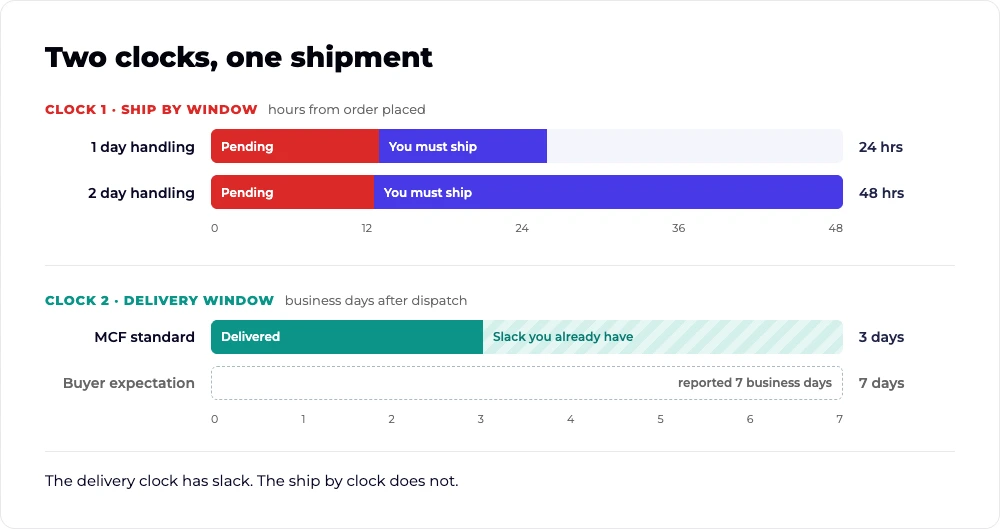
Separate the two clocks:
The ship-by clock. Temu’s listing-level handling time is an enumerated field with two legal values, 1 day or 2 days, and each order carries a hard ship-by timestamp. That’s the deadline your connector has to beat by getting a tracking number back to Temu.
The delivery clock. Sellers report that Temu’s US requirement is delivery, not shipment, within 7 business days, with a $5 penalty per item that applies even when the carrier caused the delay. Temu’s actual penalty schedule sits behind seller login, so treat those figures as seller-reported rather than confirmed policy.
Now set MCF against both. Amazon quotes standard delivery within 3 business days and expedited as fast as 2, for standard-size items already stowed in fulfillment centers and shipped within the 48 contiguous states.
Against a 7-business-day delivery expectation, a 3-day standard delivery has four days of slack. The delivery clock is comfortable. It’s the ship-by clock that’s tight, and it gets tighter because of the Pending status delay: if Pending to Unshipped burns three hours on a 1-day handling listing, you have well under 24 hours left.
So select 2-day handling time on your Temu listings. It costs you nothing on the delivery promise and it buys back the hours Pending status takes.
One structural constraint to configure around. Temu tracking numbers are single-use, and all orders under a parent order must ship together, while MCF can split a multi-item order across fulfillment centers.
UniCon’s order split handling waits for the channel’s package-split information before generating MCF orders and maps each package to one MCF order, with a configurable hold time in minutes.
How do you keep one inventory number honest across Amazon and Temu?
Name one source of truth and hold back a buffer. This pairing is harder than most because both channels draw on the same physical units.
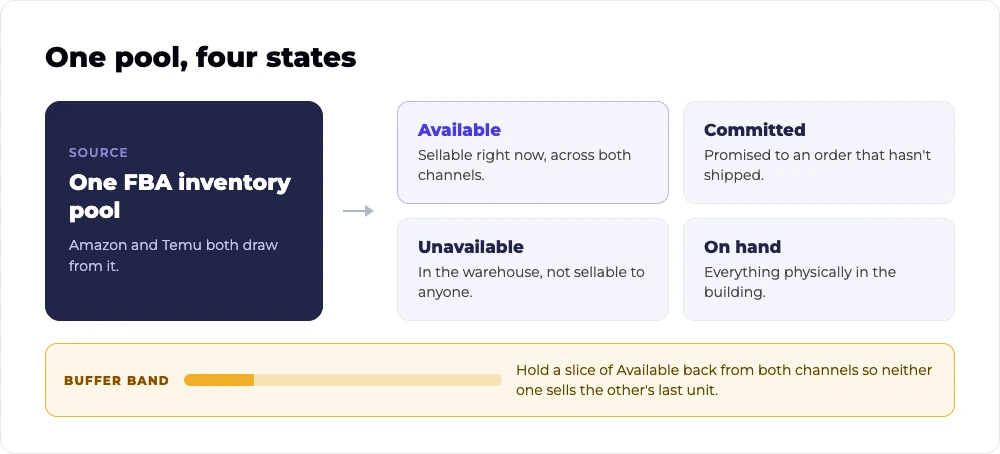
MCF ships from the same FBA pool your Amazon listings sell from. A Temu sale depletes stock Amazon is actively selling, which raises the value of holding units back rather than lowering it.
A Temu oversell also costs more than an Amazon one. It triggers a cancellation, cancellations feed Temu’s performance metrics, and the delivery-window clock is already running when it happens.
UniCon tracks four states per product per warehouse: Available, Committed, Unavailable, and On Hand. Warehouse mapping is what gives each channel its stock figure, so the mapping decides what Temu sees. Rebag runs 99.9% inventory accuracy across 25,000 one-of-one items on this model, as a CedCommerce client result.
Temu’s side supports both full inventory updates, which overwrite to a target quantity, and incremental updates that apply a delta. Updates are push-based and effectively real-time within Temu’s rate limits.
Two habits do most of the work here. Decide whether Amazon or your inventory system holds the authoritative count per SKU, and never let two systems both believe they’re authoritative. Then work UniCon’s Partial Linked queue to zero, since a partially linked product syncs inventory in one direction or matches on only the parent, which is how phantom stock appears on a channel.
How much does it cost to fulfill a Temu order through MCF?
Stack every line before you list anything, because Temu is a price-led marketplace and MCF is a per-unit cost.
What you pay:
- MCF fulfillment fee per unit, based on size, weight, ship speed, and units per order. Amazon raised these by an average of $0.30 per unit in 2026, and left them unchanged for orders of 3 or more units in the small and large standard-size categories.
- A 3.5% fuel and logistics surcharge on MCF fulfillment fees in the US.
- Holiday peak fulfillment fees from 15 October 2026 to 14 January 2027, with the 3.5% surcharge applied on top.
- Standard FBA monthly storage fees, which MCF inventory still incurs, plus aged-inventory and storage-utilisation surcharges where they apply.
- Temu’s category commission. Public reporting puts semi-managed rates somewhere between 5% and 15% depending on category. Temu doesn’t publish a rate card, so confirm yours in Seller Center.
- Shipping cost to the customer, which the seller absorbs on Temu.
What works in your favor:
- No Amazon referral fee on MCF orders. You pay one all-inclusive fulfillment fee covering pick, pack, and ship.
- Up to 50% off per-unit fulfillment fees on multi-unit orders.
- 2026 Preferred Pricing of up to 15% off MCF fees for qualifying sellers.
- No second warehouse, no 3PL minimum, no onboarding invoice, and no units pre-committed to an unproven channel.
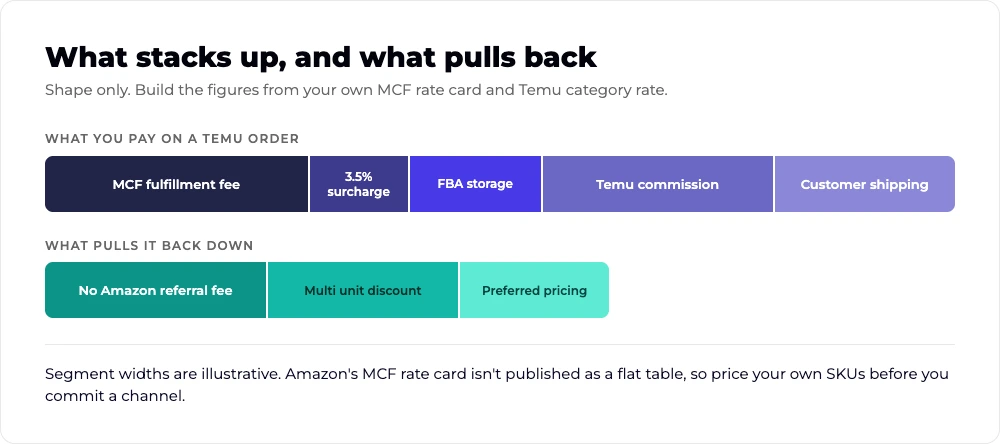
Amazon publishes its MCF rate card as a download rather than an indexable table, so build your model from your own rate card in Seller Central. Per-unit dollar figures quoted on third-party blogs aren’t verifiable against Amazon.
The screening rule. MCF suits mid-price, mid-weight SKUs, and it suits multi-unit orders best because of the 3-or-more-unit fee treatment.
Lightweight items under about $10 rarely clear the stack once Temu’s commission and the 15% to 35% price expectation are both applied. Run the math per SKU and be willing to list a subset of your catalog rather than all of it.
Channel-level price rules matter more here than on any other Temu workflow. UniCon applies per-channel pricing and markup rules for Temu, so you can meet Temu’s price expectation on the SKUs where the margin survives without touching what those products cost on Amazon.
Where does this workflow break?
Temu can revoke your ability to self-ship
Temu’s shipment confirmation API returns dedicated errors for store-level and carrier-level restrictions that force you onto Temu-purchased labels. There are specific errors for FedEx, Purolator, and other carriers, plus a templated version that applies to any carrier.
The one to understand: Temu restricts the confirm-shipment function outright for stores with “a high number of packages that were marked delivered but not actually received by customers.” Temu also mandates its own labels exclusively for Brazil orders, so the precedent for hard label mandates exists.
Self-shipping on Temu is a revocable privilege tied to delivery performance. Since MCF’s delivery scans are outside your control, a run of delivery disputes can strip that privilege while you’re mid-operation. Watch your delivery-confirmation disputes, and keep manual fulfillment configured as a fallback.
Temu rejects your tracking number
Almost always because Amazon Logistics wasn’t blocked, or because the carrier name sent to Temu doesn’t map to a carrier on Temu’s accepted list. Preventable entirely at setup.
Tracking arrives late or changes
MCF tracking becomes available only after the order status flips to Shipped, and Amazon publishes no time-to-tracking commitment. Amazon explicitly warns that tracking details can change during packaging. Subscribe to fulfillment order status notifications rather than polling, and don’t confirm shipment to Temu on the first tracking value you see.
MCF can’t fill the order
Your fulfillment policy decides what happens. UniCon exposes all three of Amazon’s options: Fill All only ships if every item is in stock, Fill or Kill cancels the whole order when an item is unavailable, and Fill All Available ships what it can and leaves the rest pending. Pick deliberately, because on Temu a cancellation carries a metrics cost.
You need to cancel
You can cancel an MCF order until the shipping label is generated. That’s an event, not a fixed window, and Amazon doesn’t publish typical time-to-label. Temu separately gives sellers 24 hours to respond to a buyer cancellation request, and auto-approves anything unanswered.
When MCF can’t serve an order, UniCon’s manual fulfillment records the tracking number, tracking URL, carrier, and source warehouse per order, per item, or for selected items. The source warehouse determines where the quantity gets deducted, so inventory stays accurate even on the exception path.
Will Amazon penalize you for selling on Temu?
Not for using MCF. Amazon built MCF for off-Amazon channels and actively promotes it for competing marketplaces. The commercial relationship is a separate question, and it deserves a straight answer.
On MCF specifically, there’s no policy problem. Amazon’s MCF Service Terms, effective 6 July 2026, contain no restriction on competing marketplaces. Amazon publishes per-marketplace MCF guides for Temu and Walmart, built a native app for SHEIN, and ran a 35% MCF discount for TikTok Shop orders.
Its only stated caveat runs the other direction: Amazon recommends you check the other marketplace’s 3PL requirements, which is what the settings section above is for.
The single limit worth knowing is that MCF with Prime is restricted to direct-to-consumer channels, so Prime delivery speeds aren’t available on Temu orders.
Talk to a marketplace expert →
On the commercial relationship, be clear-eyed. Trade reporting indicates Amazon has offered advertising credits and lower commissions to merchants who stop selling on Temu, and has removed Buy Box buttons from listings it found priced lower on Temu.
Anker closed its US Temu storefront over this pressure. Sellers report losing the Buy Box when Amazon detects price overlap between their FBA listings and their Temu listings.
That risk attaches to price parity, not to MCF. But this workflow does make your Temu presence more legible rather than less, and Temu’s 15% to 35% below-Amazon expectation points straight at the trigger. If protecting Buy Box share on your core Amazon SKUs matters more than Temu revenue, list a differentiated subset on Temu rather than your bestsellers.
The mirror question. Temu documents self-fulfilled shipments as a supported path, ships partner-warehouse APIs, and publishes no public rule against third-party fulfillment.
Its full seller policy library sits behind login, so absence of a public prohibition isn’t the same as written permission. Confirm against your own seller agreement.
Do you need a connector between Temu and Amazon MCF?
Yes, in practice. There’s no native link between the two, and Amazon’s answer to the gap is a list of integration partners rather than an app it built itself.
Before evaluating any vendor, here’s the specification the middleware has to meet. Hold whoever you’re considering to it:
- Pull Temu orders at Unshipped status, not Pending, so buyer address changes don’t corrupt the MCF order.
- Create the MCF order with a configurable fulfillment policy for partial-stock scenarios.
- Hold Blank Box and Block Amazon Logistics as persistent settings, applied before fulfillment is requested.
- Write carrier and tracking back to Temu inside the ship-by window, with carrier names mapped to Temu’s accepted list.
- Keep one inventory number honest across a pool both channels draw from.
- Handle package splits without violating Temu’s single-tracking-number and parent-order rules.
- Provide a manual fallback that still deducts inventory from the right warehouse.
UniCon meets that specification on documented capability. Amazon connects as a catalog source and brings an existing MCF connection with it, and Temu connects as a target.
AI attribute mapping proposes the field matches, you approve, and validation runs before publish. One order route per Temu channel account binds your warehouse to the MCF fulfillment location, with automatic order fulfillment submitting eligible orders.
Blank Box, Block Amazon Logistics, and the fulfillment policy sit in the MCF order settings. Tracking and status write back with the carrier, date, and tracking number visible per item.
What UniCon doesn’t do, so you can plan for it: it doesn’t make your category and attribute mapping decisions for you, it doesn’t set your Temu prices, and it doesn’t do your Temu marketing or creator work. Those stay yours.
What should you check in your first week on Temu?
Nine checks, in order. Most of these catch problems while they’re still cheap.
- Confirm Blank Box and Block Amazon Logistics are enabled before your first order, not after.
- Confirm handling time is set to 2 days on your Temu listings.
- Clear the Not Linked and Partial Linked queues to zero.
- Check the Manage Listing error column and resolve anything marked Incomplete.
- Place one test order and verify the carrier name Temu receives is on its accepted list.
- Confirm the first shipment did not move on Amazon Logistics.
- Confirm tracking reached Temu inside the ship-by window.
- Verify inventory decremented against the correct warehouse.
- Watch impressions rather than order count for the first seven days. Impression volume tells you whether your category and images are working; order count at low volume tells you very little.
Key takeaways
- Amazon MCF can fulfill Temu orders from your existing FBA inventory, and Amazon named Temu as a supported MCF channel in September 2025.
- Temu’s accepted carriers include Amazon Multi-Channel Fulfilment but not Amazon Logistics, so blocking AMZL is mandatory rather than optional. The 5% surcharge for doing so is waived until 14 January 2027.
- Set 2-day handling time. MCF’s 3-business-day standard delivery clears Temu’s reported 7-business-day delivery expectation with slack; the ship-by window is the tight constraint.
- You need a US local or semi-managed Temu account. Fully-managed hands pricing and logistics to Temu and rules out MCF.
- MCF draws on the same FBA units Amazon sells from, so decide your source of truth per SKU and hold a buffer.
- No Amazon policy restricts MCF for competing marketplaces. The real risk is Buy Box pressure from price parity, and it attaches to your pricing decision rather than your fulfillment one.
FAQ
Can I fulfill Temu orders using Amazon FBA inventory?
Yes, through Amazon Multi-Channel Fulfillment rather than FBA itself. FBA fulfills Amazon-store orders only, while MCF extends the same warehouses and the same physical units to off-Amazon channels including Temu. You don’t ship separate inventory or reserve a separate pool. You do need inventory already stowed in Amazon fulfillment centers.
Will Temu accept Amazon MCF tracking?
Yes, provided the shipment doesn’t move on Amazon Logistics. Temu’s supported carrier list includes “Amazon Multi-Channel Fulfilment,” “Amazon Shipping,” and “Amazon Buy Shipping,” but not Amazon Logistics or AMZL. Enable Block Amazon Logistics before your first order so MCF routes to a carrier Temu recognizes. The 5% surcharge for blocking is waived until 14 January 2027, and the feature is US and Canada only.
Does Amazon MCF ship Temu orders in unbranded packaging?
Yes, automatically and at no extra cost. Amazon confirms MCF orders ship in blank packaging with no Amazon branding on the boxes, tape, mailers, polybags, labels, or packing slip. Two exclusions apply in the US: items over 56 inches on the longest side and items over 49.9 lb aren’t eligible for unbranded packaging.
Do MCF fees leave any margin on a Temu sale?
On mid-price and mid-weight SKUs, usually yes. You pay one all-inclusive MCF fulfillment fee with no Amazon referral fee, plus a 3.5% fuel surcharge, FBA storage, and Temu’s category commission. Multi-unit orders benefit from up to 50% off per-unit fees, and fees held flat in 2026 for orders of 3 or more standard-size units. Lightweight items under roughly $10 rarely clear the stack once Temu’s price expectation is applied.
Do I need a connector between Temu and Amazon MCF?
Yes. No native integration exists between Temu and Amazon MCF, and Amazon addresses the gap with a published list of integration partners rather than a first-party app. The connector has to pull Temu orders at Unshipped status, create the MCF order with a fulfillment policy, hold the Blank Box and Block Amazon Logistics settings, and write carrier and tracking back inside Temu’s ship-by window.
What Temu seller account do I need to use Amazon MCF?
A US local or semi-managed account where you control shipping. Temu’s product documentation confirms US local listings support only the self-delivery option, which is what MCF needs. Fully-managed consigns your inventory to Temu and transfers pricing and logistics control, making MCF impossible on those listings.
Your inventory is already in Amazon’s network. Your next customers are on Temu.
UniCon connects Amazon as your catalog source, maps and validates your listings for Temu before they publish, applies per-channel pricing so Temu’s price expectation doesn’t touch your Amazon margins, and routes eligible Temu orders to Amazon MCF with unbranded packaging and Amazon Logistics blocked.
No second warehouse. No second inventory pool. No units pre-committed to a channel you haven’t tested.
CedCommerce clients have gone from connected catalog to first live listing in 48 hours and mapped 8,000+ SKUs in under 20 minutes. Flat $99 to start, across 10K+ sellers and $4B+ in GMV.
Further reading: how Amazon MCF now fulfills orders from other marketplaces, how to sell on Temu as a US merchant, and the UniCon Temu integration.