
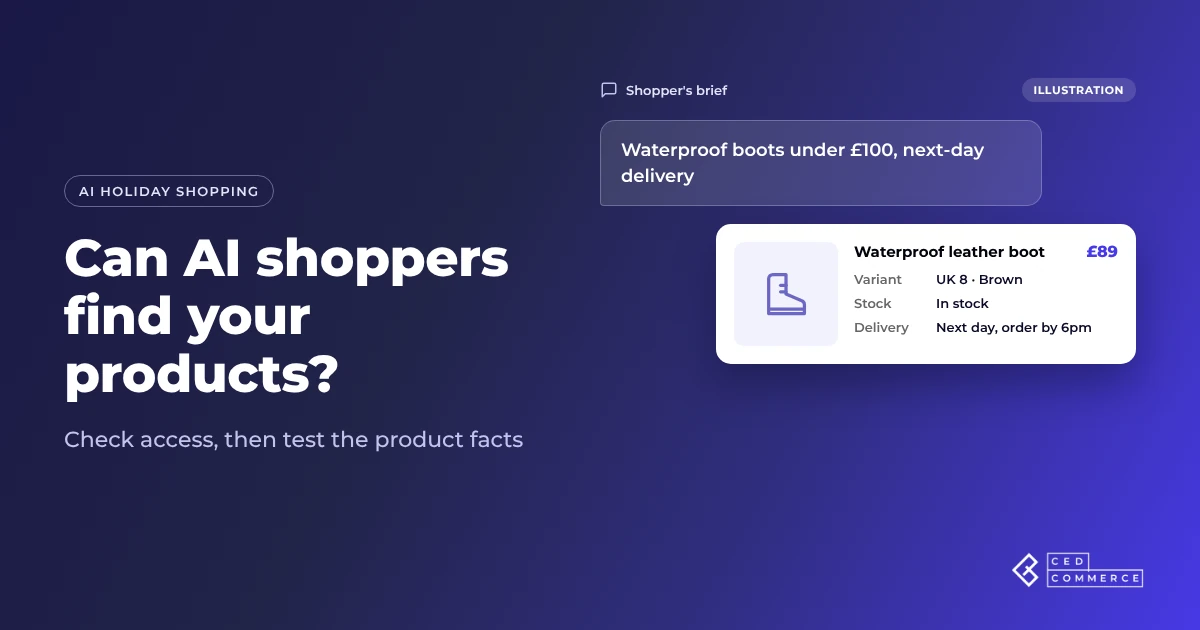
AI Holiday Shopping: Can Buyers Find Your Products?
Reading Time: 5 minutes AI holiday shopping is moving product research into chat. Shoppers ask…
Running short of time? Get PDF of the blog in your mail.
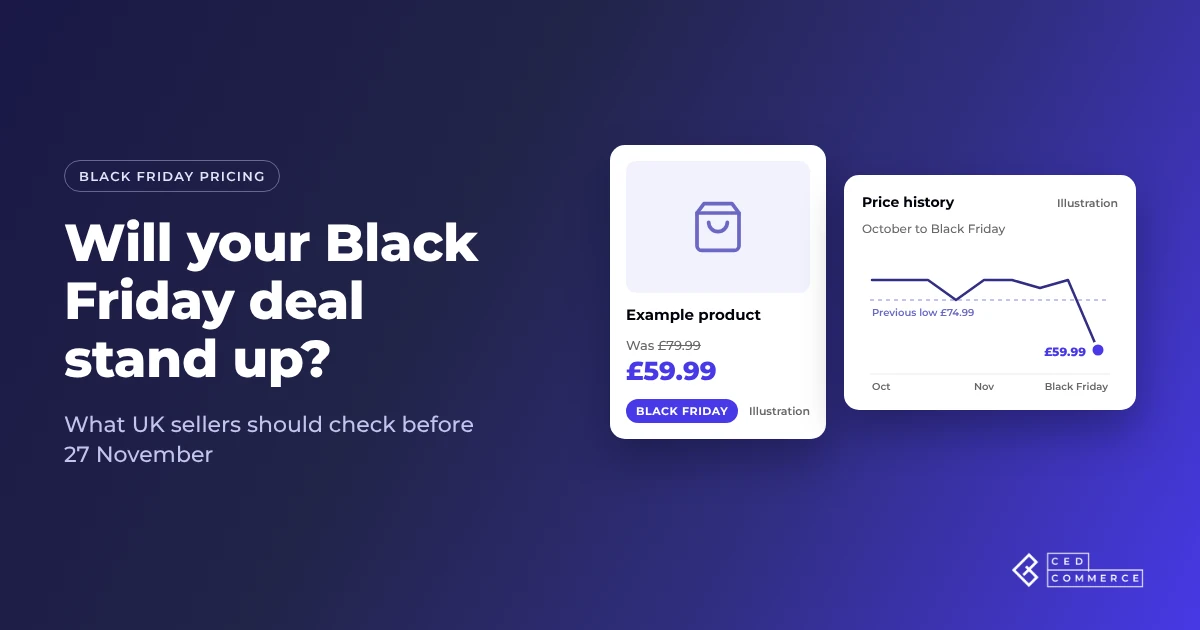
Black Friday pricing is getting a harder look from UK shoppers this year. Research from price comparison site idealo, reported by ChannelX, found that seven in ten product categories saw average prices rise at some point in the six weeks before Black Friday 2025, then fall on the day. With Black Friday on 27 November 2026, compare each advertised saving with your recent price history and work out the margin left at the sale price. Then confirm that every channel shows the offer you approved.
The same survey of more than 2,000 UK adults found that 72% believe many Black Friday discounts are misleading. 81% would trust a retailer more if it showed how its Black Friday prices compared with earlier prices. Your deal now has a second audience: the shopper checking what you charged in October.
idealo surveyed more than 2,000 UK adults and analysed over 40,000 daily prices across 100 popular products and 80 categories for its Black Friday Report 2026. The price observations describe Black Friday 2025. Read them as a guide to how buyers will judge this year’s deals rather than a forecast of 2026 prices.
Key findings, as reported by ChannelX:
The figures come from prices tracked on idealo. They don’t describe every UK retailer, and they don’t explain why prices moved. They do show what a buyer with a price-history tool is likely to notice.
Start with the reference price. idealo’s deals pages compare offers against a 90-day average built from the daily lowest prices on its site. A shopper using that view measures your deal against what the item has typically cost over three months. Build a promotion review table for each promoted SKU before the sale starts.
| Check | What to record | Why it matters |
|---|---|---|
| SKU and variant | Exact item, size and pack quantity | A saving only holds if both prices refer to the same product |
| Reference price and basis | The price you charged, the dates it applied and the channel | Buyers and comparison sites check history over weeks |
| Live offer price | The Black Friday price on each channel, with start and end times | Confirms the claim matches what buyers can see |
| Delivery charge | Shipping cost and delivery promise per channel | A higher delivery charge can cancel out a lower item price |
| Saving shown | The percentage or amount in your listing copy | Keeps the claim consistent with the reference you recorded |
If the reference price applied for only a few days, or you raised it shortly before the sale, rework the claim or lead with the final price. If you’re unsure whether a comparison claim is appropriate, have it reviewed before the offer goes live.
A deeper discount only helps if each order still covers its own costs. Work out contribution per unit at the sale price, using your actual fees, fulfilment costs and advertising spend for each channel. The example below is hypothetical.
| Line (illustrative, per unit) | Amount |
|---|---|
| Sale revenue, excluding VAT | £80 |
| Product cost | −£40 |
| Marketplace fees | −£10 |
| Fulfilment | −£6 |
| Attributed advertising | −£8 |
| Contribution before fixed overheads | £16 |
These figures are assumptions for illustration, not marketplace fee rates. Keep VAT treatment consistent on both sides of the calculation. In this example, cutting the sale price by another £8 would halve contribution to £8 per unit if the other costs stayed the same.
Item margin and contribution are different numbers. Item margin subtracts only product cost. Contribution also subtracts the costs each order triggers, and it tells you whether a volume target makes sense.
If you sell on several marketplaces and your own store, the price you approved has to reach each one on time and come off when the promotion ends. Channel-specific prices can be valid, since fees and delivery costs differ by channel. Each channel should show the offer you intended for it.
Manual edits across several channels are where mismatches creep in. Syncing catalog data, prices, and inventory from one source cuts down the places you have to update by hand.
CedCommerce · UniCon
Keep your marketplace offers up to date
Manage catalog updates and sync prices and inventory across supported channels with UniCon.
Related reading: Learn how to plan your multichannel expansion and how to manage multichannel selling from Shopify. Prefer to set things up yourself? View UniCon on the Shopify App Store.
No. In idealo’s 2025 price data, reported by ChannelX, Black Friday was the cheapest day of the year for only six of 80 product categories. Of those categories, 45% reached their lowest average price between January and March.
Record the price you charged for the same item and pack size over recent weeks, with dates and channels. Compare the Black Friday offer with that record before you publish a saving. Price comparison sites such as idealo compare deals with a 90-day average, so shoppers can easily spot a short price rise before the sale.
Not necessarily. Fees, delivery costs, and competition differ by channel, so different prices can be justified. Each channel should show the offer you approved for it, with accurate stock and delivery information.
Start with the sale price excluding VAT. Subtract product cost, marketplace or payment fees, fulfilment, and the advertising attributed to the order. The result is contribution before fixed overheads, which shows whether each extra sale adds profit.

Reading Time: 5 minutes AI holiday shopping is moving product research into chat. Shoppers ask…

Reading Time: 11 minutes By now you have seen your BFCM 2025 numbers. The harder…
Reading Time: 2 minutes Black Friday 2025 delivered the strongest U.S. eCommerce performance in history,…

Reading Time: 4 minutes OpenAI has announced a new AI-powered shopping research tool designed to…
Reading Time: 11 minutes The $240 Billion BFCM Opportunity & Why Operations Matter Every seller,…
Reading Time: 7 minutes TL;DR — Your 60-Second BFCM Battle Plan Time remaining: 3 weeks…
Reading Time: 2 minutes China’s Double 11 shopping festival — the world’s largest annual online…
Reading Time: 4 minutes About the Client TMRG is a global health and wellness brand…

Reading Time: 11 minutes Halloween 2025: The Creative Seller’s Goldmine In the age of viral…
Reading Time: 3 minutes About the Client Esty Store: Infinite Spiral, LLC Overview: Infinite Spiral,…