
Agentic Commerce Gains Ground: 96% of Retailers Have Already Invested in AI
Reading Time: 2 minutes A new industry study shows that agentic commerce is moving from…
Running short of time? Get PDF of the blog in your mail.
AI holiday shopping is moving product research into chat. Shoppers ask an assistant for gift ideas, compare its suggestions and only then click through to a store. A product the assistant can’t read or describe accurately may never make that shortlist, and your analytics won’t record the visit you missed. Before the peak, confirm that AI tools can reach and correctly read your product pages. Then measure whether the visits they send turn into orders.
UK interest is already high. In idealo research reported by ChannelX, 34% of UK adults said they plan to use AI tools such as ChatGPT, AI-powered search or retailer chatbots for Black Friday shopping. Among 18 to 24-year-olds, the figure was 50%.
Buyers still research before they purchase, but more of that research now happens in a chat window. ChannelX describes this as the first holiday season where many shoppers will start with an assistant that compares and shortlists products before they visit a seller’s site. It also notes that agents able to complete purchases for a shopper have not yet launched in the UK. For most UK sellers, the change affects discovery and click-through first.
Size doesn’t guarantee readiness. The Q3 2026 AI1000, a benchmark from ReFiBuy and Digital Commerce 360, scores the 1,000 largest online retailers on signals including bot friendliness and traffic from AI sources. Only 13 of the 100 largest online retailers rank in its top 100, and the index average is 39.9 out of 100. The benchmark covers large retailers and uses a vendor-defined method. Read it as evidence that readiness varies widely, rather than a rulebook for how assistants choose products.
Start with access, because an assistant can’t describe a page it can’t fetch. ChannelX reports that many retailers block AI agents without their commerce teams knowing. Check these settings for each tool you care about:
Test each tool separately and record the date. A successful fetch by one assistant proves access only for that tool on that day.
Once a tool can reach the page, the product facts need to be clear enough to match a buyer’s request. Review this product-data checklist on your best sellers first:
Product structured data helps machines read these facts when it matches the visible page. Where your prices differ by channel on purpose, keep each listing internally consistent and current. A stale stock level or an expired sale price on one marketplace gives an assistant conflicting facts about the same item.
Your own site and your marketplace listings are separate jobs. Site access, structured data, and any direct AI feed programmes sit with your web and SEO teams, and no tool can guarantee how an assistant ranks your products. Keeping marketplace listings accurate as prices and stock change is catalog operations work, and that is where a multichannel connector helps.
CedCommerce · UniCon
Keep your marketplace product data accurate
Prepare listings for supported marketplaces and manage catalog updates from a single dashboard without switching multiple tools!
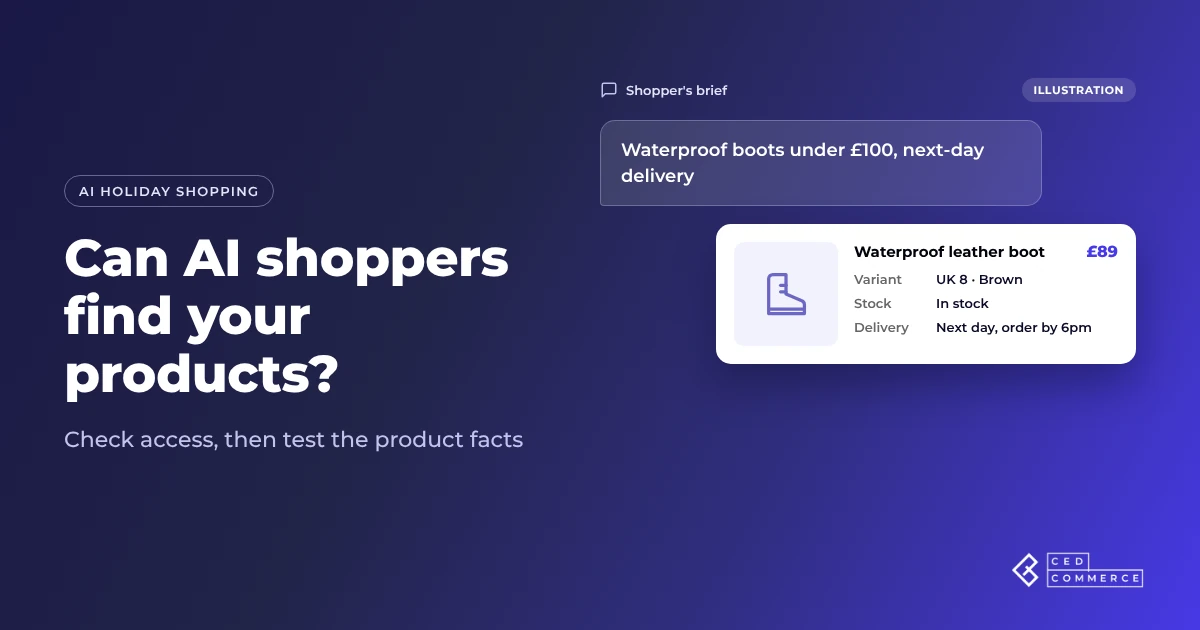
Use a fixed set of buyer prompts, such as “best waterproof walking boots under £100 with next-day delivery”, and run them on a schedule. Log the date, the tool, whether your product appeared, the URL cited, and any factual errors. A ten-product test sheet connects those checks to results:
| Field | What to record |
|---|---|
| Product and variant | The exact item tested |
| Access result | Fetched, blocked or partial, per tool |
| Correct product shown | Yes or no, with the variant the tool named |
| Price and availability match | Compared with your live offer on the test date |
| Delivery information | Whether the tool reported delivery terms correctly |
| Cited URL | The page or listing the tool linked to |
| Referral sessions and orders | Human visits and purchases from that tool, where analytics can attribute them |
Keep bot requests and human referrals apart. Server logs show crawler activity, while analytics shows people who clicked through from sites such as chatgpt.com or perplexity.ai. A screenshot of your product in an answer, or a spike in bot hits, doesn’t prove a sale. Compare referral orders and conversions with your other channels over the same period, and repeat the same prompts through January to see whether changes hold.
Related reading: Learn how to plan your multichannel expansion and how to manage multichannel selling from Shopify. Prefer to set things up yourself? View UniCon on the Shopify App Store.
First confirm that AI tools can fetch your product pages. Then check that each page states the exact variant, price, currency, availability and delivery terms, and that product structured data matches the visible page. Keep the same facts current on every channel where the product is listed.
No. Access lets a tool read your page, but each assistant decides what to show using its own methods. Treat access as a prerequisite, then measure whether your products appear for real buyer prompts.
No. Discovery is when an assistant researches and shortlists products. In-chat checkout lets the buyer pay without leaving the conversation, and its availability depends on the platform and country. ChannelX reports that agents able to complete purchases have not yet launched in the UK.
Segment analytics sessions by referrer, such as chatgpt.com, perplexity.ai, and gemini.google.com, and track orders from those sessions. Keep crawler activity from server logs separate, because bot requests are not visits from buyers.


Reading Time: 2 minutes A new industry study shows that agentic commerce is moving from…

Reading Time: 2 minutes Google is expanding AI Mode’s role in eCommerce, pushing shopping deeper…
Reading Time: 2 minutes When OpenAI confirmed a 4% transaction fee for Shopify merchants selling…