
Sell on Temu and Fulfill Orders With Amazon MCF
Reading Time: 19 minutes Ever wondered if your FBA inventory could turn Amazon into a…

Running short of time? Get PDF of the blog in your mail.
By now you have seen your BFCM 2025 numbers. The harder question is what they actually say about your marketplaces.
Across Black Friday Cyber Monday 2025 in the United States, shoppers spent about 44.2 billion dollars online. Cyber Monday contributed roughly 14.25 billion dollars and Black Friday about 11.8 billion dollars. From 1 November to 1 December, online holiday spend passed 137 billion dollars. Even strong individual performance sat inside heavy competition.
Buyer behaviour also shifted in ways your dashboards only hint at. More orders started and finished on phones. Discovery moved into TikTok feeds, creator links, and AI assisted search. BNPL supported larger baskets in electronics, home, and beauty while expectations on speed and reliability stayed strict. Marketplaces became the default place to compare options, check reviews, and complete higher value carts.
This BFCM 2025 marketplace sales analysis looks at that environment through CedCommerce seller data across Amazon, Etsy, Walmart, TikTok Shop, eBay, Temu, and SHEIN. The goal is simple. Turn one noisy peak into clear decisions on which marketplaces truly worked, which categories carried revenue, how operations helped or hurt, and what needs to change before BFCM 2026.
BFCM 2025 did not have one hero marketplace for CedCommerce sellers. Results came from a portfolio where each channel played a different role.
In total, CedCommerce merchants processed multi-million dollar GMV across seven marketplaces. Amazon, TikTok Shop, and Walmart carried much of the volume. eBay, Etsy, SHEIN, and Temu contributed focused wins in specific categories and price bands.
Marketplace performance snapshot for BFCM 2025:
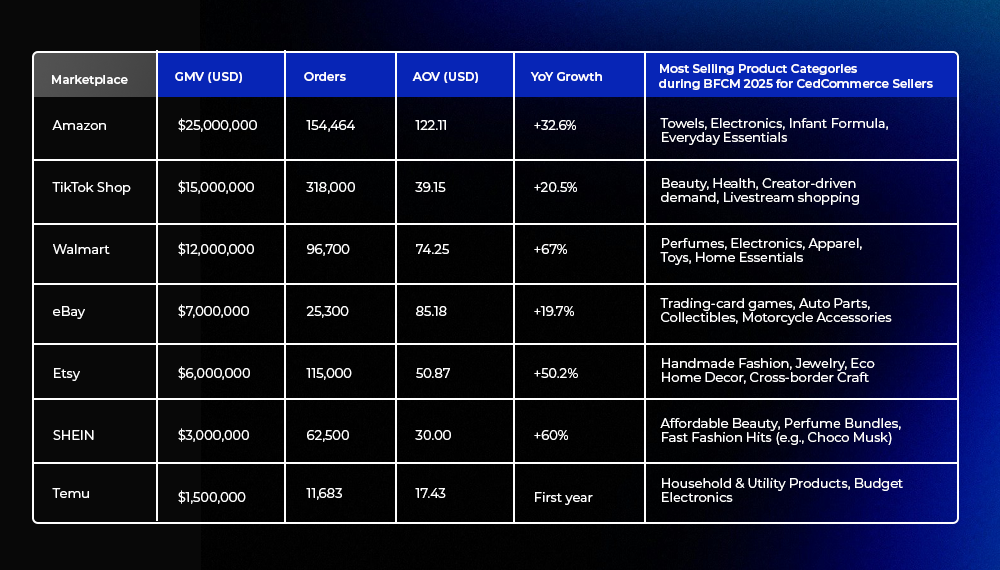
From this, three marketplace roles emerge for CedCommerce sellers.
Amazon retained its crown with $18.86M GMV, 154,464 orders, and an AOV of $122.11, continuing to deliver consistent high-ticket performance across essential verticals like electronics, infant formula, and everyday goods. TikTok Shop, meanwhile, scaled virally with $12.45M GMV, 318,000 orders, and an AOV of $39.15, surging on the back of creator-driven campaigns and frictionless mobile conversions. Together, these marketplaces now form the dual backbone of marketplace strategy. Amazon for dependable revenue and inventory planning, TikTok Shop for volume acceleration and discovery via social proof.
Direct takeaway for sellers: Treat Amazon as your inventory and margin stabilizer. Use TikTok Shop to test trend-resilient SKUs and launch socially amplifiable campaigns that can scale fast.
Walmart’s BFCM 2025 showed strong expansion, generating $7.18M GMV from 96,700 orders with a healthy $74.25 AOV. Its top-performing categories included perfumes, electronics, home essentials, and seasonal apparel. Growth came from Walmart’s blend of brand recognition, hybrid fulfillment, and strong visibility in search-led categories. Notably, it outpaced YoY expectations with +43.6% GMV growth.
Direct takeaway for sellers: Walmart should be treated as a volume-building middle layer, ideal for sellers with SKUs that perform well on trust, utility, or brand-name recognition. Lean into replenishable categories and bundle-friendly home or beauty listings.
eBay generated $2.15M in GMV, 25,300 orders, and maintained the second-highest AOV at $85.18, reflecting its strength in high-intent search categories like auto parts, trading card games, and hobbyist products. Etsy posted $5.85M GMV and 115,000 orders, delivering +6.3% YoY growth by tapping into handmade fashion, jewelry, and home decor. Both platforms performed, where purchase decisions hinged on uniqueness, specificity, and search alignment.
Direct takeaway for sellers: Use eBay to target niche categories with precise compatibility or collector value. Use Etsy to scale high-margin handmade or crafted goods – especially those that convert on story, personalization, or cross-border resonance.
SHEIN rebounded in BFCM 2025 with $1.875M GMV, 62,500 orders, and +9% YoY growth, driven by curated fast fashion, affordable fragrance bundles, and responsive trend cycles. Temu, in its first BFCM, brought in $203K GMV and 11,683 orders, succeeding in sharp-priced household and utility SKUs. Their success proved that ultra-price-sensitive audiences will transact at scale – if inventory, fulfilment, and positioning are precise.
Direct takeaway for sellers: Use SHEIN and Temu as testing grounds for price-sensitive or seasonal SKUs. Focus on clarity, bundle logic, and fulfillment readiness. Don’t spread effort – deploy with precision to categories that win in their ecosystems.
When you review your own BFCM 2025 results, the first question is not “what was my total GMV”. It is “which marketplaces played each of these roles, and which roles are missing in my portfolio before 2026”.
In CedCommerce data, a small set of categories did most of the work in BFCM 2025.
Across Amazon, Etsy, Walmart, TikTok Shop, Temu, SHEIN, and eBay, beauty and fragrance, home and household, apparel, electronics, and hobby categories led marketplace performance. These categories matched strong search demand, clear value stories, and how buyers already use marketplaces during peak.
Beauty and fragrance stood out across multiple marketplaces. Walmart perfumes, TikTok Shop beauty, Temu oils, and SHEIN fragrances all carried meaningful GMV.
These products work because price points feel reachable, gifting is simple, and reviews and creators build trust quickly on marketplace and social surfaces.
If you already sell beauty or fragrance: plan specific marketplace plays for Walmart, TikTok Shop, Temu, and SHEIN instead of treating them as side experiments.
Home and household categories also showed strong BFCM 2025 performance. Etsy Home and Living, bath towels on Amazon, and containers on Temu all moved significant volume.
Buyers used BFCM to upgrade comfort, storage, and routines, not only to buy gadgets. These SKUs perform because they solve clear problems, bundle well, and feel like low risk value upgrades in busy carts.
Apparel appears consistently in CedCommerce BFCM data across Etsy, TikTok Shop, and SHEIN. It performs best where style, social proof, and fast fulfilment move together.
These products benefit from creator content, reviews, and visual search, which explains their strength in social driven and brand expressive marketplaces.
Electronics on Amazon and auto or hobby parts on eBay delivered higher AOV for CedCommerce sellers.
These categories succeed when specifications, reviews, and discounts are presented cleanly. BFCM buyers will commit to bigger tickets when information is precise and the marketplace feels reliable.
Trading card games and similar niches on eBay added smaller but very high-intent revenue.
These categories perform because collectors search with specific queries, accept less discounting, and care most about availability and accuracy. That behaviour suits marketplaces with strong search and structured catalog data.
Direct takeaway for 2026: Do not spread effort across every possible category. Lean into categories where your catalog already aligns with how buyers used marketplaces in BFCM 2025.
BFCM 2025 showed that buyers did not just spend more. They changed how they move through marketplace journeys.
CedCommerce data sits within broader BFCM 2025 ecommerce statistics and points to three clear patterns. Buyers shopped on mobile first, bought across borders more comfortably, and reached listings through social and AI-assisted discovery more often.
Global reports show that more than half of BFCM 2025 online revenue came from mobile. CedCommerce data reflects the same pattern. Amazon alone saw 154,464 orders in five days at mobile-friendly price points. Most Amazon and Walmart discovery now begins on phones, not desktops.
For marketplace sellers, that shift changes where performance really comes from. Listing success depends heavily on what a buyer sees on the first screen: title, main image, price, key badges, and the first lines of copy. Long descriptions still matter, but rarely decide the sale in peak periods.
CedCommerce BFCM 2025 data also shows how normal cross-border buying has become. Etsy’s demand concentrates in the United States, Great Britain, and Germany. Temu orders cluster in Germany, France, and Spain, with additional volume from the United States. SHEIN demand appears strongly in the United States, with Miami standing out.
This matches wider BFCM 2025 marketplace performance, where shoppers treat geography as a configuration, not a barrier. They expect honest timelines, correct currency, and clear return expectations. Once those are met, they decide based on product fit and social proof.
Another clear trend is how buyers reach product pages in the first place. TikTok Shop BFCM results show 3.45 million dollars in GMV for CedCommerce sellers, driven by short videos, live selling, and creator links that open directly on product or cart views. Social is no longer a campaign add-on. It is part of the marketplace funnel.
At the same time, AI-assisted search and answer experiences influence which listings even appear. Clean titles, structured attributes, and consistent imagery now support marketplace search, classic SEO, and generative or answer style engines that summarise options for buyers. Catalog quality has shifted from a hygiene task to a performance lever.
2026 buyer behaviour checklist:
In short, buyers are still using marketplaces, but their journeys are mobile, cross-border, and strongly shaped by social and AI. Your listings, not only your discounts, need to match that reality before 2026.
Strong BFCM numbers only matter if your stack stays stable and orders keep moving.
In CedCommerce data, uptime, inventory sync, and fulfilment speed were quiet but decisive factors that protected seller revenue across Amazon, Etsy, Walmart, TikTok Shop, eBay, Temu, and SHEIN.
CedCommerce integrations remained stable through the BFCM window.
Amazon, Walmart US, TikTok Shop, eBay, Temu, and SHEIN reported 100 percent system uptime. The Etsy and connected Shopify ecosystem operated at near-perfect levels, with no extended outages for CedCommerce sellers. Every short disruption during Black Friday and Cyber Monday directly reduces GMV. Stability is not a background metric.
Key insight: Treat uptime reports as revenue reports. If integrations cannot stay live at the BFCM scale, the rest of the plan does not matter.
The second operational layer was inventory accuracy. CedCommerce sync performance stayed clean on most channels, with one managed issue.
Amazon and Walmart US saw no inventory sync issues during the BFCM window. TikTok Shop, eBay, Temu, and SHEIN also ran with clean inventory updates. Walmart CA experienced API throttling that affected inventory updates but was handled with an alternative API based solution within roughly 12 hours.
Key insight: Before BFCM 2026, list your critical marketplaces and confirm how your integration partner responds if an API slows down during peak.
The final piece is how fast orders move and how quickly issues are resolved when they appear.
Approximate fulfilment and support performance across CedCommerce marketplaces:
Revenue from BFCM 2025 did not depend only on how many orders came in. It also depended on how quickly those orders turned into confirmed, shipped, and delivered experiences that protect ratings and rankings.
Key insight: Treat fulfilment speed and support response times as primary performance indicators. Marketplaces that bring you traffic and GMV also reward sellers who consistently deliver on time.
This BFCM 2025 marketplace sales analysis is useful only if it changes how you plan the next peak.
The data from Amazon, Etsy, Walmart, TikTok Shop, eBay, Temu, and SHEIN points to three practical moves for 2026.
You do not need to be everywhere. You need each channel to do a clear job.
If a marketplace has no defined role in your mix, reconsider how much time and inventory you give it in 2026.
Your BFCM 2025 performance followed category patterns, not random luck.
The goal is fewer “nice to have” listings and more depth in categories that already convert for you.
BFCM 2025 confirmed that uptime, sync, and clean data are revenue inputs, not only support topics.
BFCM 2025 also highlighted patterns that did not work. Thin listings on every marketplace, discounting weak categories, and untested integrations created more risk than revenue. BFCM 2026 plans should remove these patterns, not carry them forward.
If you enter BFCM 2026 with clear marketplace roles, focused category bets, and tested operations, the next peak will feel less like a stress test and more like a planned campaign your team can run with confidence.
Amazon and TikTok Shop anchored GMV and orders. Walmart, eBay, Etsy, SHEIN, and Temu added category or regional strength depending on product fit, price band, and audience.
Beauty and fragrance, home and household, apparel, electronics, and hobby or collectible niches led BFCM 2025 results. These categories worked because they matched strong intent and discount-friendly value bands.
More activity moved to mobile. Buyers used BNPL more often, discovered products through social and creators, and relied more on marketplaces to compare options and complete checkout. Desktop browsing played a smaller role.
Temu suits value-focused household and utility products with sharp pricing. SHEIN works best for selected beauty and fashion ranges. Most sellers should treat both as tactical channels, not core volume anchors.
BFCM 2025 data suggests you should assign roles to each marketplace, double down on proven categories, and prioritise operational stability and catalog quality. A balanced portfolio will matter more than chasing one “winning” channel.
Optimise titles, main images, and first bullets for mobile and answer style search. Keep attributes and variants clean. Align bundles and pricing with categories that already converted in BFCM 2025.
The most important operational areas are uptime, inventory sync accuracy, fulfilment speed, and support response times. If any of these fail during Black Friday Cyber Monday 2026, marketplace performance will suffer regardless of offer strength.

Reading Time: 19 minutes Ever wondered if your FBA inventory could turn Amazon into a…

Reading Time: 1 minuteIntro Summary France has passed a revised fast-fashion law aimed at regulating…

Reading Time: 3 minutes Major global marketplaces, including Temu, SHEIN, eBay, Amazon, and AliExpress, are…

Reading Time: 9 minutes Your buyers are not shopping in one place anymore. They search…

Reading Time: 4 minutes Temu has become a General Member of the International AntiCounterfeiting Coalition,…

Reading Time: 11 minutes What if reaching hundreds of millions of Amazon customers didn’t mean…

Reading Time: 3 minutes Temu has taken a decisive and globally significant step in Turkey…
Reading Time: 16 minutes If you consider Black Friday/Cyber Monday as Amazon, Walmart, or DTC…

Reading Time: 2 minutes Key Highlights AI-driven traffic to U.S. retail sites will increase by…
Reading Time: 8 minutes Every sale you make online in the UK comes with a…