
How to Fulfill SHEIN Orders with Walmart MCS: Eligibility, Setup and Limits
Reading Time: 13 minutes Q4 is a bad time to discover that expanding to another…
Running short of time? Get PDF of the blog in your mail.
Your buyers are not shopping in one place anymore.
They search on Amazon, compare on Walmart, discover products on TikTok Shop, browse category-led marketplaces like SHEIN and Temu, and still use eBay for high-intent purchases. For sellers with a catalog that already works, this creates a direct growth question: where should that catalog go next? The answer is not as simple as uploading the same products everywhere.
Each marketplace has its own category structure, required attributes, listing rules, inventory behavior, pricing logic, and fulfillment expectations. The more channels you add, the more work your team has to repeat unless the workflow is built for cross-listing from the start.
UniCon is built for that shift.
UniCon is CedCommerce’s cross-listing app that helps sellers list, sync, and fulfill from one existing catalog across multiple marketplaces. Sellers can start from Shopify, Amazon, or Walmart and expand into Amazon, Walmart, TikTok Shop, Temu, SHEIN, and eBay. UniCon connects catalog data, marketplace-ready listings, inventory, pricing, orders, and fulfillment from one dashboard, with the first listing live in 48 hours after connect.
Selling on one strong channel is a useful start. It helps you test demand, understand pricing, build fulfillment habits, and identify products worth scaling. The next stage needs a different operating model. When you add another marketplace, you are not only creating more listings. You are managing new marketplace rules, new category requirements, new inventory behavior, new pricing decisions, and new order workflows.
That is where basic listing tools start to fall short.
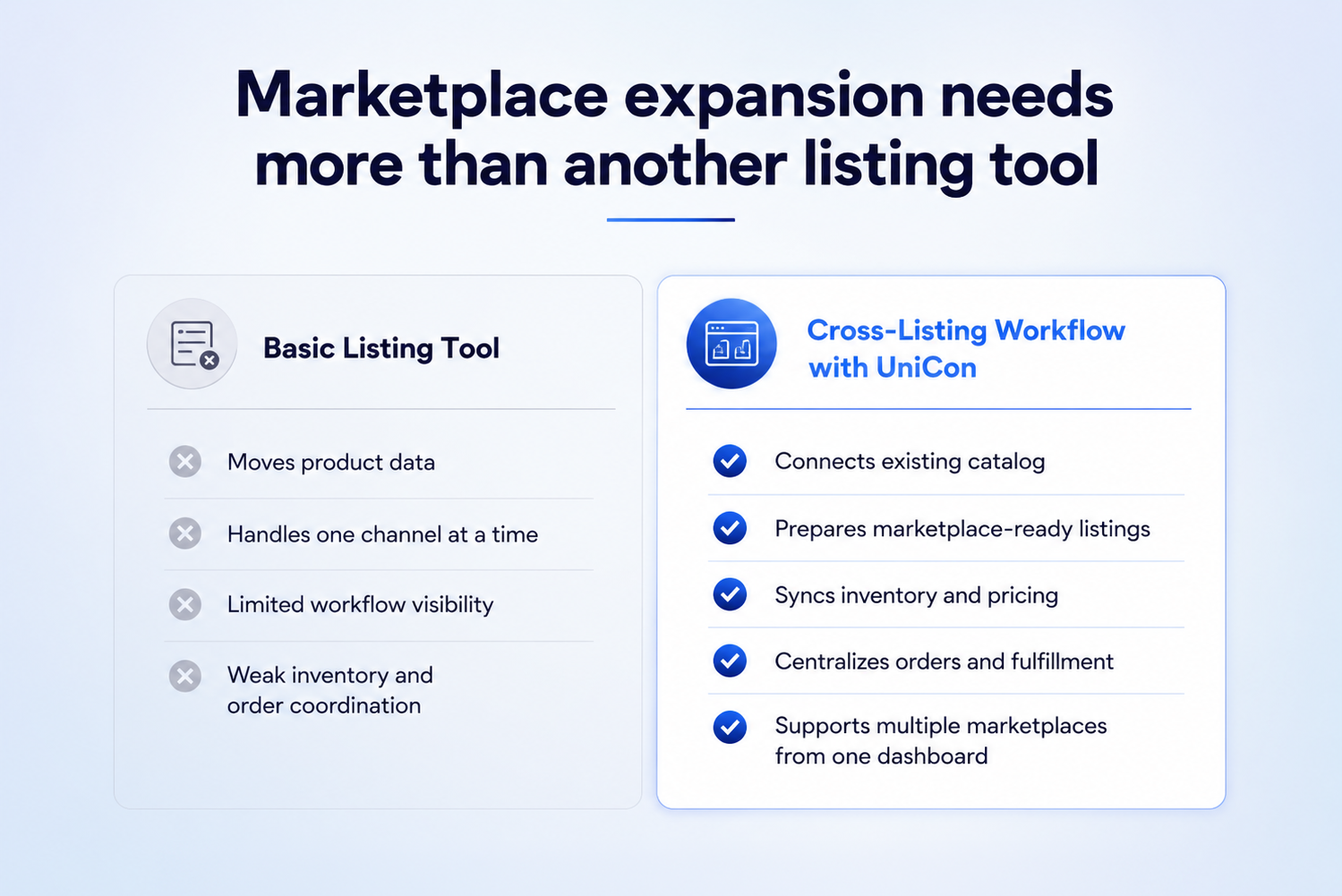
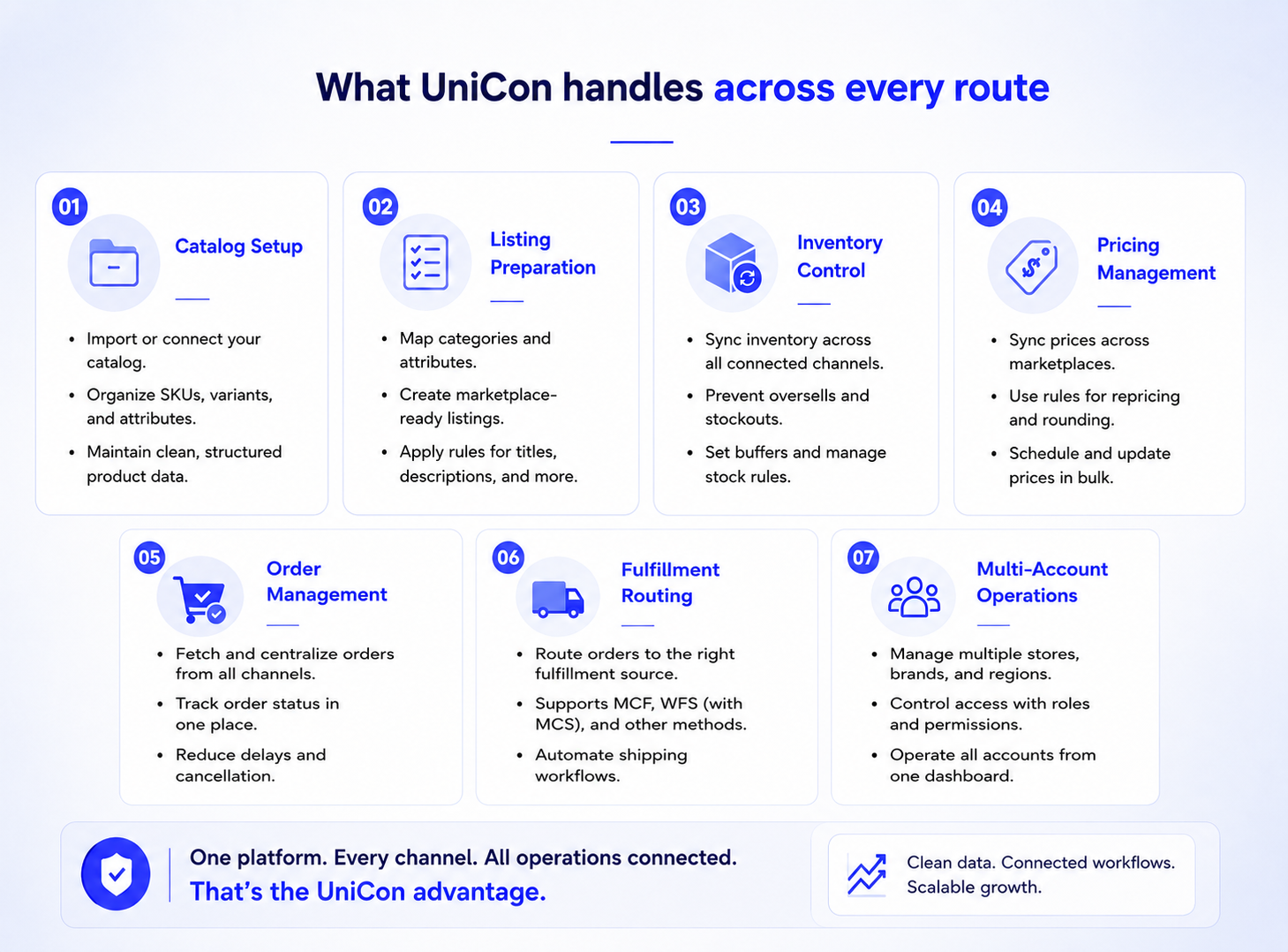
A listing tool can move product data from one place to another. A cross-listing app has to manage the full expansion workflow:
For sellers expanding from Shopify, Amazon, or Walmart, the goal is not to start again. The goal is to take the catalog that already works and prepare it for the next marketplace without rebuilding the same work every time. Unlike single-marketplace connectors that handle one channel at a time, UniCon brings catalog, listing, inventory, pricing, orders, and fulfillment into one workflow across every marketplace your buyers shop.
Cross-listing sounds simple until the operational details start showing up. The work is manageable when the workflow is built for it. It becomes expensive when each channel becomes a separate process.
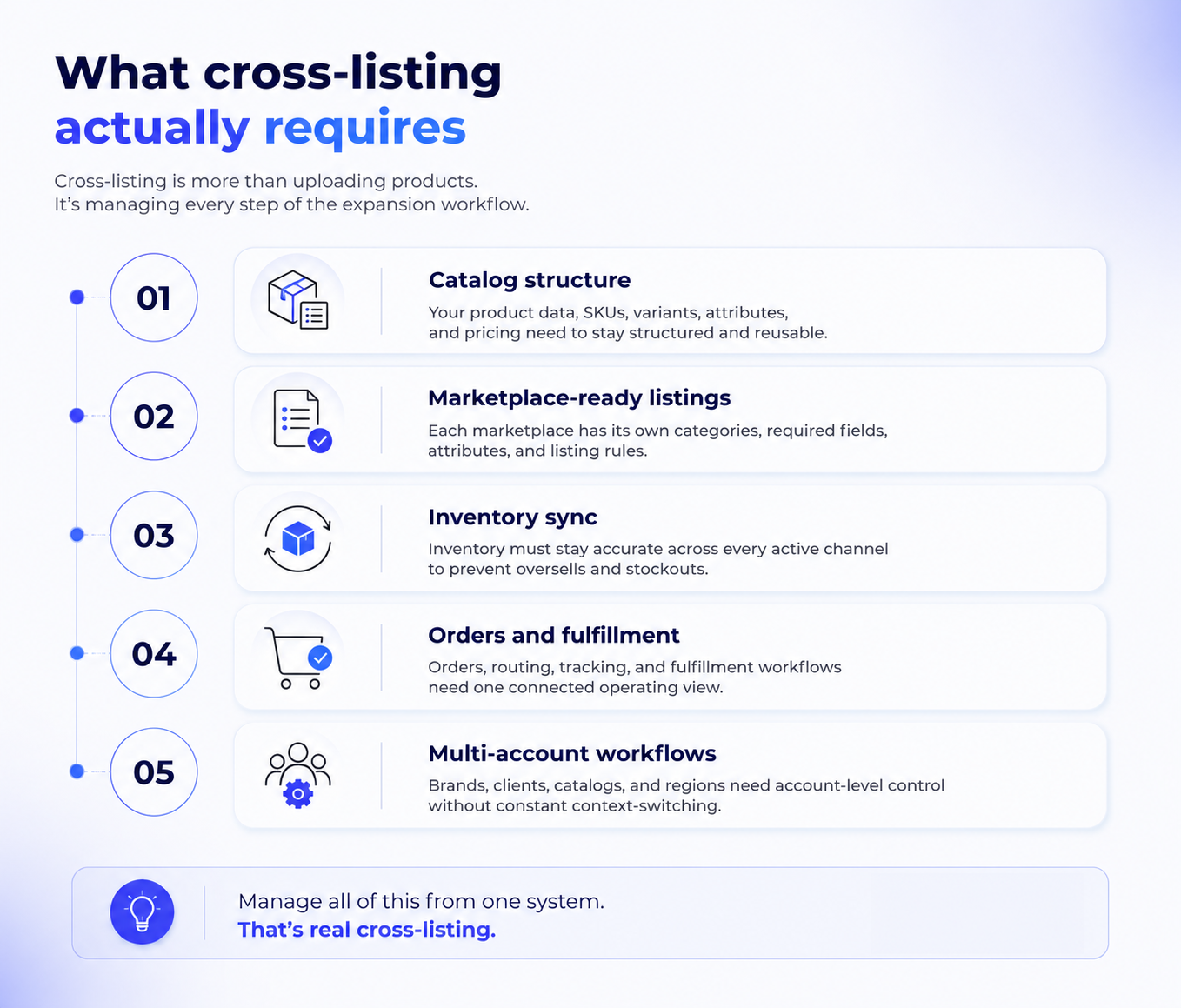
Your catalog is not just product content. It includes SKUs, variants, titles, descriptions, images, attributes, pricing, and inventory logic.
That structure has to travel well. Amazon, Walmart, TikTok Shop, Temu, SHEIN, and eBay all read product data differently. Each marketplace has its own category structure, required fields, and listing rules. If your product data has to be rebuilt manually for every channel, expansion slows before listings even go live.
UniCon uses shared SKU structure, templates, custom lists, and bulk updates so sellers can prepare product data once and use it across more marketplaces.
Marketplace-ready listings need more than a product title, image, and price.
Each channel has required fields, attribute rules, category logic, and listing conditions. If these details are missed, listings may get rejected or delayed before buyers ever see them.
UniCon maps categories and attributes by marketplace. It also supports required-field validation before submission, so sellers can catch listing issues earlier.
Unlike free Shopify-native connectors that may work for basic channel setup, UniCon is built for sellers who need deeper control over variants, category-specific attributes, listing rules, and sync behavior.
Once the same SKU sells across multiple marketplaces, inventory cannot sit in disconnected systems.
A sale on one channel should update available stock across connected channels. Without that, sellers risk oversells, stockouts, cancellations, and account health issues.
UniCon syncs inventory across connected marketplaces and gives sellers one place to manage stock movement as channels grow.
More marketplaces mean more orders, tracking updates, fulfillment rules, and carrier decisions.
Sellers may use Amazon MCF, Walmart MCS, self-fulfillment, or a mixed setup. The work becomes harder when every marketplace has to be checked separately.
UniCon centralizes order visibility, routing, fulfillment workflows, carrier assignment, and tracking updates from one dashboard.
Agencies, aggregators, enterprise sellers, and multi-brand operators face a larger version of the same challenge.
They may manage multiple seller accounts, catalogs, brands, clients, or regions. That work needs account-level control without constant context-switching.
UniCon supports multi-account and multi-marketplace workflows from day one.
UniCon is built for sellers who already have a working catalog and want to expand without repeating the same setup work channel by channel.
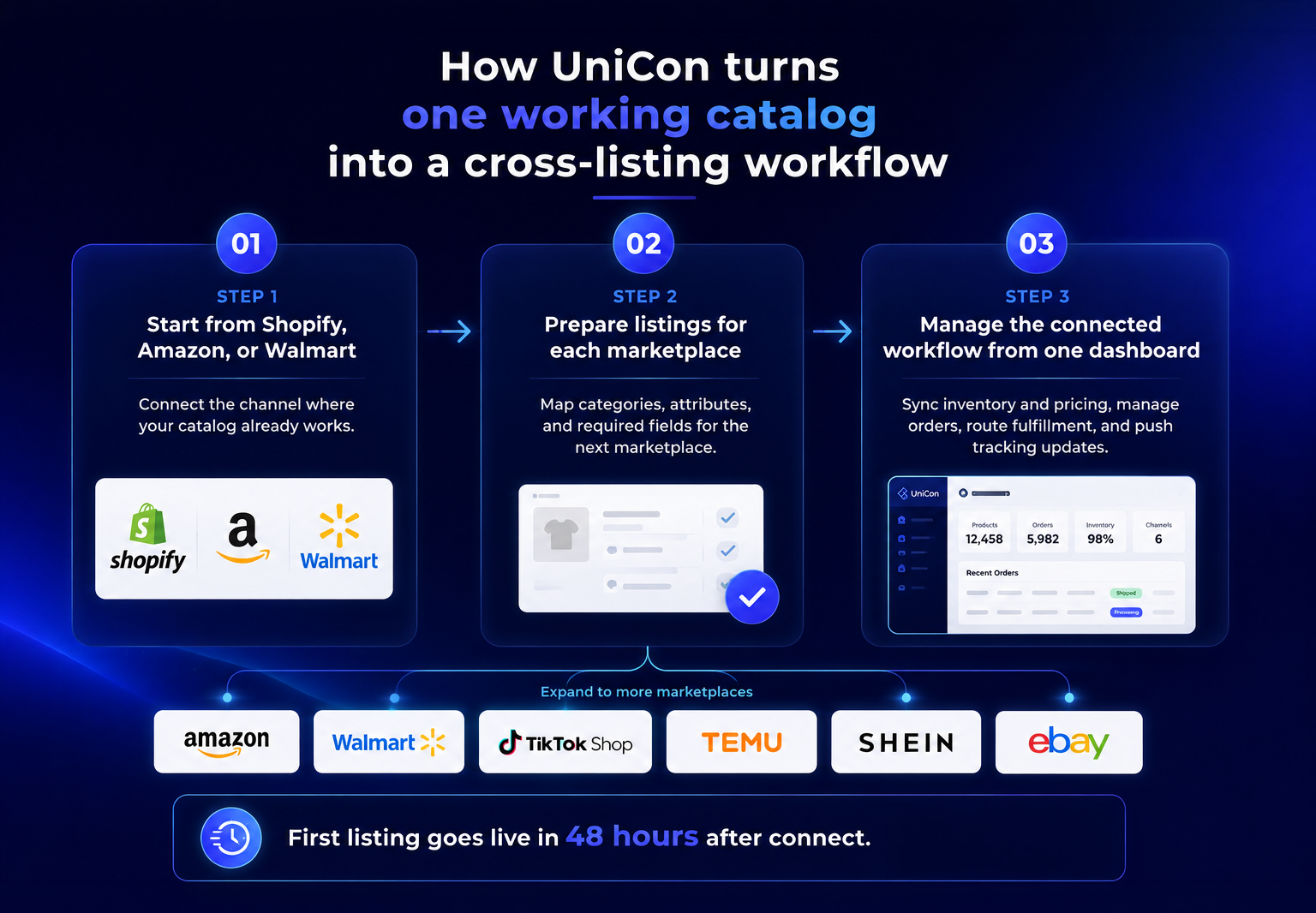
The workflow is straightforward: connect your starting channel, prepare listings for the next marketplace, and manage the connected operations from one dashboard.
Connect the channel where your catalog already works.
UniCon brings in product data, listings, inventory, and pricing from Shopify, Amazon, or Walmart. That existing setup becomes the starting point for expansion.
From there, sellers can expand into Amazon, Walmart, TikTok Shop, Temu, SHEIN, and eBay.
UniCon maps your catalog to the category, attribute, and required-field rules of the next marketplace.
This helps sellers prepare listings for Amazon, Walmart, TikTok Shop, Temu, SHEIN, or eBay before submission.
After listings go live, UniCon keeps daily marketplace operations connected.
Sellers can sync inventory and pricing, view orders, route fulfillment, assign carriers, and push tracking updates from one dashboard.
First listing goes live in 48 hours after connect.
Use this route matrix to identify where your catalog can go next.
This is where UniCon’s value compounds.
A seller does not need one process for Amazon, another for Walmart, another for TikTok Shop, and another for eBay. The same catalog can move through one cross-listing workflow, with marketplace-specific rules handled inside the platform.
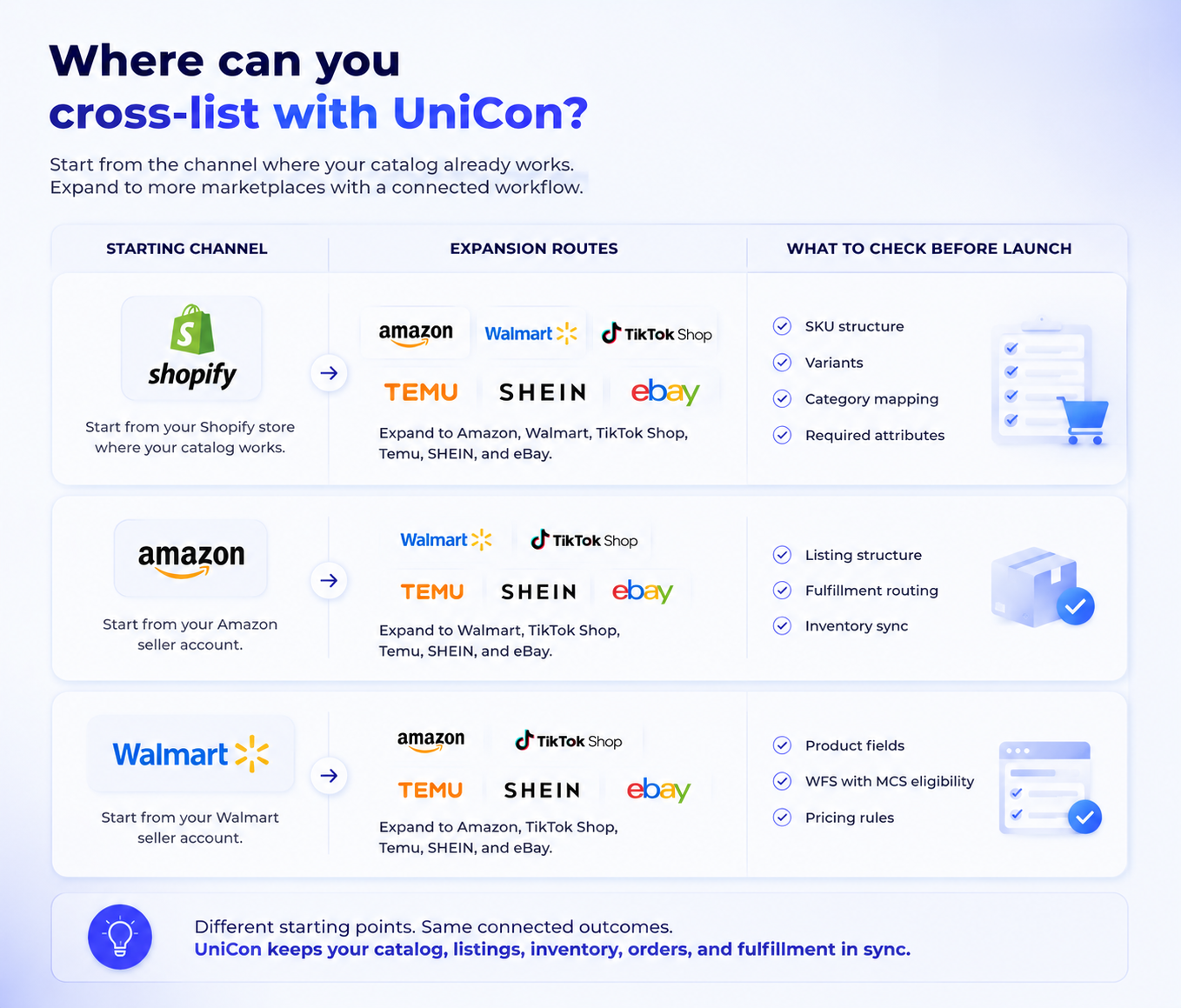
Every expansion route has different details, but the seller jobs stay the same.
Unlike PIM-first platforms that focus mainly on product data, UniCon connects product data with the marketplace operations that happen after listings go live.
Before you connect the next marketplace, run this quick check.
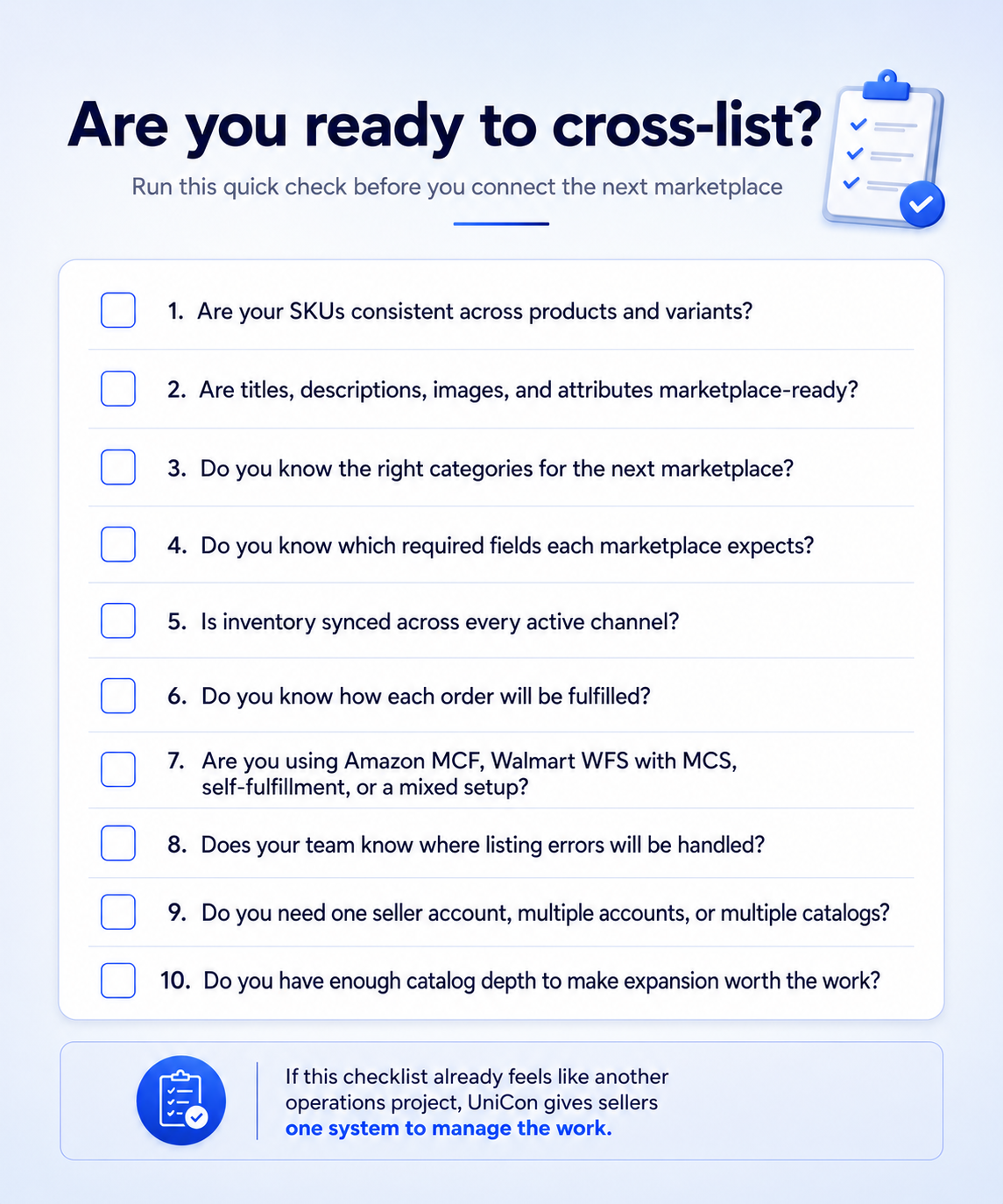
If this checklist feels like another weekly operations project, UniCon gives sellers one system to manage the work.
UniCon is built for sellers with a working catalog, clear channel targets, and a team that needs expansion to move faster.
You sell on Shopify, Amazon, or Walmart and want to add 1 or 2 more marketplaces. You have a working catalog, but no full marketplace operations team.
UniCon helps you prepare listings, sync inventory, and manage orders from one dashboard.
Recommended plan: Starter or Growth.
You already sell on 1 or 2 channels and are preparing for 3 to 5 more. Your team manages listings, pricing, inventory, and orders across more than one system.
UniCon centralizes those workflows so the next marketplace does not create another disconnected process.
Recommended plan: Growth or Performance.
You manage seller accounts across brands, clients, catalogs, or regions. You need multi-account workflows without switching between separate systems all day.
UniCon gives those workflows one central operating layer.
Recommended plan: Performance or Enterprise.
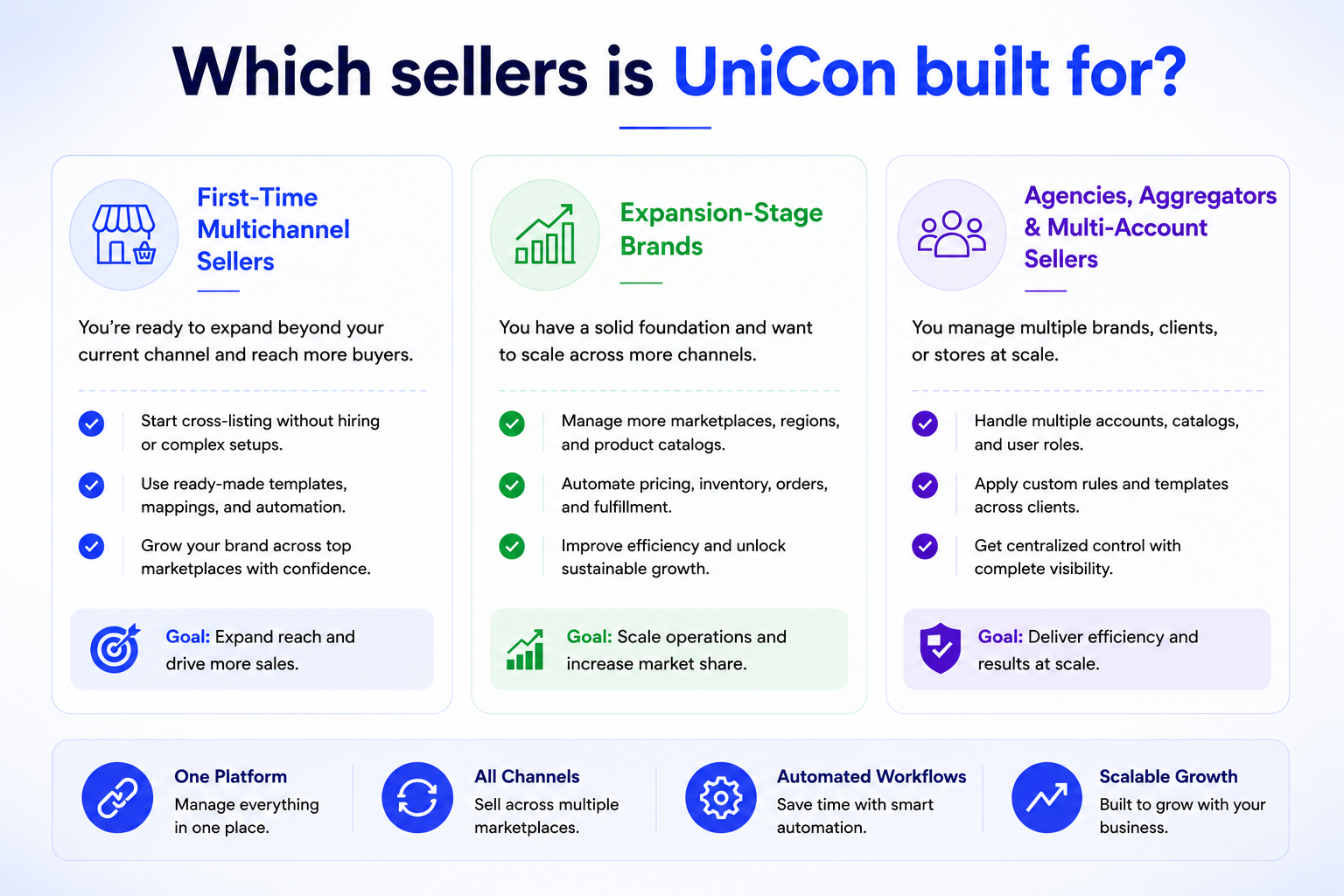
Choose the plan based on catalog size, order volume, marketplace coverage, and account complexity.
| Plan | Price | Best for | What to know |
|---|---|---|---|
| Starter | $99/mo | First-time multichannel sellers | Up to 1,000 active listings, 1,000 orders per month, 1 Amazon account, and any 2 of TikTok Shop, SHEIN, or Temu. |
| Growth | $499/mo | Sellers expanding across 3 marketplaces | Up to 5,000 active listings, 5,000 orders per month, up to 2 Amazon accounts, and all 3 marketplaces. |
| Performance | $999/mo | Established multichannel sellers | Up to 10,000 active listings, 10,000 orders per month, up to 5 Amazon accounts, faster sync, and named operations support. |
| Enterprise | Custom | Agencies, aggregators, and multi-brand sellers | Unlimited listings and orders, unlimited Amazon accounts, all marketplaces, custom routing, and senior growth support. |
All plans include a 14-day trial:
Cross-listing means listing one product catalog across multiple marketplaces while keeping product data, inventory, pricing, orders, and fulfillment connected. UniCon lets sellers cross-list from Shopify, Amazon, or Walmart into supported marketplaces from one dashboard.
Yes. UniCon lets Shopify sellers use their existing catalog as the starting point and prepare it for Amazon, Walmart, TikTok Shop, Temu, SHEIN, and eBay.
Yes. Amazon sellers can use UniCon to extend their existing catalog into TikTok Shop, subject to seller eligibility, category approval, and marketplace requirements.
Yes. Walmart can be used as a starting channel in UniCon. Sellers can prepare catalog data for TikTok Shop, Temu, SHEIN, and other supported marketplaces.
Yes. UniCon uses your existing Amazon catalog structure as the starting point, then maps product data to Walmart’s category and attribute requirements.
No. UniCon uses your Shopify, Amazon, or Walmart catalog as the starting point, then maps marketplace requirements against your existing product data and listing structure.
UniCon syncs inventory across connected channels, centralizes order visibility, routes orders, and pushes tracking updates back to the right marketplace.
Yes. UniCon supports Amazon MCF and Walmart MCS workflows for eligible sellers and listings.
For sellers with an established catalog, UniCon’s onboarding commitment is 48 hours from connect to first live listing.
Yes. UniCon supports multi-account workflows. Performance supports up to 5 Amazon accounts, while Enterprise supports unlimited Amazon accounts.
You do not need to rebuild your catalog every time you add a marketplace. You need one way to carry product data, listings, inventory, pricing, orders, and fulfillment into the channels where your buyers already shop.
UniCon gives sellers one centralized system to cross-list from Shopify, Amazon, or Walmart into Amazon, Walmart, TikTok Shop, Temu, SHEIN, and eBay.
First listing live in 48 hours. Every plan includes a 14-day trial.

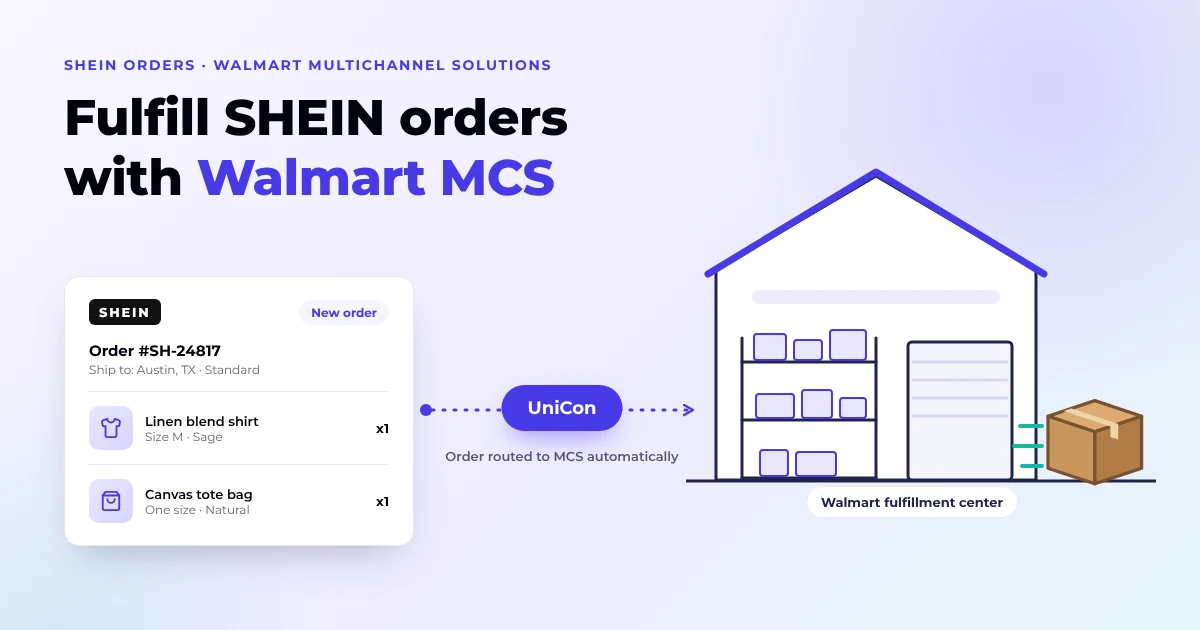
Reading Time: 13 minutes Q4 is a bad time to discover that expanding to another…
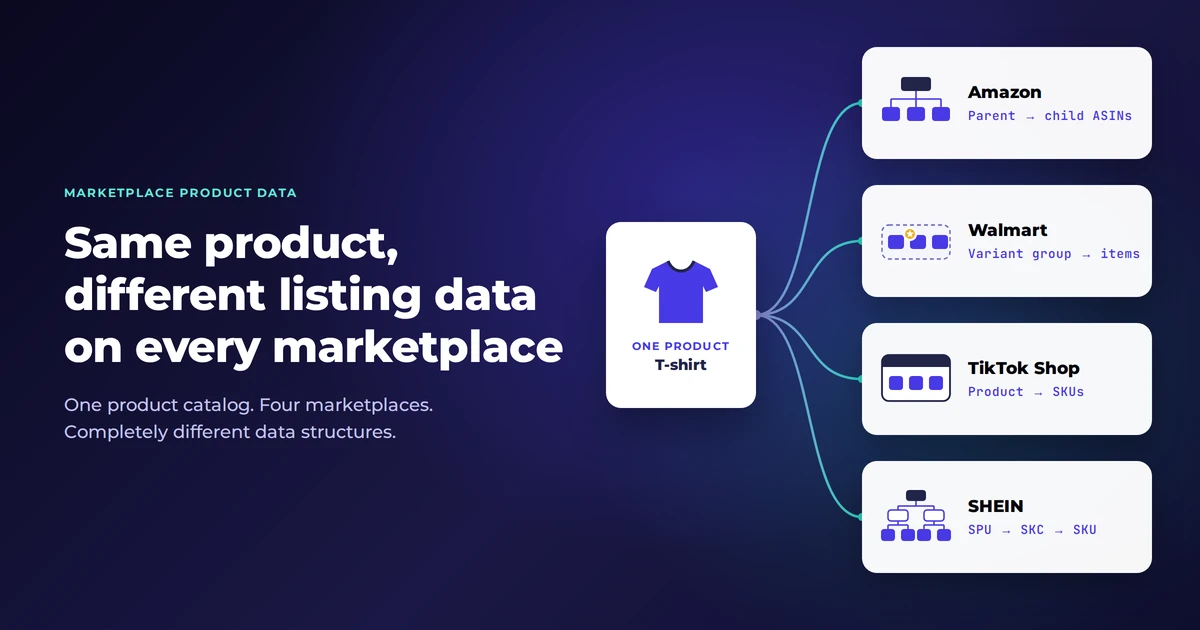
Reading Time: 11 minutes The same physical product can require a different listing structure on…
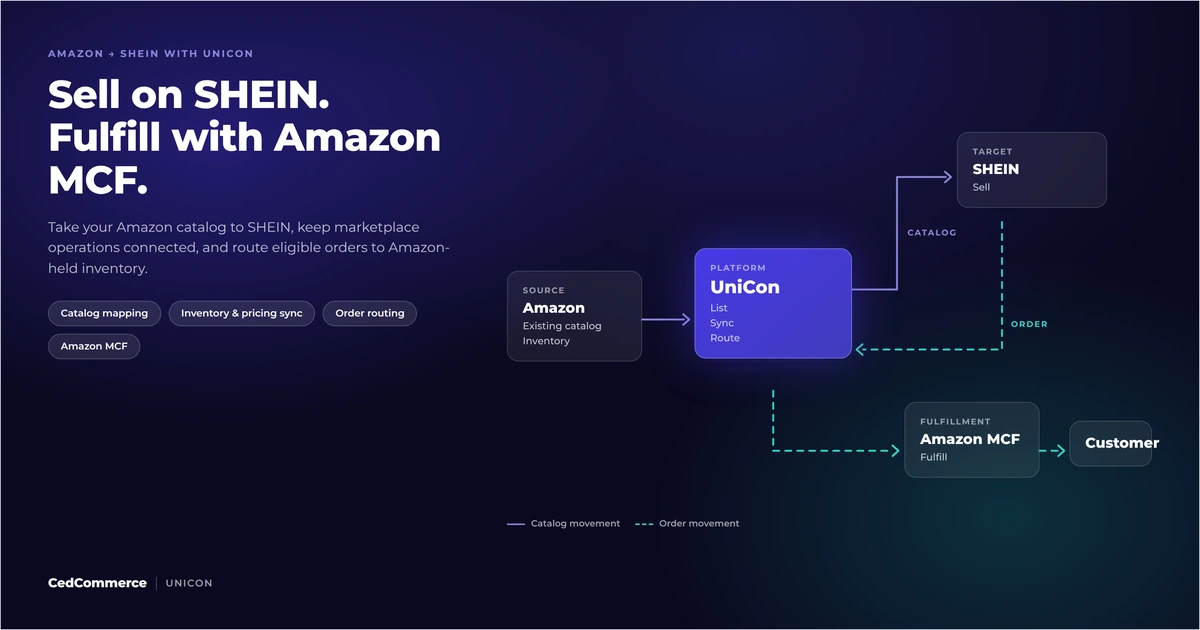
Reading Time: 12 minutes Looking to sell on SHEIN from Amazon? You could potentially tap…
Reading Time: 10 minutes SHEIN Marketplace sellers work with two underlying fulfillment models: seller-managed fulfillment,…

Reading Time: 1 minuteIntro Summary France has passed a revised fast-fashion law aimed at regulating…
Reading Time: 3 minutes SHEIN has launched a new product safety and quality compliance training…

Reading Time: 3 minutes Major global marketplaces, including Temu, SHEIN, eBay, Amazon, and AliExpress, are…
Reading Time: 11 minutes What if reaching hundreds of millions of Amazon customers didn’t mean…
Reading Time: 16 minutes If you consider Black Friday/Cyber Monday as Amazon, Walmart, or DTC…

Reading Time: 2 minutes Amazon has expanded Multi-Channel Fulfilment (MCF) and the broader Supply Chain…