
How to Fulfill SHEIN Orders with Walmart MCS: Eligibility, Setup and Limits
Reading Time: 13 minutes Q4 is a bad time to discover that expanding to another…
Running short of time? Get PDF of the blog in your mail.
SHEIN Marketplace sellers work with two underlying fulfillment models: seller-managed fulfillment, where you arrange delivery and report tracking, and marketplace-integrated logistics, where SHEIN’s connected network moves the parcel. In practice, those two models show up as five recognizable routes: self-fulfillment, an independent 3PL, SHEIN Online Order (SHEIN’s integrated logistics), Amazon Multi-Channel Fulfillment, and SHEIN Fulfillment Service (SFS).
Every route is not viable for every seller. Availability depends on your market, your seller mode, the individual order, and what your account is eligible for. A route a UK seller sees may not appear for a US account, and SHEIN has reportedly narrowed self-fulfillment for some US merchants in 2026. Read the five routes below as the full map, then confirm which ones your own Seller Hub actually offers.
However, every route answers to the same clock. SHEIN expects orders delivered within 7 business days of purchase, and integration partner documentation reports a $1 fee on each order that misses the window. Your route decides whether that deadline is routine or expensive. This guide compares the five routes on eligibility, control, setup, sync behavior, and returns, so you can pick before the late fees pick for you.
2026 Update: self-fulfillment eligibility is changing for some US sellers. SHEIN has reportedly begun restricting self-fulfillment for a portion of US merchant accounts.
Affected sellers may lose the ability to export customer addresses and batch-upload tracking, and may be required to route orders through SHEIN’s Online Order workflow instead. This is not a confirmed marketplace-wide ban, and it does not appear to affect every seller or every market.
Treat your own Seller Hub as the source of truth: check which fulfillment modes are returned for your account and your orders before you plan inventory or sign a 3PL contract around a route you assume is available.
At the marketplace level, SHEIN runs two fulfillment tracks. Its developer platform documents one track for orders fulfilled through SHEIN integrated logistics, where you book delivery and print SHEIN-issued labels, and another for orders you fulfill on your own, where you upload tracking numbers and update order status yourself.
In day-to-day selling, those two tracks split into five working routes. The availability column matters as much as the cost column, because a route you cannot access is not a choice.
| Route | Who ships the order | Setup effort | Returns | Availability | Best fit |
|---|---|---|---|---|---|
| Self-fulfillment, where eligible | You, from your own location | Low | You handle | Account and market dependent; restricted for some US accounts | Low volume, testing SHEIN |
| Independent 3PL / Seller Fulfillment, where eligible | Your contracted 3PL | Medium: carrier authorization, warehouse mapping | Your 3PL | Available where Seller Fulfillment is enabled | Multichannel sellers with a 3PL in place |
| SHEIN Online Order / integrated logistics | You or your warehouse, on SHEIN-issued labels via connected carriers | Low | You handle; inventory stays with you | Available when assigned to eligible orders | Sellers without their own carrier accounts |
| Amazon MCF for SHEIN | Amazon’s fulfillment network | Medium: dedicated warehouse plus SKU mapping | Amazon network | US Marketplace only; approved route | Sellers with inventory already in FBA |
| SHEIN Fulfillment Service (SFS) | SHEIN, from its own warehouses | High: invite, inbound shipping | SHEIN handles | Invite or programme eligibility required | High-volume, SHEIN-first sellers |
Note: Availability differs by region and seller mode, self-operated or semi-managed, so confirm each route inside your own Seller Hub before you commit inventory to it.
Potentially. Self-fulfillment remains supported for eligible sellers and orders, but it may not be available to every merchant account.
Where it is enabled, you pack and ship from your own location, then upload the tracking number so SHEIN can update the order status. SHEIN’s developer platform documents this seller-fulfilled track directly, including tracking uploads and status updates.
The change in 2026 is that some US merchants have reportedly had these capabilities restricted, losing address export and batch tracking upload and being moved toward Online Order. Because eligibility now varies by account, treat the response in your Seller Hub or the API as the final signal.
The trade-off, where you can use it, is exposure. You own the entire 7-business-day window, so a slow week at your warehouse turns into per-order late fees and a weaker performance record.
Choose this route if you are validating demand on SHEIN with a small catalog and your account still offers it. Avoid it if daily order volume already strains your team on other channels.
You may be able to use your existing 3PL when Seller Fulfillment is enabled for your account. Some US merchants, however, are reportedly being moved to SHEIN’s Online Order workflow, where fulfillment runs through logistics providers connected to the platform rather than any 3PL you choose.
Where independent 3PL fulfillment is available, seller-shipped orders can run through your contracted 3PL or carrier accounts, with connector support documented for major carriers including USPS, UPS, and DHL.
Preferred status means deeper integration for that partner; on its own, it does not tell you whether your account can still use an outside 3PL. SHEIN’s US onboarding material continues to mention third-party warehouses, but that broad guidance now has to be read against the account-level restrictions reported for some US merchants.
Warehouse mapping errors can route orders to a location that does not hold the stock. And shipment data that fails to reach SHEIN’s back end leaves orders stuck as unshipped even after the parcel is moving; integration guides document exactly this “not exported yet” stall.
An integration layer between your store, your 3PL, and SHEIN closes most of those gaps, because orders, tracking numbers, and warehouse assignments move automatically instead of by spreadsheet.
SHEIN Online Order, sometimes referred to as SHEIN Shipping, is SHEIN’s integrated logistics route. Instead of buying a label from your own carrier, you fulfill the order through SHEIN’s connected logistics network.
The workflow runs in sequence:
Choice is not guaranteed at step four. In some cases, SHEIN designates the logistics channel; in others, Online Order exposes eligible cooperating channels for you to pick from. This route needs no carrier account of your own, which is what makes it the fallback when self-fulfillment or an independent 3PL is not available.
One point prevents confusion: Online Order is not the same as SFS. Online Order does not necessarily mean SHEIN stores your inventory. Your merchandise can stay in your own warehouse while a SHEIN-connected provider collects and delivers the parcel. SFS, covered below, is different: your stock is inbounded to a fulfillment facility that stores, picks, packs, and ships it.
Choose this route if you want SHEIN to handle the carrier relationship and tracking upload, or if it is the route your account is assigned. Avoid building your economics around it if you hold negotiated carrier or 3PL rates that beat SHEIN’s connected pricing, since you give up that margin on every order.
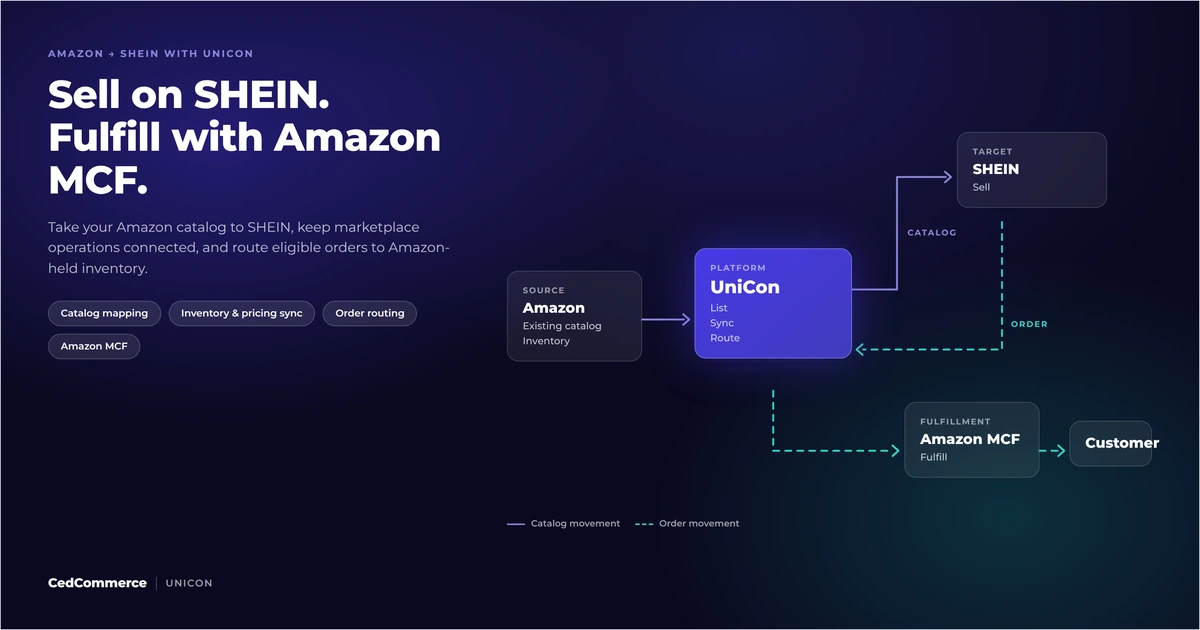
Amazon MCF for SHEIN lets SHEIN US Marketplace sellers fulfill SHEIN orders from inventory stored in Amazon’s fulfillment network. Amazon announced the integration at its Accelerate conference on September 18, 2025.
What makes MCF different from an arbitrary outside 3PL is that it is a recognized, approved route.
Setup has two requirements worth planning for.
Choose this route if your stock already lives in FBA and you want one inventory pool across Amazon, SHEIN, and your store. Avoid it if your SKUs do not match across catalogs, because mapping errors ship the wrong product.
For the full picture of Amazon’s multichannel push, read our breakdown of how Amazon MCF now powers SHEIN, Walmart, and Shopify orders.
In SFS, you send inventory in bulk to SHEIN’s warehouses, and SHEIN handles storage, picking, packing, shipping, and returns from there.
It is the strongest route on SLA risk, since delivery timelines and returns sit with SHEIN rather than with you. Third-party logistics guides report US facilities near major distribution hubs, which puts stock closer to buyers.
Access is the catch. SFS is invite-based and aimed at high-volume sellers. Revenue thresholds circulating in logistics blogs do not appear in official SHEIN documentation, so treat any figure you read as unconfirmed and ask your SHEIN account manager directly.
Choose this route if SHEIN drives most of your revenue and you qualify. Avoid it if you need that inventory available to other channels, because stock committed to SFS warehouses cannot fulfill your other orders.
Match the route to your eligibility first, then to your volume, inventory location, and multichannel plans.
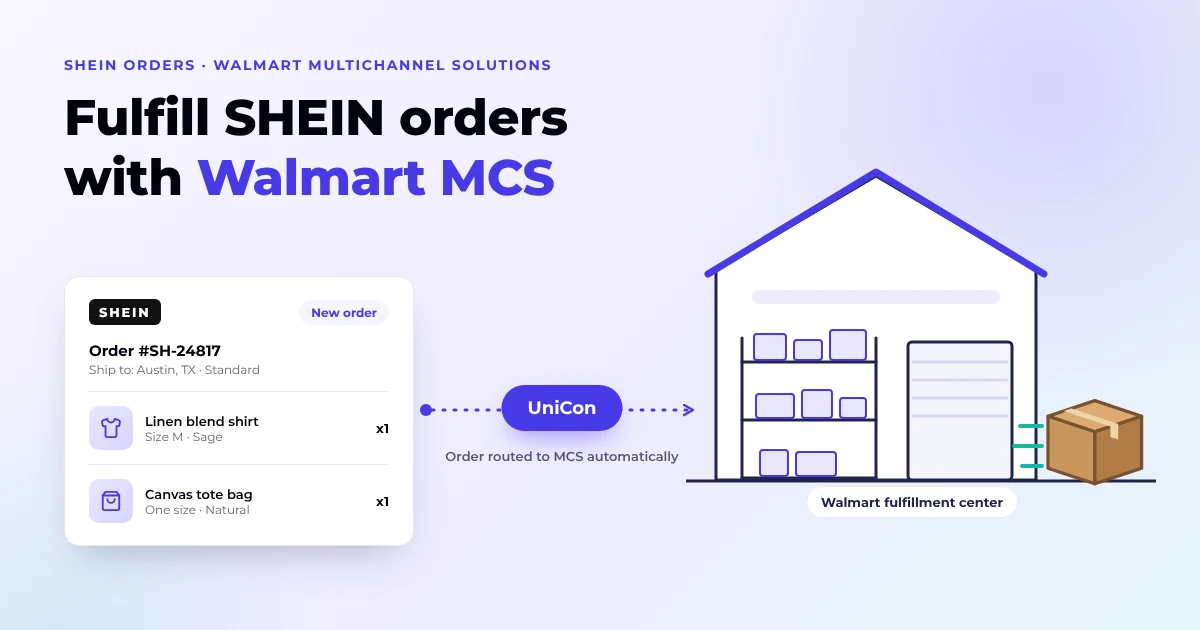
Whichever route you land on, the orders still have to move between SHEIN and your store without manual entry. That coordination layer is where most day-to-day fulfillment errors can be prevented.
A connector between your online store and SHEIN keeps four things aligned:
Those are the coordination points that hold no matter which fulfillment route an order takes.
You may use an independent 3PL when Seller Fulfillment is enabled for your SHEIN account and order. Some US merchants, however, have reportedly been moved to SHEIN’s Online Order workflow, which uses platform-connected logistics providers. Confirm what your own Seller Hub returns before you rely on an outside 3PL.
SHEIN Online Order, also called SHEIN Shipping, is SHEIN’s integrated logistics route. The order is fulfilled through SHEIN’s connected logistics network: you confirm parcel details, SHEIN generates the logistics order and shipping label, and tracking flows back automatically. Your inventory can remain in your own warehouse, which is what separates it from SFS.
Not universally. Independent 3PL and self-fulfillment remain available for eligible accounts, but SHEIN has reportedly restricted self-fulfillment for some US merchants and routed them to Online Order in 2026. Whether third-party logistics is available depends on your market, seller mode, and account, so treat your Seller Hub as the authority.
Yes. The MCF for SHEIN app connects your SHEIN Seller Hub to Amazon Seller Central so SHEIN orders ship from your FBA inventory. App users are automatically exempt from SHEIN’s shipping-label requirement, while manual MCF users must request the exemption. You will need a dedicated warehouse entry in Seller Hub and matching SKUs across both catalogs.
SHEIN expects delivery within 7 business days of purchase, and integration partner documentation reports a $1 fee per order that misses the window. Repeated misses also drag down seller performance, which affects visibility on the platform.

Reading Time: 13 minutes Q4 is a bad time to discover that expanding to another…
Reading Time: 11 minutes The same physical product can require a different listing structure on…
Reading Time: 12 minutes Looking to sell on SHEIN from Amazon? You could potentially tap…

Reading Time: 1 minuteIntro Summary France has passed a revised fast-fashion law aimed at regulating…
Reading Time: 3 minutes SHEIN has launched a new product safety and quality compliance training…

Reading Time: 3 minutes Major global marketplaces, including Temu, SHEIN, eBay, Amazon, and AliExpress, are…
Reading Time: 9 minutes Your buyers are not shopping in one place anymore. They search…
Reading Time: 11 minutes What if reaching hundreds of millions of Amazon customers didn’t mean…
Reading Time: 16 minutes If you consider Black Friday/Cyber Monday as Amazon, Walmart, or DTC…
Reading Time: 2 minutes Amazon has expanded Multi-Channel Fulfilment (MCF) and the broader Supply Chain…