Ultimate BFCM Prep Guide for Marketplace Sellers 2026
October 6, 2026
Please correct the marked field(s) below.
Running short of time? Get PDF of the blog in your mail.
Thank You! The PDF is headed straight to your inbox
Reading Time: 19 minutes
Black Friday–Cyber Monday used to be a weekend. In 2026, it is a much longer pressure test for your product pages, inventory, fulfillment, pricing, and ad math. Black Friday falls on November 27, 2026, followed by Cyber Monday on November 30, 2026.
The opportunity is also getting bigger. Adobe Analytics forecasts U.S. online holiday spending of $275.1 billion between November 1 and December 31, 2026, up 6.7% year over year. Cyber Week alone is expected to generate $47.5 billion, including $12.9 billion on Black Friday and $15.1 billion on Cyber Monday.
That does not mean every promotion will be profitable. Adobe expects discounts to reach as high as 30% during Cyber Week, making margin discipline, inventory availability, and channel execution especially important. Mobile is also expected to account for 57.4% of total U.S. online holiday spending, so sellers need listings and checkout experiences that work just as well on a phone as they do on desktop.
So: this guide skips vague BFCM advice and gives you marketplace-by-marketplace playbooks, practical checklists, and a deadline-first preparation plan for protecting margins, avoiding stockouts, and scaling the promotions that actually work.
Amazon — Black Friday–Cyber Monday Seller Strategy
Amazon’s peak season is no longer about preparing for one shopping weekend. October deal events, early holiday promotions, Black Friday Week, and Cyber Monday increasingly blend into one extended demand period.
For 2026, Amazon’s peak-season guidance lists November 18 as the deal-submission deadline for Black Friday Week in the referenced marketplace. Requirements, inventory cutoffs, and eligible promotion types can differ by marketplace, so your Seller Central account should remain the final source for your region.
Win when traffic peaks: get deal candidates ready early, maintain enough sellable inventory, protect your minimum contribution margin, and make sure advertising does not outrun stock availability.
What to Prioritize (Fast)
Lock your deal candidates: shortlist products with enough margin, inventory depth, conversion history, and review strength to justify aggressive promotion.
Confirm your 2026 deal deadlines: Amazon’s current peak-season guidance lists November 18 for Black Friday Week deal submissions in the referenced marketplace. Check your own Deals dashboard for marketplace-specific eligibility and dates.
Protect FBA availability: work backward from Amazon’s inbound receiving guidance instead of treating your carrier delivery date as the date inventory becomes sellable.
Set margin stop-losses: include referral fees, fulfillment costs, deal fees, discounts, returns, and expected advertising costs before increasing spend.
Refresh high-traffic product pages: update images, video, titles, bullets, Brand Store content, and A+ Content where eligible.
Prepare operational coverage: plan additional support and inventory monitoring across Thanksgiving week through Cyber Monday.
Tactical Playbook
Deal Strategy
Choose a focused set of hero SKUs based on contribution margin, conversion rate, demand, reviews, and available inventory.
Use broader discounts or coupons for catalog coverage and higher-visibility deal formats only where the economics and stock depth support them.
Do not treat a promotion as successful purely because revenue increases. Measure incremental profit after discounts, fees, and media spend.
PPC & Creative
Separate discovery campaigns from high-intent exact-match and branded campaigns so budgets can be adjusted independently during BFCM.
Test creative before the highest-cost advertising days. Move proven assets into Sponsored Brands, Sponsored Display, and other eligible formats.
Track ACoS, ROAS, conversion rate, budget utilization, and inventory together. A high-performing ad can still become a problem if it accelerates a stockout.
Inventory & Fulfillment
Confirm FBA inventory, inbound status, receiving timelines, and any available overflow options from the Seller Central dashboard.
Use safety-stock thresholds so promotions can be reduced or paused before a hero SKU reaches an operationally risky inventory level.
Coordinate contingency inventory and fulfillment with your 3PL or merchant-fulfilled operation if your business uses both FBA and external inventory.
Pricing & Margin
Build a per-SKU margin model that includes the promotional price, marketplace fees, fulfillment, advertising, expected returns, and other peak-season costs.
Define a hard minimum contribution margin before campaigns launch rather than deciding how low you can go after competitors cut prices.
CX & Operations
Prepare reusable responses for delayed shipments, cancellations, out-of-stock questions, replacements, and refunds.
Increase customer-service coverage around Black Friday weekend and Cyber Monday based on your normal peak-ticket volume and response-time targets.
Checklist (Action Items You Can Tick Off Today)
Select your priority deal SKUs and review eligibility in the Deals dashboard.
Check 2026 FBA inbound and receiving dates in Seller Central.
Build or refresh a margin calculator for every promoted SKU.
Refresh A+ Content, images, video, and other conversion-critical assets on hero listings.
Create advertising guardrails for spend, ACoS/ROAS, and available inventory.
Run a 48–72 hour operational stress test covering fulfillment, customer support, cancellations, and returns.
Live-Day KPIs (Track These Closely)
Featured Offer/Buy Box performance on promoted SKUs
Revenue, units sold, and sell-through by SKU
Conversion rate and sessions
ACoS/ROAS against predefined profitability limits
Available inventory and days of supply
Inbound inventory status
Cancellation and late-shipment risk
Customer-support backlog and response time
Example Micro-Play
Use an early promotion on a hero SKU to test demand before committing your largest BFCM advertising budget. If conversion improves while contribution margin and inventory remain healthy, increase spend during Black Friday Week. If profitability deteriorates, keep the traffic but reduce promotional depth or paid-media intensity.
Sell efficiently this season with the CedCommerce Amazon Channel—built to help sellers synchronize marketplace operations from Shopify.
Already have your BFCM catalog working on Amazon?
Use UniCon to prepare existing products for additional marketplaces instead of rebuilding the same catalog channel by channel. Keep inventory and orders connected as BFCM demand moves between marketplaces.
Etsy’s BFCM opportunity is different from Amazon’s. Discovery, gifting intent, product originality, personalization, shipping confidence, and strong listing presentation matter as much as the size of the discount.
Rather than relying on old holiday-search statistics, use Etsy’s current seller resources. Etsy’s Holiday Merchandising Guide provides current seasonal planning guidance, while Marketplace Insights uses Etsy marketplace data to help sellers identify search and demand trends.
Own more of the buyer journey: make listings easy to discover, give shoppers clear delivery expectations, and make gifting decisions simple.
What to Prioritize (Fast)
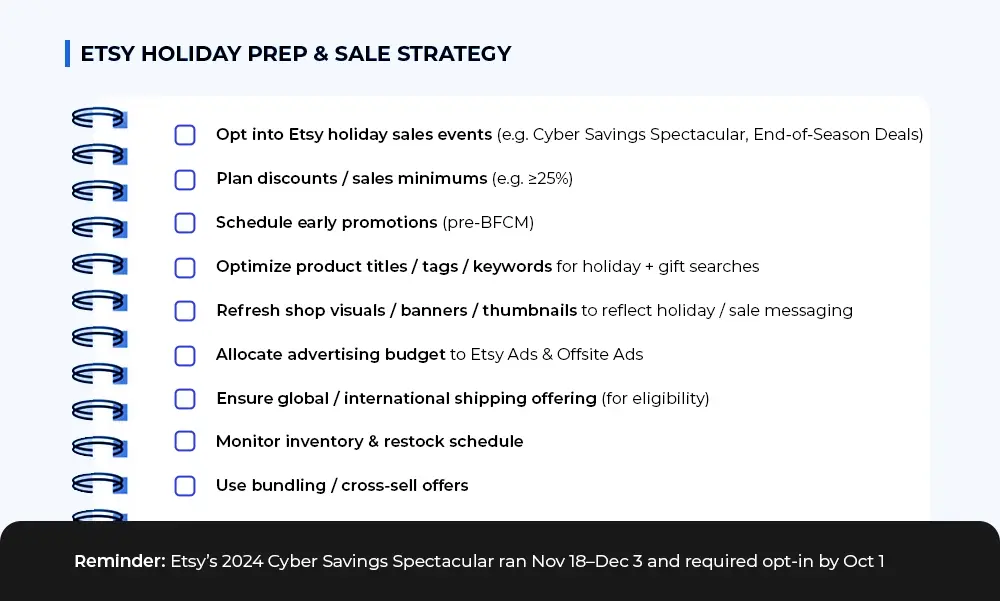
Plan BFCM promotions: use Etsy’s Sales & Discounts tools and choose a discount level your margins can sustain. Check Shop Manager for any event-specific requirements before enrolling.
Refresh titles and tags: use current Etsy Marketplace Insights and Seller Handbook guidance instead of recycling last year’s holiday keywords.
Prepare inventory buffers: build ready-to-ship stock for proven sellers where your production model allows it.
Publish realistic processing times: update dispatch estimates and holiday order cutoffs as carrier deadlines get closer.
Prepare message templates: cover personalization, delivery estimates, address changes, late parcels, and returns.
Organize packaging: prepare gift-ready packaging, inserts, and packing materials before order volume rises.
Run a capacity test: estimate how many orders you can realistically make, pack, and dispatch each day without quality slipping.
Tactical Playbook
Promo & SEO
Choose priority listings based on margin room, recent demand, giftability, reviews, production capacity, and available stock.
Use bundles, free-shipping thresholds, or product-specific discounts where they produce better economics than a blanket shopwide discount.
Use current Etsy search data and Marketplace Insights to identify relevant holiday queries and buyer language.
Make the first listing image immediately communicate the product, while additional images can clarify gift readiness, personalization, sizing, packaging, or dispatch information.
Keep shipping cutoffs accurate as the season progresses.
Paid Traffic (Etsy Ads & Offsite Ads)
Prioritize products with enough inventory and margin to absorb paid acquisition costs.
Test listing photography and keyword changes before the main BFCM window where possible.
Shift budgets toward listings generating profitable orders and reduce spend where traffic is not converting.
Inventory & Fulfillment
Complete as much ready-to-ship production as practical before peak demand.
Monitor component-level inventory as well as finished products if you sell handmade or personalized items.
Review carrier deadlines and create a fallback plan for expedited or alternative shipping where economically viable.
Pricing & Margin
Model Etsy fees, promotion depth, shipping subsidies, packaging, advertising, and production costs for each featured item.
Use a minimum margin floor so a high-volume BFCM listing does not become a high-volume loss.
Bundle complementary items when doing so increases order value without creating excessive production complexity.
Customer Experience & Support
Prepare saved replies for common holiday questions.
Be explicit about personalization requirements, production time, dispatch dates, and delivery expectations.
Update shop announcements and listing information quickly if fulfillment capacity changes.
Checklist (Action Items You Can Tick Off Today)
Select your holiday hero listings.
Review current Etsy seasonal search trends and update titles and tags where relevant.
Build realistic inventory or production capacity for peak demand.
Finalize your first version of the holiday order-cutoff calendar.
Calculate the margin impact of every planned discount.
Refresh listing images and gifting information.
Test packing and dispatch capacity at higher-than-normal volume.
Prepare customer-support templates before demand spikes.
Live-Day KPIs
Visits and search visibility on priority listings
Conversion rate by listing
Orders and revenue per promoted product
Ad spend relative to attributable revenue and margin
Available inventory or remaining production capacity
Open buyer messages and response time
Late-dispatch risk
Example Micro-Play
Take one giftable bestseller and test a bundle, gift-wrap upgrade, or limited holiday variation before the BFCM peak. Compare conversion and average order value with the standard offer, then scale the version that improves profit without adding unsustainable production complexity.
eBay’s holiday opportunity spans fixed-price products, auctions, collectibles, refurbished goods, fashion, electronics, parts, and other categories with very different buyer behavior. Instead of relying on old traffic-percentage claims, focus on what eBay currently recommends for peak periods: complete listings, accurate item specifics, competitive total delivered cost, reliable shipping, and targeted promotion.
eBay’s current peak-season seller guidance emphasizes accurate shipping information, expedited options where appropriate, and reliable handling. Its Seasonal Playbook also highlights product research, item specifics, mobile optimization, Promoted Listings, offers, and Seller Hub.
What to Prioritize (Fast)
Identify your strongest BFCM products using demand, margin, inventory, recent conversion, and eBay Product Research data.
Complete item specifics so listings have the structured product information eBay uses throughout discovery.
Audit mobile presentation because buyers need to understand condition, compatibility, price, shipping, and returns without digging through long descriptions.
Review shipping promises and handling times before peak traffic begins.
Use sale events and advertising selectively rather than discounting an entire catalog without regard to margin or demand.
Tactical Playbook
Listings & Promotions
Improve titles, item specifics, images, pricing, shipping, and condition information on priority products.
Use eBay sale events for relevant categories or groups of products rather than automatically discounting everything in your store.
Use offers to interested buyers where the resulting price remains profitable.
For auction-suited inventory, schedule auctions around periods when your own historical data shows the strongest buyer activity instead of relying on generic “best hour” claims.
Advertising
Use Promoted Listings with the strategy that fits your economics: the general strategy uses cost-per-sale pricing, while priority campaigns use cost-per-click pricing.
eBay added short-video support for eligible Promoted Listings priority campaigns in 2026, giving sellers another format for demonstrating products.
Review suggested ad rates and bids, but set your own limits based on contribution margin rather than treating marketplace recommendations as automatic targets.
Inventory, Shipping & Fulfillment
Verify actual inventory before promotions go live.
Use accurate package weights, dimensions, carrier services, and handling times so delivery estimates remain dependable.
Where appropriate, provide faster buyer-paid shipping options for late-season shoppers.
Monitor carrier disruptions and shipping updates throughout the event.
Pricing & Margin
Calculate marketplace fees, shipping, promoted-listing costs, markdowns, and return risk for every major BFCM promotion.
Avoid bidding wars and discounts that increase GMV while reducing or eliminating contribution margin.
CX & Operations
Prepare templated replies for compatibility questions, delivery estimates, returns, cancellations, and item condition.
Protect handling-time performance by matching advertised availability to what your warehouse can actually dispatch.
Checklist (Action Items)
Select priority SKUs or listings using eBay Product Research and your own performance data.
Complete missing item specifics on high-demand listings.
Review listings on mobile.
Create targeted sale events for relevant inventory.
Configure Promoted Listings only within predefined profitability limits.
Confirm stock, shipping settings, and warehouse capacity.
Live-Day KPIs
Impressions and click-through rate
Conversion and sell-through by listing
Promoted Listings spend and attributable sales
Average selling price and contribution margin
Inventory remaining
Handling-time and shipping performance
Buyer-message and case volume
Example Micro-Play
Create a targeted BFCM sale event around one product category instead of applying the same markdown to your full store. Pair it with Promoted Listings and offers to interested buyers, then compare incremental profit with similar non-promoted inventory.
Sell tactically this season with the CedCommerce eBay Integration—built to help Shopify sellers manage eBay listings and orders.
Walmart — Black Friday Cyber Monday Seller Strategy
Walmart Marketplace continues to make fulfillment, competitive pricing, seller performance, and promotional readiness central to holiday success. The latest completed BFCM period provides useful context: Walmart said its 2025 Black Friday and Cyber Monday event was the fastest and highest-performing event in Marketplace history and produced a single-day conversion record.
Walmart also reported that Walmart Fulfillment Services (WFS) surpassed the GMV it generated during its first full year of operation in a single Black Friday. Around that holiday period, WFS was shipping 80% more two-day items and 250% more next-day items than the prior year.
What to Prioritize (Fast)
Protect seller performance: review the metrics that influence eligibility, visibility, and your Pro Seller status before peak traffic arrives.
Use WFS strategically: prioritize SKUs where faster fulfillment and stronger delivery promises can improve the customer experience.
Confirm 2026 event dates in Seller Center: Walmart’s public holiday guidance and seller-account deadlines can change by event, program, and fulfillment route.
Review pricing competitiveness: factor referral fees, fulfillment, discounts, media, and returns into the price buyers see during BFCM.
Prepare promotional inventory: a strong deal without enough sellable inventory can lose momentum at the exact point demand peaks.
Tactical Playbook
Use Walmart’s deals and promotions tools for eligible products rather than making manual last-minute price changes across your catalog.
Prioritize SKUs with enough margin and inventory depth to remain competitive throughout the event.
Use Walmart Connect advertising to support products that already have competitive pricing, strong content, and adequate stock.
Monitor sell-through, pricing, inventory, advertising, and fulfillment performance throughout BFCM rather than managing each metric independently.
Inventory & Fulfillment
Review current WFS inventory and inbound receiving status well before Black Friday.
Prioritize replenishment for products with proven demand and promotional plans.
Keep safety stock where appropriate so one promotion does not create stockouts across other channels.
If using seller fulfillment, validate your handling capacity and carrier collection schedule for the holiday weekend.
Pricing & Advertising
Use Walmart’s pricing and repricing tools where appropriate, but keep your own minimum-margin guardrails.
Separate advertising budgets for hero products from general catalog campaigns so high-intent products do not run out of budget prematurely.
Do not continue funding ads for products that are about to stock out or no longer have a competitive offer.
Customer Experience
Prepare customer-service responses for delivery delays, cancellations, returns, and replacements.
Keep shipping and return information accurate as seasonal policies and carrier timelines change.
Confirm BFCM promotions and event eligibility in Seller Center.
Check pricing competitiveness and margin by SKU.
Prepare Walmart Connect campaigns for priority products.
Set low-inventory and performance alerts before traffic peaks.
Live-Day KPIs
Conversion rate
Units and GMV by promoted SKU
Buy Box/offer competitiveness
WFS and seller-fulfilled inventory availability
Ad ROAS
Cancellation and late-shipment risk
Customer-support volume
Key Data Insight
The most useful lesson from Walmart Marketplace’s 2025 BFCM results is operational rather than promotional: fulfillment speed and product availability increasingly sit at the center of peak-season performance. WFS set major volume and delivery-speed milestones during the latest completed holiday event, so 2026 sellers should treat inventory placement as part of their marketing plan, not as a separate warehouse task.
Example Micro-Play
Choose a proven WFS SKU with healthy stock, competitive pricing, and room for promotion. Run a focused deal supported by Walmart Connect, then track sales velocity against remaining inventory. Increase spend only while the offer remains profitable and enough inventory exists to sustain the event.
Sell securely this season with the CedCommerce Walmart Integration—built to help sellers manage listings, inventory, and orders across Walmart operations.
TikTok Shop — Black Friday Cyber Monday Seller Strategy
TikTok Shop has become a major BFCM commerce channel rather than simply a social platform that sends traffic elsewhere. During its latest completed BFCM campaign, TikTok reported more than $500 million in sales across the four-day 2025 shopping period. TikTok also said nearly 50% more U.S. shoppers purchased through TikTok Shop during the 2025 BFCM campaign period than during the prior year’s campaign.
That makes creator content, LIVE shopping, product availability, competitive offers, and operational readiness important parts of the same BFCM plan.
What to Prioritize (Fast)
Identify products that work in content: prioritize items that are easy to demonstrate, compare, explain, or transform into a clear creator story.
Use current Shop analytics: validate products through actual clicks, product-page activity, orders, affiliate results, and LIVE performance rather than relying only on broad social trends.
Plan LIVE sessions: TikTok reported record-breaking LIVE Shopping performance during its 2025 BFCM campaign, making LIVE worth testing for products with strong demonstration potential.
Coordinate creators early: secure briefs, samples, content rights, promo codes, commissions, and stock commitments before peak dates.
Connect promotion to fulfillment: do not launch a creator or LIVE push without knowing how a sudden order spike will be fulfilled.
Tactical Playbook
Use shoppable short-form video and LIVE sessions to demonstrate the product rather than repeating a static product-page pitch.
Test multiple hooks, creators, and formats before committing the largest BFCM budgets.
Use limited-time offers and bundles when they improve conversion without damaging contribution margin.
Coordinate paid traffic, creator activity, affiliate promotion, and LIVE inventory so several demand sources do not unexpectedly exhaust the same SKU.
CX & Operations
Maintain fast order handling and accurate tracking during creator- and LIVE-driven demand spikes.
Prepare customer-service coverage for product questions, delivery issues, cancellations, and returns.
Keep inventory synchronized if the same product is also being sold on Amazon, Walmart, Shopify, or another marketplace.
Checklist (Action Items)
Select products with strong content and demonstration potential.
Confirm BFCM campaign eligibility and current requirements in TikTok Shop Seller Center.
Schedule creator and LIVE activity before peak dates.
Prepare promotional inventory and fulfillment capacity.
Build several creative variations instead of relying on one viral concept.
Run a pre-BFCM creator and LIVE test around one hero product. Compare creator conversion, LIVE conversion, promotional margin, and fulfillment capacity. Put the strongest product-and-creative combination into your main Black Friday campaign rather than spreading budget evenly across the catalog.
Key Data Insight
TikTok Shop’s official 2025 results show why the channel deserves a dedicated BFCM operating plan: sales exceeded $500 million over four days, while the number of U.S. shoppers purchasing during the campaign rose nearly 50% year over year. Discovery can create demand quickly, so inventory and order operations need to move at the same speed as content.
Sell strategically this season with the CedCommerce TikTok Shop Connector—built to help sellers manage TikTok Shop operations from Shopify.
Multichannel Tools & Integration
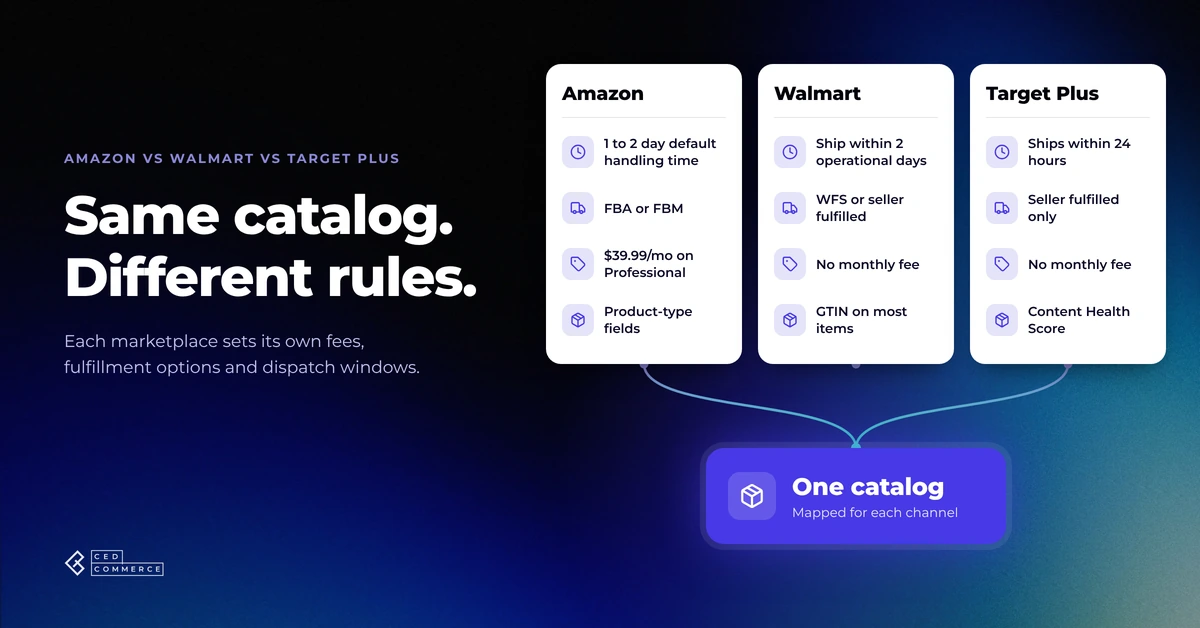
BFCM becomes harder as soon as the same SKU is selling on several marketplaces. A promotion that works on Amazon can drain inventory needed for Walmart. A creator campaign on TikTok Shop can produce an unexpected order spike. A price or stock change that reaches one marketplace but not another can create overselling, cancellations, or wasted advertising.
Multichannel Integration Tactics
Centralize inventory visibility: know how much stock is available to each active marketplace before increasing promotions.
Synchronize product changes: make sure important catalog, inventory, and pricing updates reach connected channels consistently.
Keep orders in one operational view: reduce the need to switch between marketplace dashboards during the busiest days of the year.
Set low-stock thresholds: reduce or pause promotion before a shared SKU oversells.
Plan fulfillment routes in advance: decide which warehouse or fulfillment service handles each channel before orders begin arriving.
Monitor exceptions: surface listing errors, failed updates, inventory mismatches, and fulfillment issues before they become customer-service problems.
Must-Know Insight
During BFCM, automation is most valuable when it removes repetitive operational work without removing seller control. Pricing, promotion depth, marketplace approvals, inventory allocation, and exceptions still need clear business rules. The goal is not simply to automate more—it is to keep product data, inventory, orders, and fulfillment aligned while demand changes quickly.
How CedCommerce UniCon Can Support a Multichannel BFCM Strategy
If your BFCM strategy spans several marketplaces, the operational challenge is often less about finding another channel and more about preparing the same catalog for different marketplace requirements while keeping stock and orders coordinated.
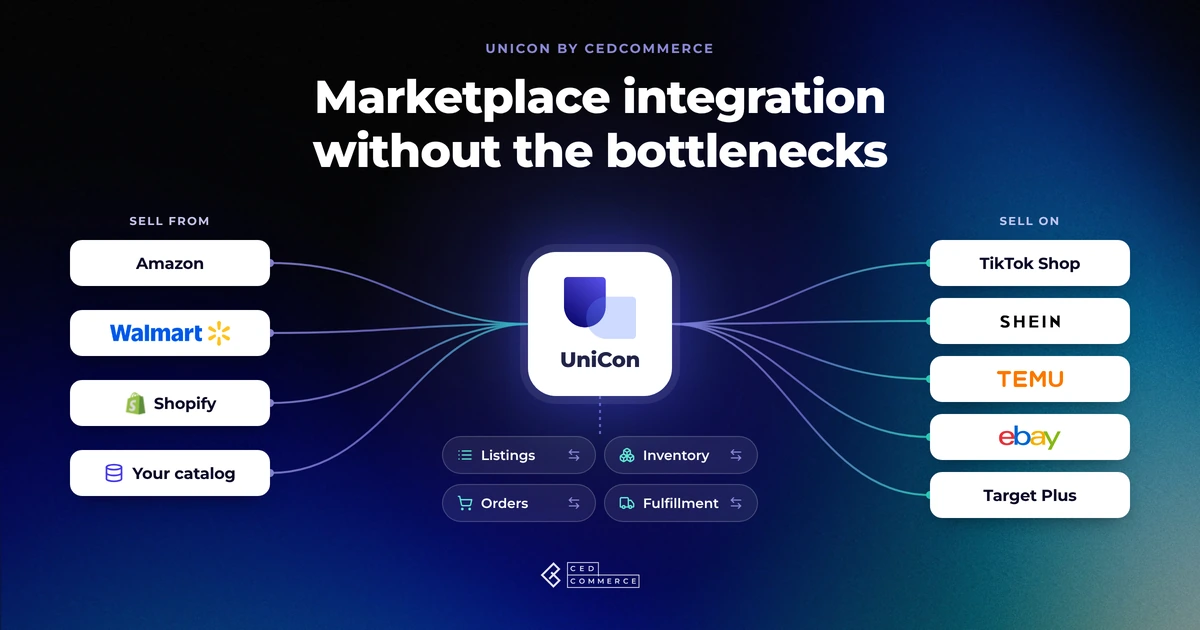
CedCommerce UniCon is designed around that use case. Instead of rebuilding products from scratch for each marketplace, sellers can use an existing connected catalog as the starting point for multichannel expansion.
Where UniCon Fits Into BFCM Operations
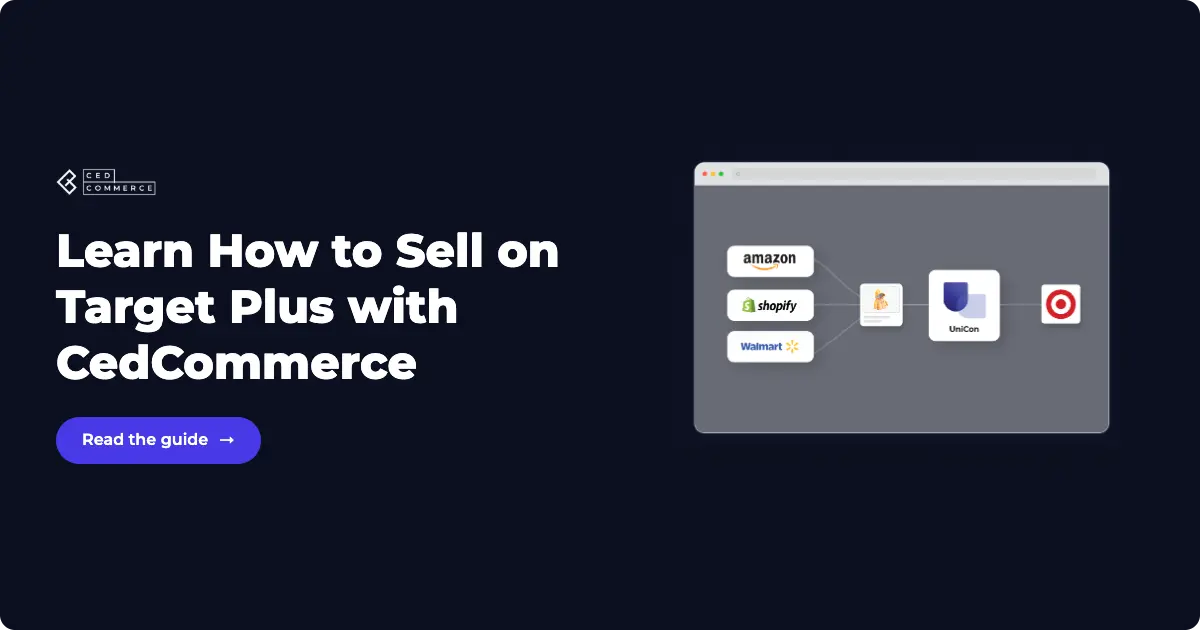
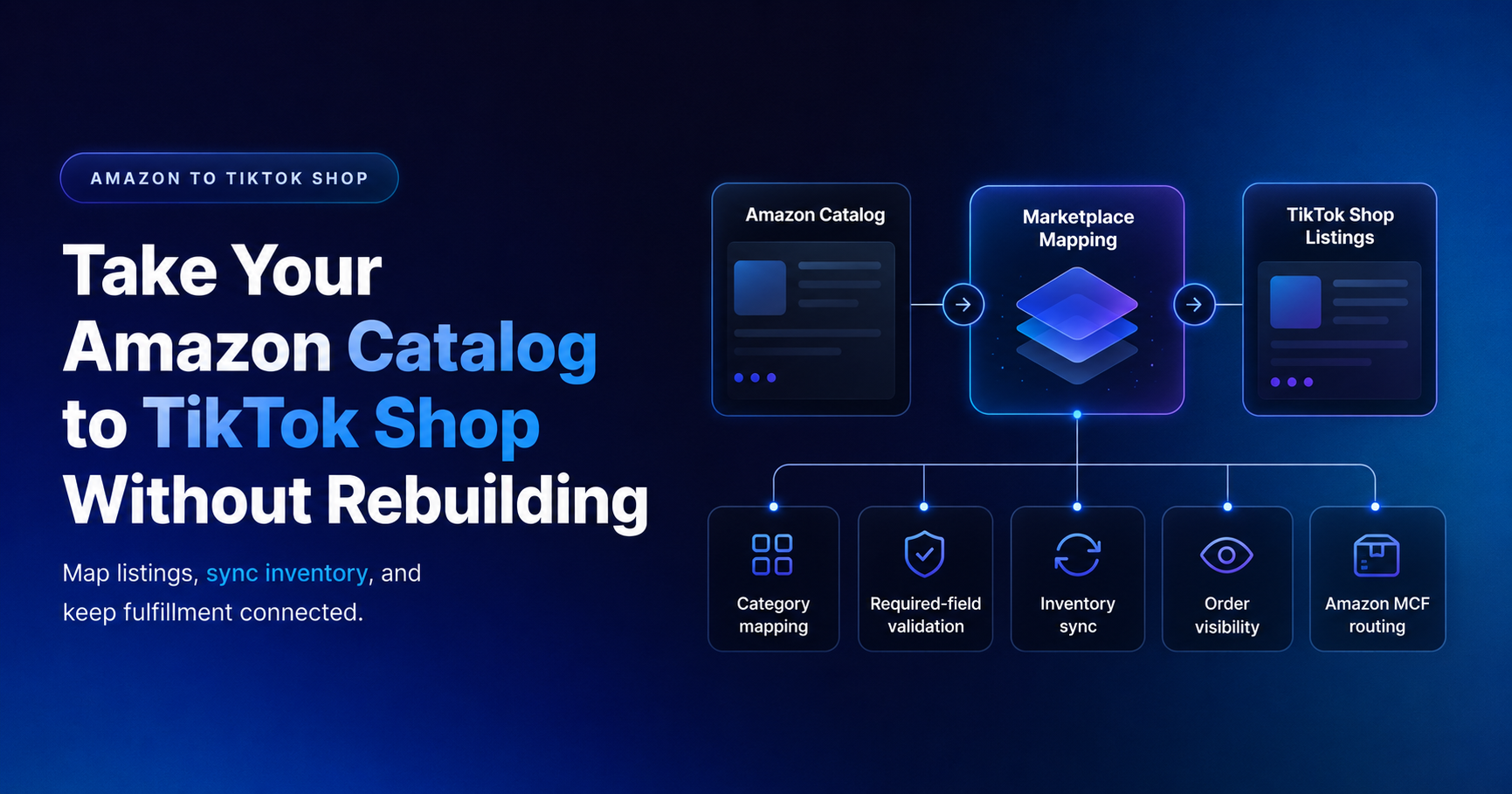
Cross-list existing catalogs: use products that already exist on a connected source such as Amazon, Walmart, or Shopify as the basis for expansion to supported target marketplaces rather than re-entering the same product information manually.
AI-assisted mapping: UniCon uses AI-assisted category and attribute mapping to help match existing product data to the fields required by a target marketplace. Sellers can review mappings before products are published.
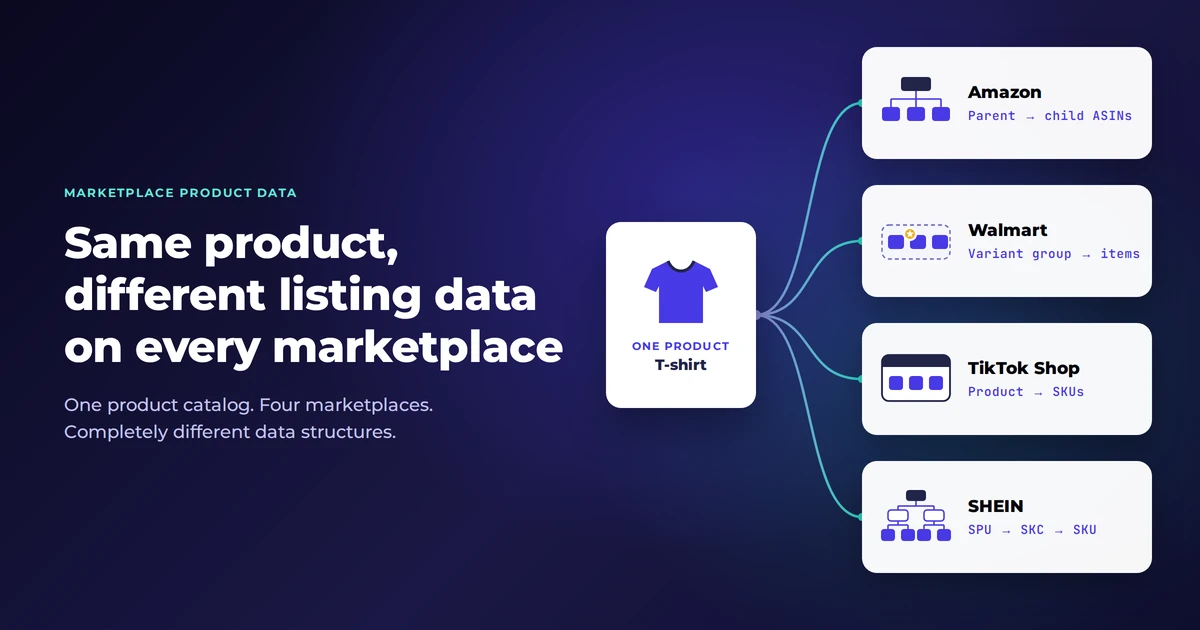
Marketplace-specific listing preparation: product data can be adapted for marketplace-specific requirements rather than assuming one listing structure works everywhere.
Inventory synchronization: connected products can share inventory updates, reducing the risk that a BFCM promotion sells stock already consumed by another marketplace.
Order synchronization: orders from connected channels can be brought into a centralized workflow for easier peak-season operations.
Centralized multichannel management: product linking, channel configuration, inventory, orders, and fulfillment can be managed without treating every marketplace as a completely separate operating system.
Using Existing Fulfillment Inventory Across Channels
UniCon can also connect marketplace expansion with existing fulfillment infrastructure on supported routes.
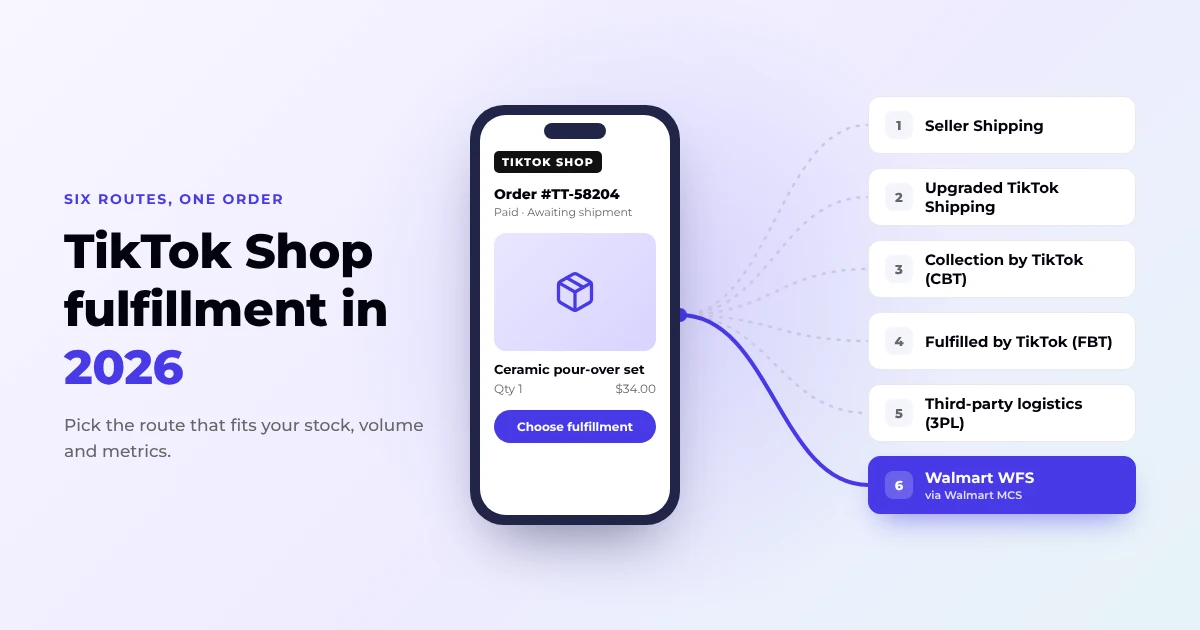
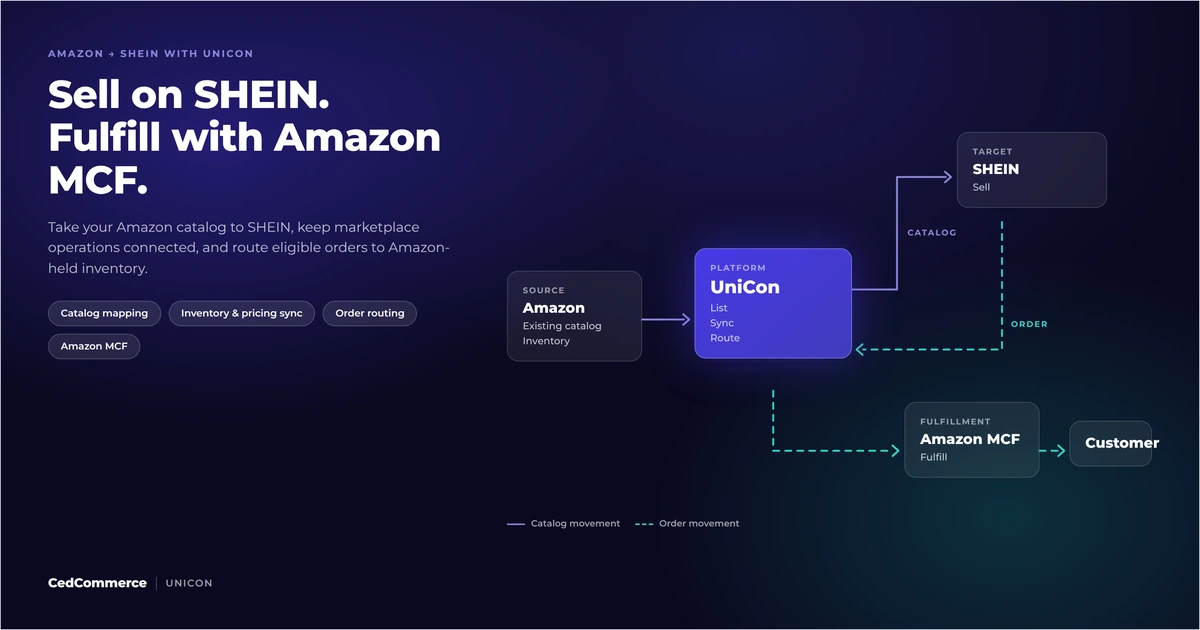
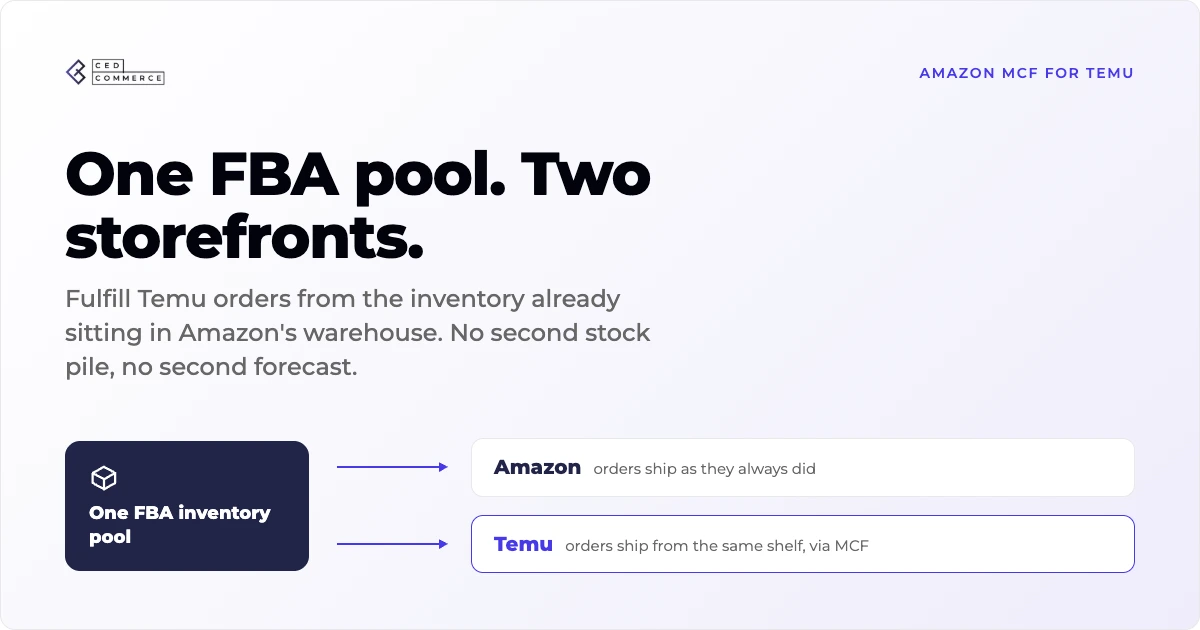
Amazon Multi-Channel Fulfillment (MCF): UniCon’s current Amazon connection supports routing eligible orders from supported external channels through Amazon MCF when the corresponding inventory is available in Amazon’s fulfillment network. UniCon documentation includes MCF workflows for connected channels such as TikTok Shop and Walmart, along with order and tracking synchronization.
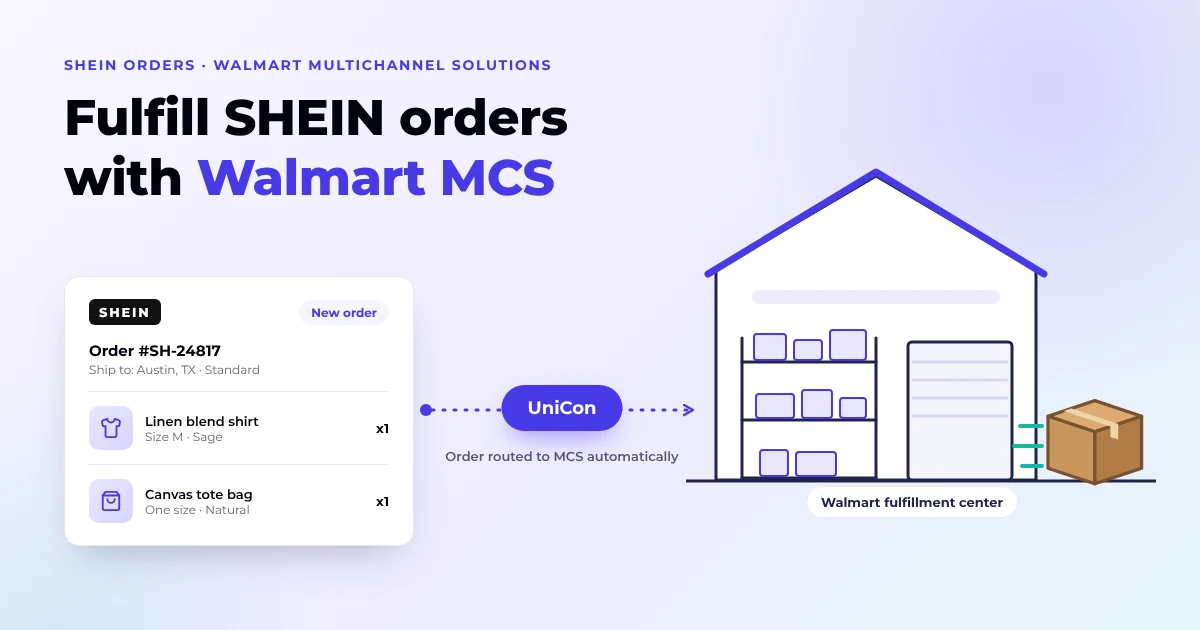
Walmart Multichannel Solutions (MCS): sellers already holding eligible stock in Walmart Fulfillment Services can use supported UniCon routes to fulfill external marketplace orders through Walmart MCS. For example, UniCon currently documents a Walmart-to-SHEIN setup in which eligible SHEIN orders can be routed to Walmart MCS using corresponding WFS inventory.
These capabilities can matter during BFCM because the same inventory pool can potentially support more than one storefront without requiring a separate fulfillment operation for every channel. Eligibility, marketplace restrictions, inventory availability, delivery services, and route support should still be confirmed before relying on MCF or MCS for a peak-season campaign.
For sellers managing BFCM across several marketplaces, the practical value is straightforward: the catalog gets prepared for each channel, inventory and orders remain connected, and supported fulfillment routes can use infrastructure you already have in place.
Planning BFCM across Amazon, Walmart, TikTok Shop, SHEIN, Temu, eBay, or other connected channels?
Talk through your catalog source, target marketplaces, inventory setup, and whether Amazon MCF or Walmart MCS can fit your fulfillment plan before peak traffic arrives.
Timeline & Checklist for BFCM Preparation — October to November 2026
With Black Friday arriving on November 27, 2026 and Cyber Monday on November 30, October is the point where planning needs to become execution. Deal eligibility, inventory positioning, listing updates, creator campaigns, advertising rules, and operational testing should move from spreadsheets into live systems.
October Priorities
Audit sellable inventory: review FBA, WFS, 3PL, merchant-fulfilled, and other available inventory by SKU. Identify where stock is shared between channels.
Confirm marketplace deadlines: check Seller Central and each marketplace’s seller dashboard for your exact BFCM promotion, inventory, and campaign deadlines. Amazon’s current 2026 peak guidance lists November 18 as its Black Friday Week deal-submission deadline in the referenced marketplace.
Finalize hero products: determine which products will receive the deepest discounts, highest ad budgets, creator support, or special fulfillment treatment.
Refresh listings: complete high-impact changes to titles, attributes, images, video, descriptions, item specifics, and marketplace-required product data.
Lock your margin model: calculate the lowest profitable promotional price for every priority SKU.
Configure inventory alerts: determine when campaigns, deals, or channel availability should be reduced because stock is running low.
Stress-test fulfillment: simulate higher order volume and validate pick/pack, warehouse cutoffs, carrier collection, tracking, cancellations, returns, and customer support.
Prepare advertising rules: define what happens when ROAS falls, ACoS rises, inventory drops, or a product loses offer competitiveness.
November Priorities
Recheck every promotion: confirm deal status, approved pricing, inventory, campaign dates, and marketplace eligibility.
Freeze unnecessary catalog changes: avoid large last-minute edits to stable hero listings unless something materially needs fixing.
Increase monitoring cadence: move from weekly reviews to daily—and then intraday—monitoring as BFCM approaches.
Confirm fulfillment contingencies: know how orders will be handled if FBA, WFS, a 3PL, or another warehouse route reaches capacity.
Prepare post-BFCM actions: plan how you will handle excess stock, retargeting, December promotions, returns, and advertising normalization after Cyber Monday.
Key Critical Dates
October 2026: finalize inventory positioning, listing readiness, BFCM economics, and campaign structure across active channels.
November 18, 2026: Amazon’s current peak-season guidance lists this as the Black Friday Week deal-submission deadline in the referenced marketplace. Confirm the date shown in your own Seller Central account.
November 26, 2026: Thanksgiving.
November 27, 2026: Black Friday.
November 30, 2026: Cyber Monday.
Checklist Snapshot
Select and lock priority promotional SKUs across marketplaces.
Confirm sellable inventory and inbound status.
Review marketplace-specific promotion deadlines.
Refresh listing content and creative.
Validate discount and advertising economics.
Confirm fulfillment routes for every active channel.
Set inventory, advertising, and order alerts.
Prepare customer-service and returns coverage.
Test tracking and order synchronization across connected systems.
Build a post-BFCM inventory and advertising plan before the event starts.
Next Steps
Black Friday–Cyber Monday 2026 is expected to set another U.S. ecommerce record. Adobe forecasts $47.5 billion in Cyber Week online spending, including $12.9 billion on Black Friday and $15.1 billion on Cyber Monday.
But record traffic does not automatically create record profit. Sellers still need to decide what to promote, how deeply to discount, where inventory should sit, which channels deserve budget, and how orders will be fulfilled once demand arrives.
Get Ahead Now
Prioritize profitable products rather than putting every SKU into the same promotion.
Confirm marketplace deadlines directly in Seller Central and other seller dashboards, because event requirements and cutoff dates can vary by account and region.
Connect inventory decisions to marketing decisions so a successful campaign does not create an avoidable stockout.
Prepare for mobile-first shopping: Adobe expects mobile to drive 57.4% of 2026 U.S. online holiday spending.
Use multichannel systems where they remove repetitive work: synchronized listings, inventory, orders, and supported fulfillment routing can become more valuable as the number of active marketplaces grows.
Monitor profitability throughout BFCM: revenue, ROAS, and unit volume matter, but contribution margin and inventory health determine whether the promotion actually worked.
The sellers best positioned for BFCM 2026 will be the ones entering November with the right products, inventory, pricing rules, fulfillment routes, and marketplace operations already in place.
Tags:
amazon marketplacecedcommerceEbayfestive seasonHoliday salesHoliday Seasonsell on ebaysell on walmartUniCon
About The Author
Ananaya Banerjee
With a pen in one hand and coffee in the other, Ananaya is currently living out her dream of being a writer. Whether she's diving into the latest eCommerce trends or decoding the mysteries of Amazon's algorithms, Ananaya is always on the hunt for the next great adventure (and the perfect playlist). She believes life’s too short for anything but joy, hilarious mishaps, and stories that make you smile!