
CedCommerce BFCM 2025 Marketplace Sales Analysis: Performance, Categories, And 2026 Strategy
Reading Time: 11 minutes By now you have seen your BFCM 2025 numbers. The harder…
Running short of time? Get PDF of the blog in your mail.
Tariffs. AI-driven marketplace algorithms. Rising acquisition costs. And shoppers spreading holiday purchases across more channels and a longer buying window. For merchants, Black Friday Cyber Monday (BFCM) 2026 is shaping up to be another highly competitive sales season. The Black Friday weekend used to be the Super Bowl of eCommerce, an intense, four-day push of deals and discounts.
 (Shift in BFCM 2025 early shopper behaviour and projected revenue)
The shift? BFCM is now a multi-month sprint where the best-prepared sellers can capture demand before competitors launch their biggest discounts.
Why the shift?
The implication is clear, though that merchants who start preparing early for BFCM can spread risk, improve operations, and capture demand before the November rush begins.
BFCM 2026 runs from Friday, November 27 through Monday, November 30, 2026.
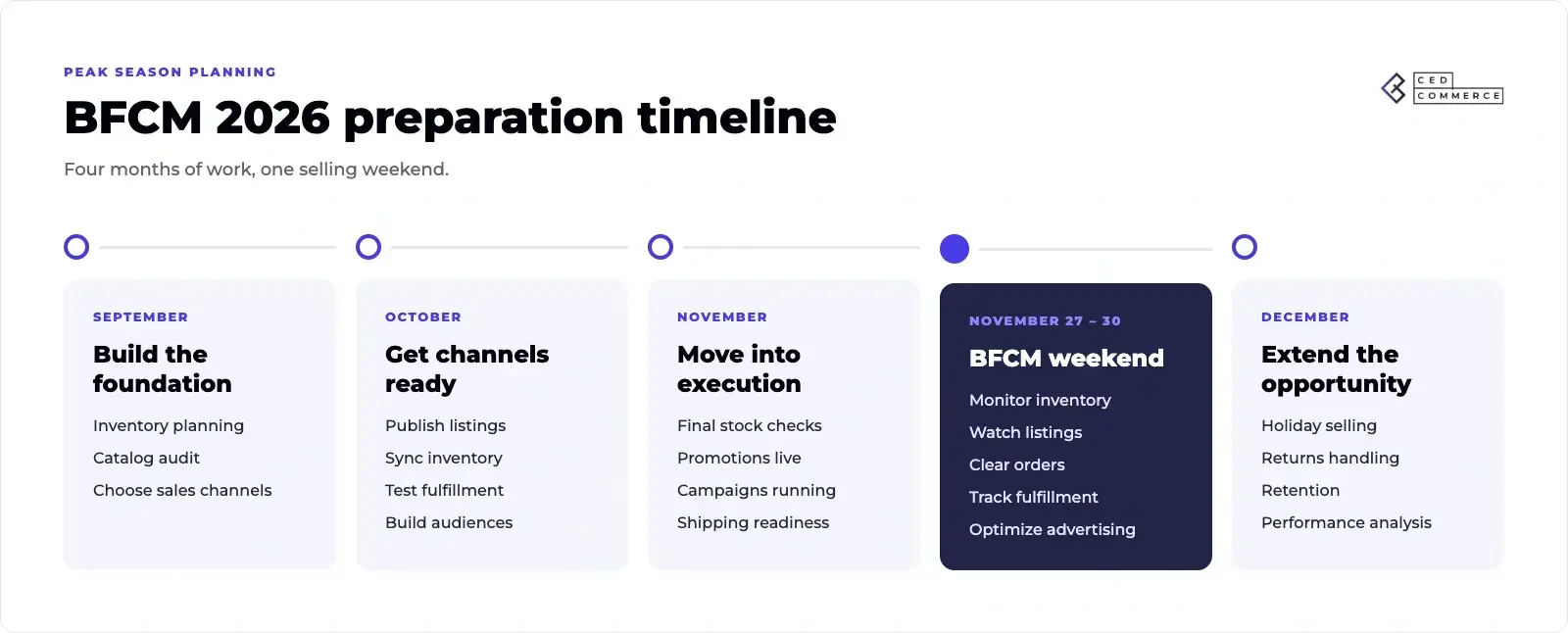
Here’s our suggested BFCM preparation timeline:
| Month | Primary Focus |
|---|---|
| September | Inventory, catalog, channel, and campaign planning |
| October | Marketplace listings, fulfillment, testing, and audience building |
| November | Promotions, final inventory checks, campaigns, and operational readiness |
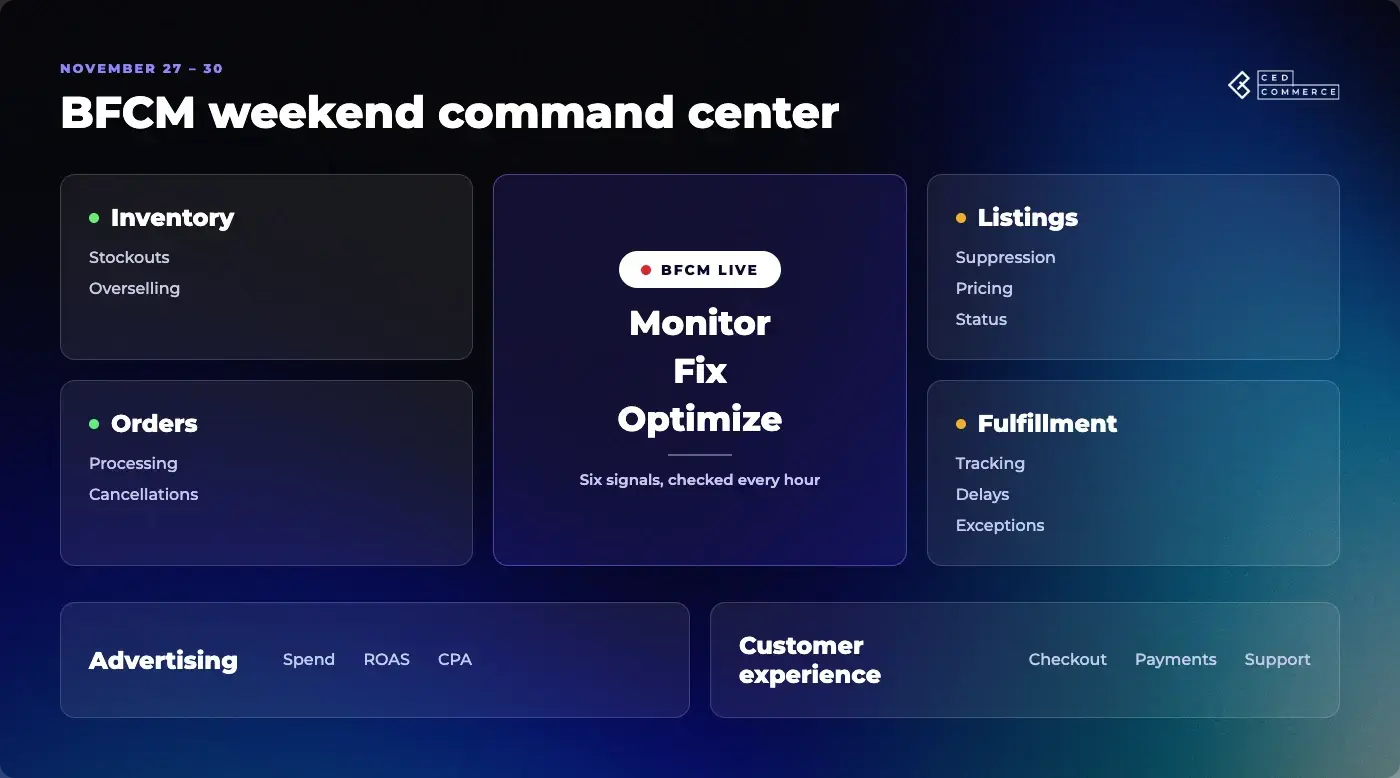
| November 27–30 | Monitor sales, inventory, listings, orders, and advertising |
| December | Continue holiday selling, manage returns, and analyze performance |
Starting early helps you secure advantages that become increasingly difficult to recover once November arrives.
Whether you are a Shopify DTC brand or a multi-marketplace seller, early preparation gives you more control over inventory, marketing costs, listings, and operations while competitors are still scrambling to get ready.
One of the biggest risks during BFCM is running out of stock on your hero products.
When your strongest products are sold out before Cyber Monday, shoppers are unlikely to wait. They can switch to another brand or marketplace within minutes.
Early planning ensures you are closer to the front of the supplier queue. By September, you can:
Action Step: Build a list of your highest-priority BFCM SKUs and forecast inventory at the SKU level instead of treating your entire catalog equally.
CedCommerce Tip: For multichannel sellers, inventory planning should also account for where products will be sold. UniCon helps sellers manage products and inventory across connected marketplaces so stock remains easier to monitor as orders begin arriving from multiple channels.
Every seller wants a slice of BFCM traffic, and advertising competition rises as Black Friday approaches.
By starting in September–October, you can:
For Shopify DTC sellers, October can be used to introduce gift guides, early-access lists, product education, and holiday-focused landing pages.
For marketplace sellers, smaller pre-BFCM promotions can also help identify which products have the strongest demand before larger campaigns begin.
The BFCM rush will expose weaknesses in your store and operations.
Shoppers will not tolerate slow pages, broken discount codes, unavailable products, failed payments, or inaccurate delivery information when alternatives are one click away.
Starting early gives you time to test:
Finding these problems in September or October gives you time to fix them before they become lost revenue.
CedCommerce tip: Merchants using our store optimization suite can simulate high-traffic events in advance, ensuring infrastructure holds up during peak days.


Different activities matter at different stages, hence do not approach BFCM preparation as one long checklist.
September should focus on foundations. October should move into implementation. November should prioritize execution. And once BFCM begins, your attention should shift toward monitoring operations in real time.
September is where you should make the major decisions that determine how the rest of the season will operate.
Start with your own data.
Review:
Use this information to create a shortlist of products that deserve most of your BFCM investment.
Rather than spreading inventory and advertising equally across your entire catalog, create a Top BFCM SKU list that will anchor your campaigns.
Estimate demand using:
Review supplier lead times and establish additional buffer stock for your most important products.
Before increasing traffic, make sure your product information is ready.
Review:
Marketplace sellers should pay particular attention to category-specific attributes.
A product that is complete on Amazon or Shopify may still need different categories, attributes, variations, or listing content before it can be published on another marketplace.
BFCM demand can come up across channels. Even if your strongest products already sell successfully on Amazon, Walmart, or Shopify, September is a good time to determine whether they should also be available through additional channels.
Depending on your business, that could include:
Please note: You do not need to list every SKU on every marketplace. Start with products that already have proven demand, reliable inventory, healthy margins, and complete product information.
Map the promotional period before you begin producing individual campaigns. Your calendar may include:
Once dates are mapped, work backwards to set deadlines for creative, landing pages, emails, marketplace promotions, and inventory.
October is where preparation moves from planning to implementation. By the end of the month, your priority products should ideally be listed, campaigns should be prepared, inventory should be allocated, and fulfillment workflows should be tested.
If your highest-performing products are already selling successfully on one marketplace, October is the time to get selected products ready for additional channels.
Do not wait until Black Friday week to start creating marketplace listings.
Every marketplace may require different:
Creating and correcting this information marketplace by marketplace can quickly become a bottleneck. Start with your highest-value products and work toward getting them live before November.
For multichannel sellers, ask:
Are your strongest products available across the channels where your customers are likely to shop?
UniCon helps sellers use an existing catalog from Amazon, Walmart, or Shopify to prepare and manage products across additional marketplaces including eBay, TikTok Shop, SHEIN, Temu, and Target Plus.
UniCon AI can help predict marketplace-specific category and attribute mappings, while pre-publish validation can surface missing or mismatched information before it becomes a listing error.
You can also prepare channel-specific listing content and manage connected product, inventory, and order operations from one system.
Rather than publishing your entire catalog everywhere, the goal is to take the products that already perform and make them ready for the channels that see demand before the peak time arrives.
A listing sitting inside your marketplace dashboard is not necessarily a listing customers can buy. Prioritize issues affecting the products you expect to promote most heavily.
Review priority SKUs for:
Selling on more channels increases inventory risk if stock updates do not move quickly between marketplaces. If Amazon, Walmart, Shopify, eBay, TikTok Shop, or other channels are drawing from the same inventory, a unit sold in one place needs to be reflected elsewhere.
Before BFCM:
More sales channels should not automatically require separate fulfillment operations for every marketplace. Review how orders from each channel will be fulfilled.
Depending on channel eligibility and the fulfillment network you already use, eligible orders from other marketplaces may be fulfilled using existing inventory through programs such as Amazon Multi-Channel Fulfillment (MCF) or Walmart Multichannel Solutions (MCS). Learn how you can do this on UniCon via this guide.
Before peak season, test:
October is also the right time to decide what customers will actually be offered.
Consider:
Make sure every discount still makes sense once marketplace fees, fulfillment, advertising, and returns are considered.
Start warming your audience before November.
Use October to:
Test the complete buying journey before additional traffic arrives.
Review:
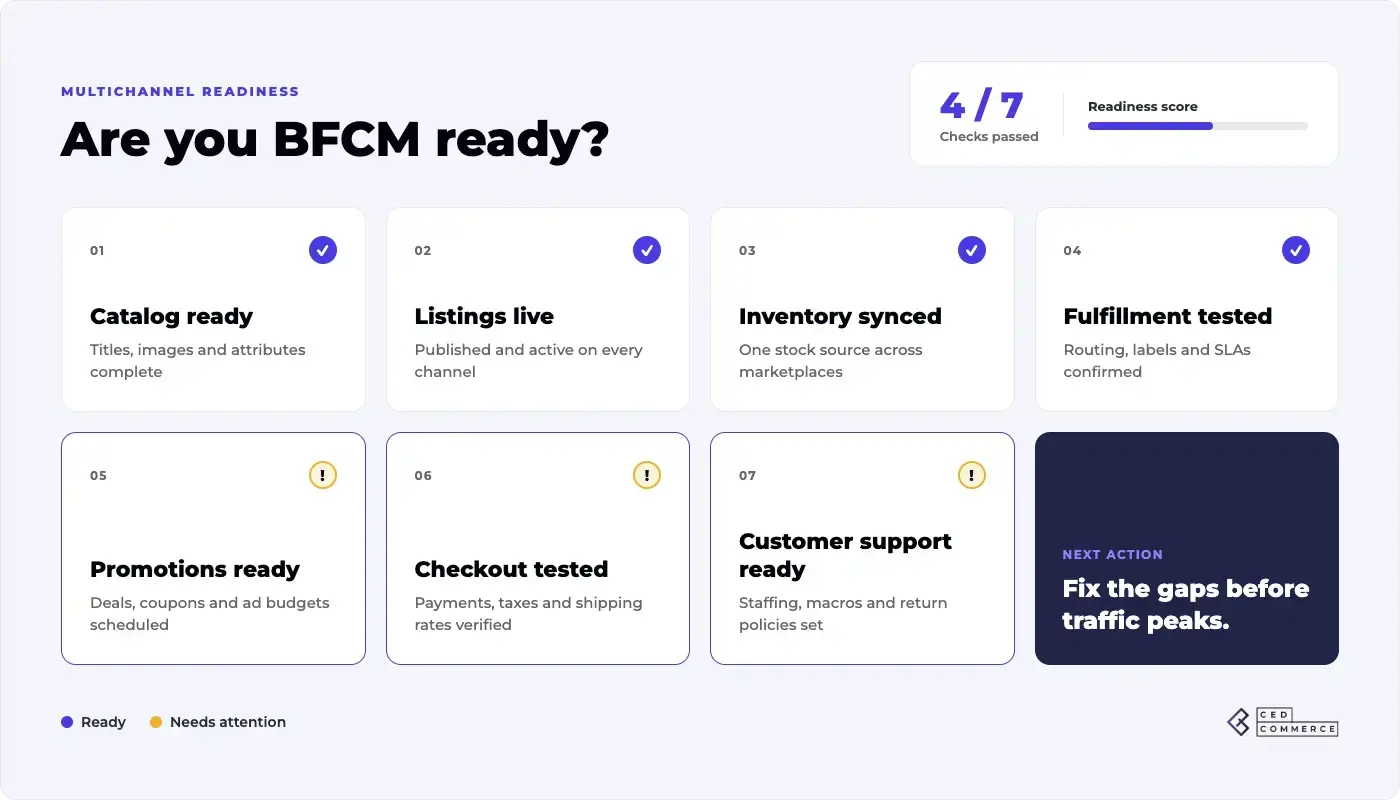
By November, your focus should shift toward launching campaigns and protecting revenue.
Review every priority SKU and separate products into:
Adjust campaigns accordingly. Why spend aggressively to promote a product that is likely to run out before your largest campaigns begin?
Review the marketplaces where your BFCM products are available.
Check:
Your campaign calendar should now be locked.
Prepare:
Also decide which metrics determine whether you increase, pause, or change a campaign.
Make delivery expectations clear.
Display important shipping information across:
Coordinate with fulfillment partners and carriers before publishing promises to customers.
Make sure your support team is ready for common questions involving:
Once BFCM begins, your job shifts from preparation to monitoring.
Watch high-volume products closely.
If a SKU approaches stockout:
Check priority listings for:
A listing error during BFCM is not simply a catalog issue. It can immediately become a revenue issue.
Look for:
Track:
Do not continue pushing spend toward products that cannot support additional demand.
Watch:
Cyber Monday is not the end of the eCommerce holiday season. December gives merchants an opportunity to continue generating revenue while turning BFCM performance into longer-term learning.
Use BFCM data to identify products worth promoting through the rest of the holiday period.
Focus on:
Shift messaging from Black Friday urgency toward gifting and delivery.
Make sure:
Compare performance across channels.
Review:
Do not evaluate marketplaces on revenue alone.
A lower-volume marketplace may still be valuable if it provides stronger margins or lower customer acquisition costs.
Build post-purchase journeys using:
Do not treat every BFCM customer as a one-time transaction.
Every marketplace plays by its own rules. Hence, BFCM prep means understanding what each platform requires and making sure your products and operations are ready well before peak demand.
Shopify merchants control their own brand experience, but they are also competing against rising advertising costs and a crowded holiday promotional calendar.
The earlier you optimize your funnel, the more time you have to test it.
If Shopify is your primary catalog, also decide which products should be available on additional marketplaces before BFCM.
Pro Tip: Use CedCommerce’s Shopify services to sync promotions across your DTC store and marketplaces, ensuring brand consistency.
Amazon sellers should prepare inventory and listings well ahead of peak demand.
Review:
If Amazon is your source catalog, you can also evaluate whether successful Amazon products should be expanded onto additional marketplaces rather than rebuilding those product records manually.
Pro Tip: Use CedCommerce’s Amazon growth suite of services to optimize your inventory, product listing, and order fulfillment for BFCM 2026 and beyond.
These marketplaces have their own catalog structures, promotional tools, and seller requirements.
Before BFCM:
Pro Tip: CedCommerce’s bulk listing tool lets you push updates across marketplaces in one go. Know More!
Discovery-oriented marketplaces require both catalog readiness and strong product presentation.
Prepare:
For TikTok Shop, batch product demos, UGC-style videos, and other campaign assets before November so your content calendar is not being created at the same time as BFCM operations are peaking.
For SHEIN and Temu, start catalog preparation early enough to resolve marketplace-specific product data requirements before November.
Explore end-to-end account management services, featuring influencer collabs, UGC content prep, and channel-specific listing optimization services for your BFCM sales growth!
During BFCM, attention is scarce. Promoting your entire catalog can spread inventory and advertising budgets too thin. Merchants should instead focus on the products most likely to generate profitable sales.
Instead of guessing which products will sell, use your own data:
Action Step: Build a Top BFCM SKU list to anchor homepage placements, marketplace expansion, promotions, and advertising.

Bundles can increase basket size while also helping move complementary inventory.
Consider:
Pre-build bundles before November and make sure inventory for every component can support the expected demand.
Pre-build bundles using CedCommerce apps like Amazon Shopify Integration. For marketplace sellers, replicate bundles across Amazon, Walmart, and Etsy to maintain consistency.
The way you present your products matters.
Consider:
Optimize your D2C store with BFCM-specific themes, product pages, and layouts with our Shopify experts.
Merchandising should connect directly with operations.
Use your priority products to guide:
Discounts are powerful, but poor discount planning can quickly reduce margins. The strongest BFCM offers should balance customer appeal with profitability.
Tiered discounts encourage customers to spend more to unlock a larger saving.
For example:
Map thresholds against your existing AOV rather than choosing arbitrary amounts.
Volume promotions can work particularly well for consumables, accessories, apparel basics, or products with repeat-purchase potential.
Examples include:
Calculate COGS, fulfillment, and marketplace fees before finalizing the offer.
You do not have to offer the same promotion to every customer.
Consider:
These campaigns can help you start converting demand before peak advertising competition begins.

A strong storefront can still lose a sale if shipping expectations are unclear or payment fails.
Preparing these systems early helps reduce avoidable friction during peak demand.
Before BFCM:
For multichannel sellers, also make sure fulfillment rules are clear for every marketplace.
If you use Amazon FBA or Walmart Fulfillment Services, evaluate whether eligible off-marketplace orders can be supported through Amazon MCF or Walmart MCS as part of your multichannel fulfillment strategy.
Make sure customers can use the payment methods they expect.
Review:
Test the complete checkout flow across the devices and regions that matter most to your business.
CedCommerce integrations allow you to sync shipping rules and payment configurations across Amazon, Walmart, TikTok Shop, eBay, Etsy, and other leading marketplaces. This ensures that every channel delivers a consistent, reliable checkout experience.
For merchants selling across multiple channels, BFCM creates a different type of operational challenge.
Products may exist across several marketplaces. Each channel may require different catalog data. Inventory can be shared between listings. Orders can come in from several destinations at once. And fulfillment decisions need to happen quickly.
UniCon is built to help merchants connect these operations.
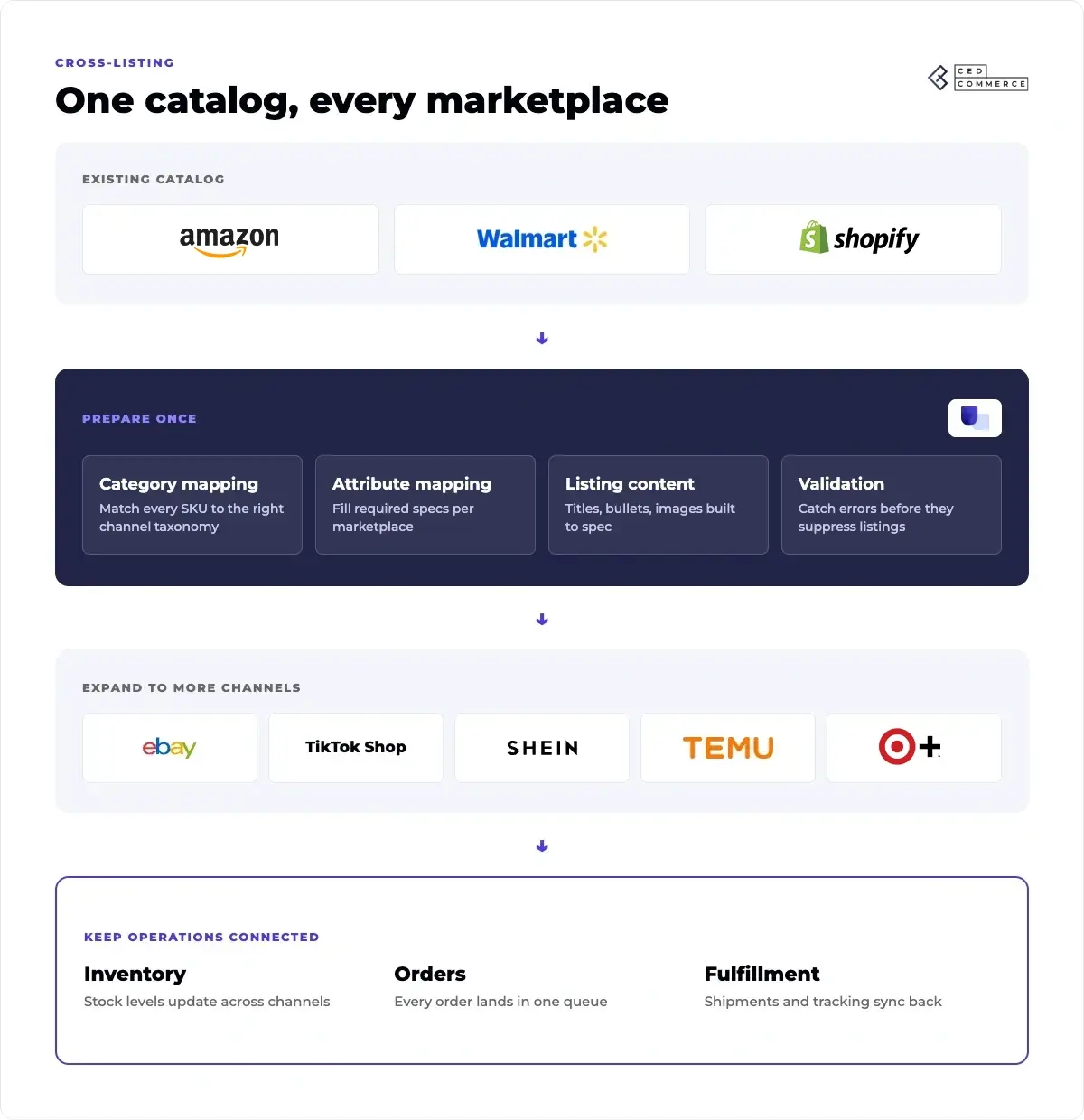
Depending on your source catalog, marketplaces, and setup, UniCon can support:
For BFCM, the best starting point is straightforward:
Choose the products you want to prioritize, decide where you want them available, and complete the catalog and operational work before peak demand arrives.
Black Friday 2026 falls on Friday, November 27.
Cyber Monday 2026 falls on Monday, November 30.
September is a practical starting point for many merchants because it leaves time to plan inventory, audit catalogs, prepare campaigns, expand to additional marketplaces, and test fulfillment before November.
Businesses with longer manufacturing or supplier lead times may need to begin earlier.
September should focus on foundations.
Review previous performance, identify priority products, forecast inventory, audit catalog data, choose the marketplaces you want to sell through, and build your promotional calendar.
October should focus on implementation.
Publish marketplace listings, resolve catalog errors, synchronize inventory, test fulfillment, prepare promotions, build audiences, and test your storefront and checkout.
November should focus on execution.
Complete final inventory and listing checks, launch campaigns, confirm shipping cutoffs, prepare support teams, and closely monitor operations as demand increases.
Priority products should ideally be live well before Black Friday.
Getting listings published during October gives sellers more time to resolve marketplace errors, complete missing attributes, test inventory updates, and validate order and fulfillment workflows.
Only where doing so makes operational and commercial sense.
Rather than publishing your entire catalog everywhere, begin with products that already have proven demand, sufficient inventory, healthy margins, and complete product information.
Keep inventory synchronized across connected channels, establish safety stock where needed, monitor fast-moving products closely, and make sure stock changes are reflected across marketplaces using the same inventory.
Continue holiday campaigns where demand remains strong, prepare for returns, reconcile inventory, compare channel performance, and build post-purchase campaigns designed to turn BFCM customers into repeat buyers.
Before Black Friday arrives, ask:
The goal of early BFCM preparation is to complete the right work early enough that when demand arrives, your team can focus on selling instead of fixing avoidable problems.


Reading Time: 11 minutes By now you have seen your BFCM 2025 numbers. The harder…
Reading Time: 3 minutes Summary Cyber Monday 2025 has officially become the largest online shopping…
Reading Time: 2 minutes Black Friday 2025 delivered the strongest U.S. eCommerce performance in history,…
Reading Time: 13 minutes Still approaching BFCM with generic discounts, last-minute price cuts, or scattered…
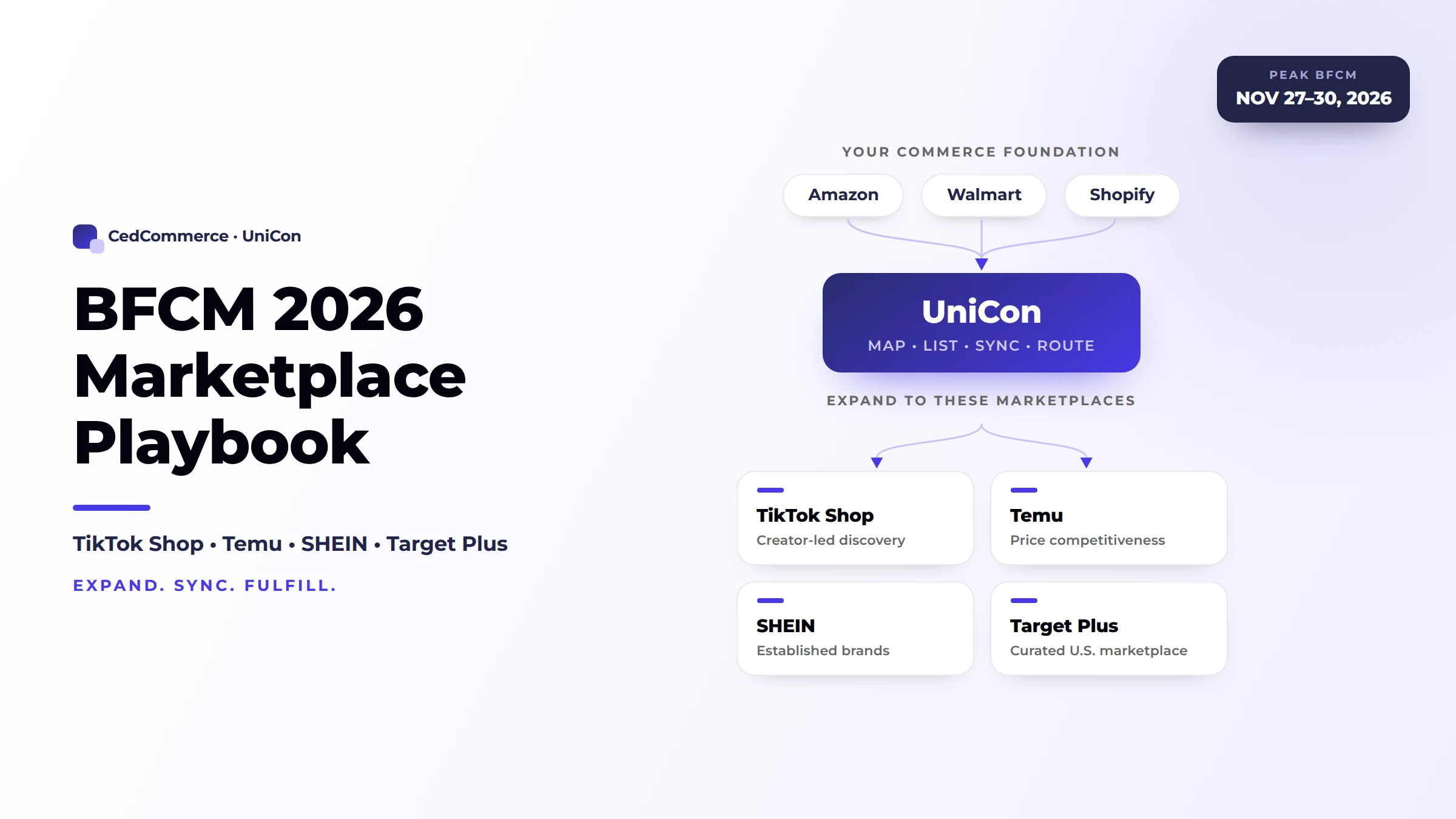
Reading Time: 16 minutes If you consider Black Friday/Cyber Monday as Amazon, Walmart, or DTC…
Reading Time: 10 minutes Black Friday Cyber Monday (BFCM) isn’t a weekend anymore; it’s a…
Reading Time: 11 minutes The $240 Billion BFCM Opportunity & Why Operations Matter Every seller,…
Reading Time: 7 minutes TL;DR — Your 60-Second BFCM Battle Plan Time remaining: 3 weeks…
Reading Time: 2 minutes China’s Double 11 shopping festival — the world’s largest annual online…
Reading Time: 15 minutes It’s early October. The whiteboard is covered in timelines, SKU codes,…