
How to Fulfill SHEIN Orders with Walmart MCS: Eligibility, Setup and Limits
Reading Time: 13 minutes Q4 is a bad time to discover that expanding to another…
Running short of time? Get PDF of the blog in your mail.
If you consider Black Friday/Cyber Monday as Amazon, Walmart, or DTC events, you are missing out on the action emerging players are witnessing. In 2025, TikTok Shop recorded more than $500 million in U.S. sales during the four-day BFCM shopping period, while nearly 50% more shoppers purchased on TikTok Shop during its broader BFCM campaign compared with the previous year. Creator affiliates also published nearly 10 million shoppable videos during the campaign.
Temu and SHEIN were competing for the same holiday attention. During the 2025 Black Friday weekend, Temu led the U.S. retail-app market for time spent at 108% above the market average, while SHEIN also ranked among the top retail apps by time spent. The overall opportunity grew too. U.S. shoppers spent a record $14.25 billion online on Cyber Monday 2025.
That leaves sellers preparing for BFCM 2026 with a different question:
Where else should our products be selling when demand peaks?
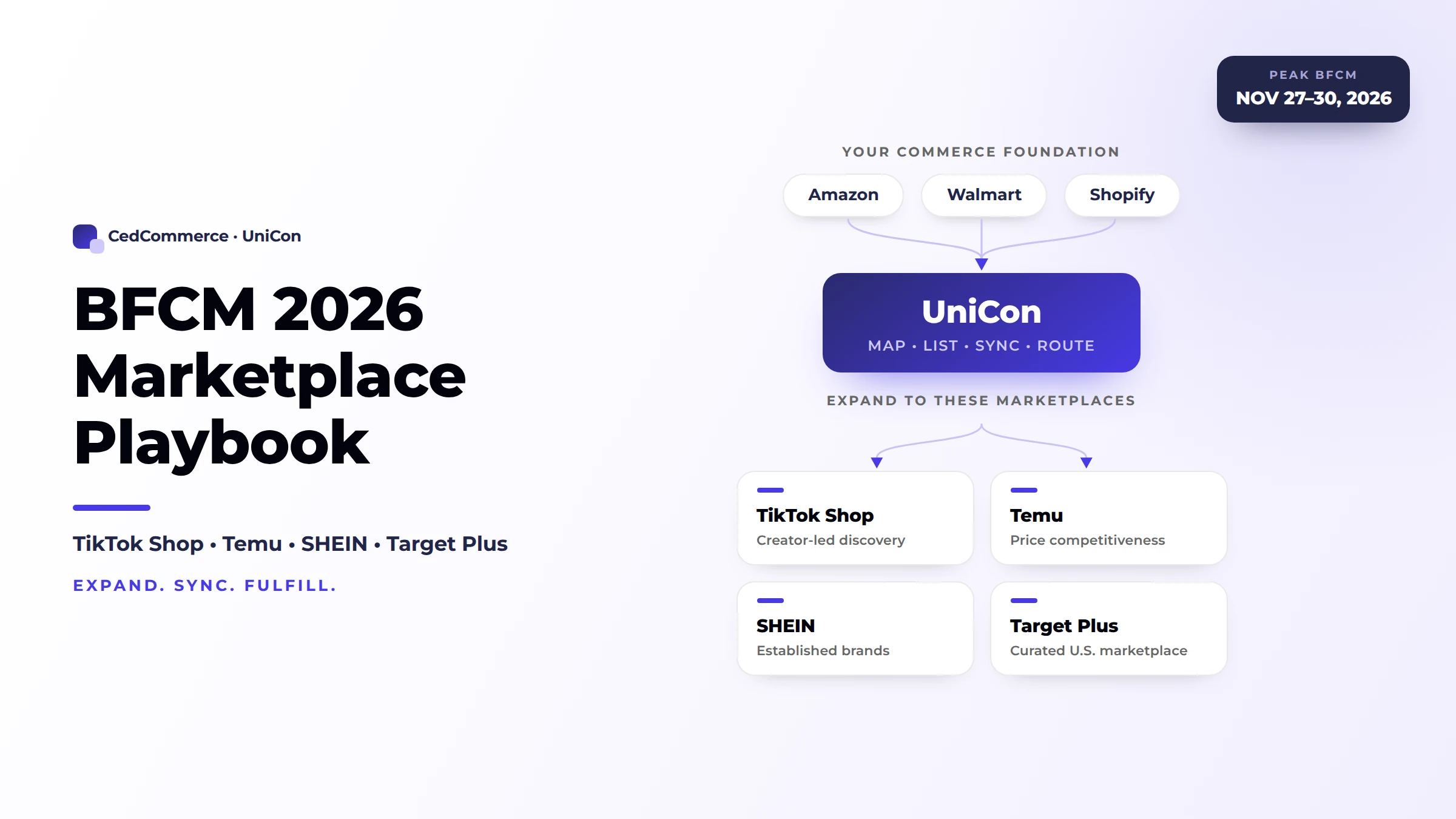
Black Friday falls on November 27, 2026, followed by Cyber Monday on November 30. If you already sell through Amazon, Walmart, or Shopify, this guide will help you determine whether TikTok Shop, Temu, SHEIN, or Target Plus fits your business, what needs to be ready before BFCM, and how to expand without rebuilding your entire catalog and fulfillment operation for every marketplace.
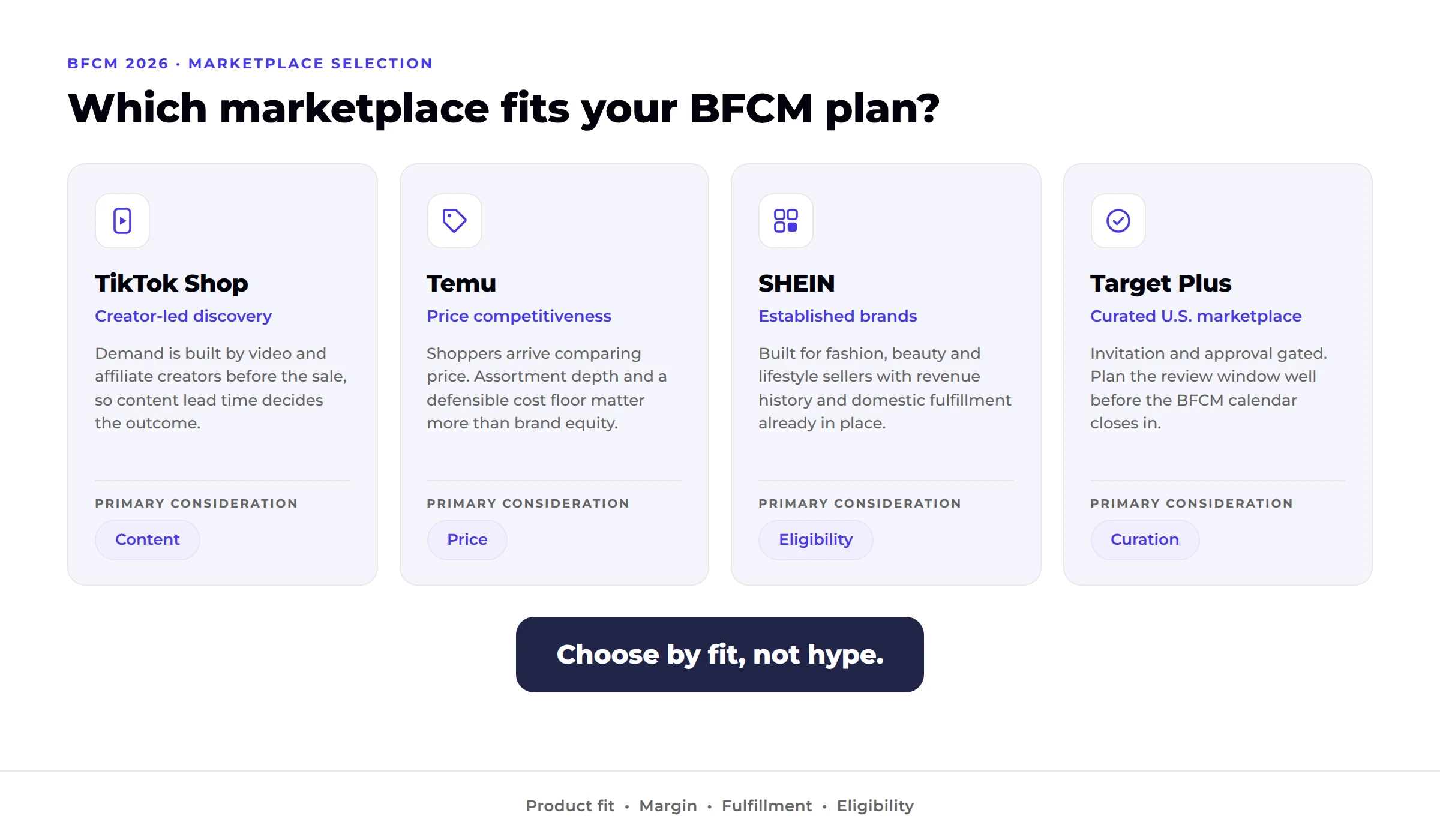
There is no single marketplace every seller should add first. Your product, margins, fulfillment setup, existing catalog, and ability to meet each marketplace’s requirements matter more than choosing the channel with the most buzz.
Use this table as a starting point.
| Marketplace | Best fit | Entry difficulty | BFCM growth lever | Fulfillment consideration | Best for sellers already on |
|---|---|---|---|---|---|
| TikTok Shop | Visual, creator-friendly and impulse-driven products | Medium | Shoppable video, LIVE, affiliates and platform campaigns | Seller fulfillment, FBT or supported multichannel fulfillment routes | Amazon, Shopify |
| Temu | Price-competitive products with scalable inventory | Low-Medium | Competitive pricing, promotions and marketplace visibility | Sellers choose how orders are fulfilled | Amazon, Walmart, Shopify |
| SHEIN Marketplace | Established brands with trend-led or seasonal assortments | High | Seasonal assortment and marketplace promotions | U.S. orders must ship domestically; multichannel fulfillment is supported | Amazon, Walmart |
| Target Plus | Established U.S. brands with differentiated assortment | High | Curated marketplace exposure | Shipping, returns and fulfillment remain seller responsibilities | Established U.S. marketplacesellers |
The goal is not necessarily to launch everywhere before November. It is to choose the marketplace where your existing catalog, operations, and BFCM economics give you the strongest reason to test.
Not sure which marketplace fits your catalog?
For sellers searching for a BFCM channel where product discovery and purchase can happen within the same piece of content, TikTok Shop deserves serious attention.
Its 2025 BFCM performance showed how large the shopping opportunity has become. But succeeding there requires more than uploading products and waiting for marketplace traffic. For BFCM 2026, TikTok Shop has already listed its Black Friday & Cyber Monday campaign from November 11 through December 1.
Its Creator Community BFCM activity begins even earlier, on November 1, with increased activity around the main Black Friday and Cyber Monday period.
September to early October
Get your catalog ready. Identify hero products, check product data, confirm stock availability, review margins, and decide how orders will be fulfilled.
October
Start testing content. Build relationships with creators where relevant, seed products, test short-form creative, and identify which products get the strongest engagement before paid BFCM traffic becomes more competitive.
November 1 onward
Creator activity starts building around BFCM. Sellers working with affiliates should have products, samples, commission structures, and briefs ready rather than starting outreach during Black Friday week.
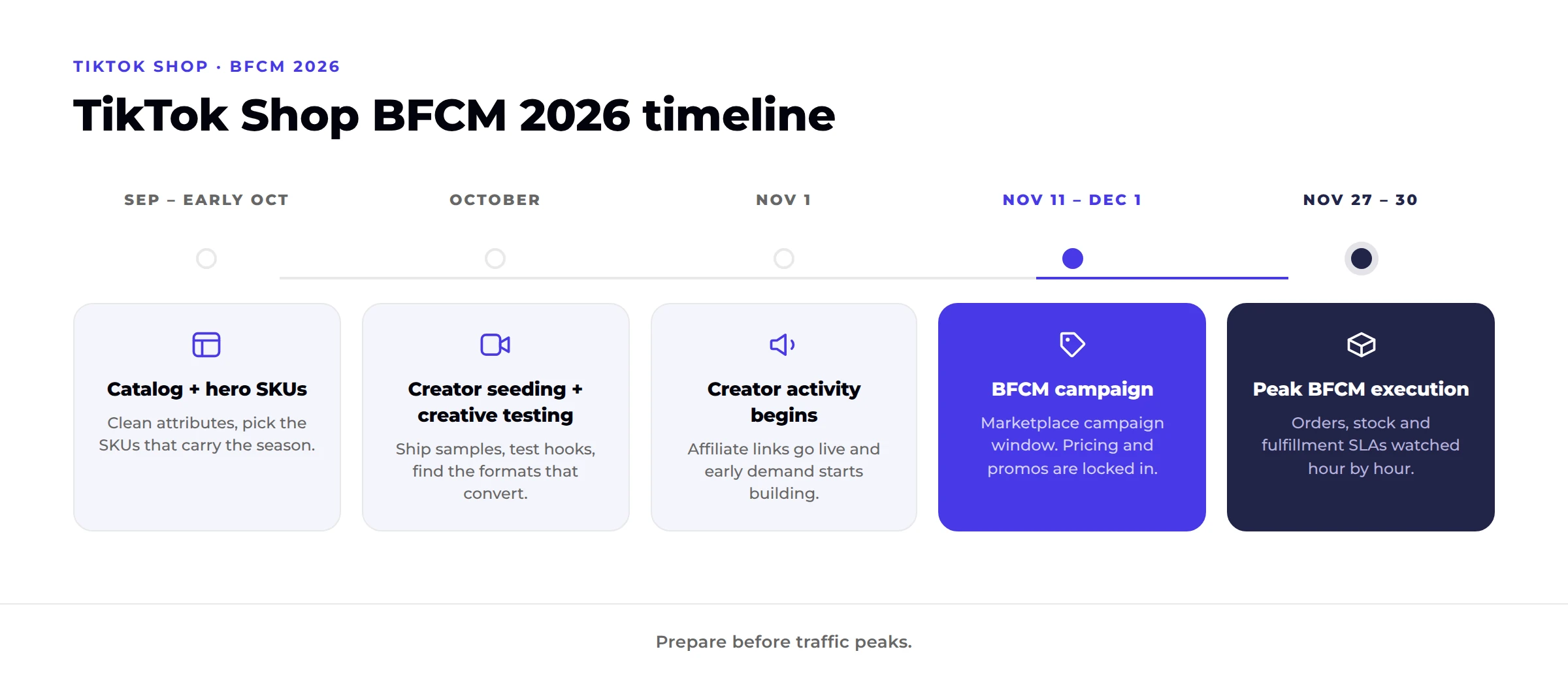
November 11 to December 1
TikTok Shop’s official BFCM campaign period is scheduled to run across this window.
November 27 to November 30
Treat Black Friday through Cyber Monday as the peak execution period. Inventory availability, creator performance, campaign pricing, order processing, and fulfillment need much closer monitoring here.
BFCM revenue can look impressive while contribution margin quietly disappears. TikTok Shop’s current Smart Promotion model charges participating sellers 3.5% of store GMV during non-campaign periods and 4.5% during major campaign periods.
The platform states that participating sellers receive corresponding platform-funded discount support, and Smart Promotion is integrated with major platform campaign participation.
That is only one part of your economics.
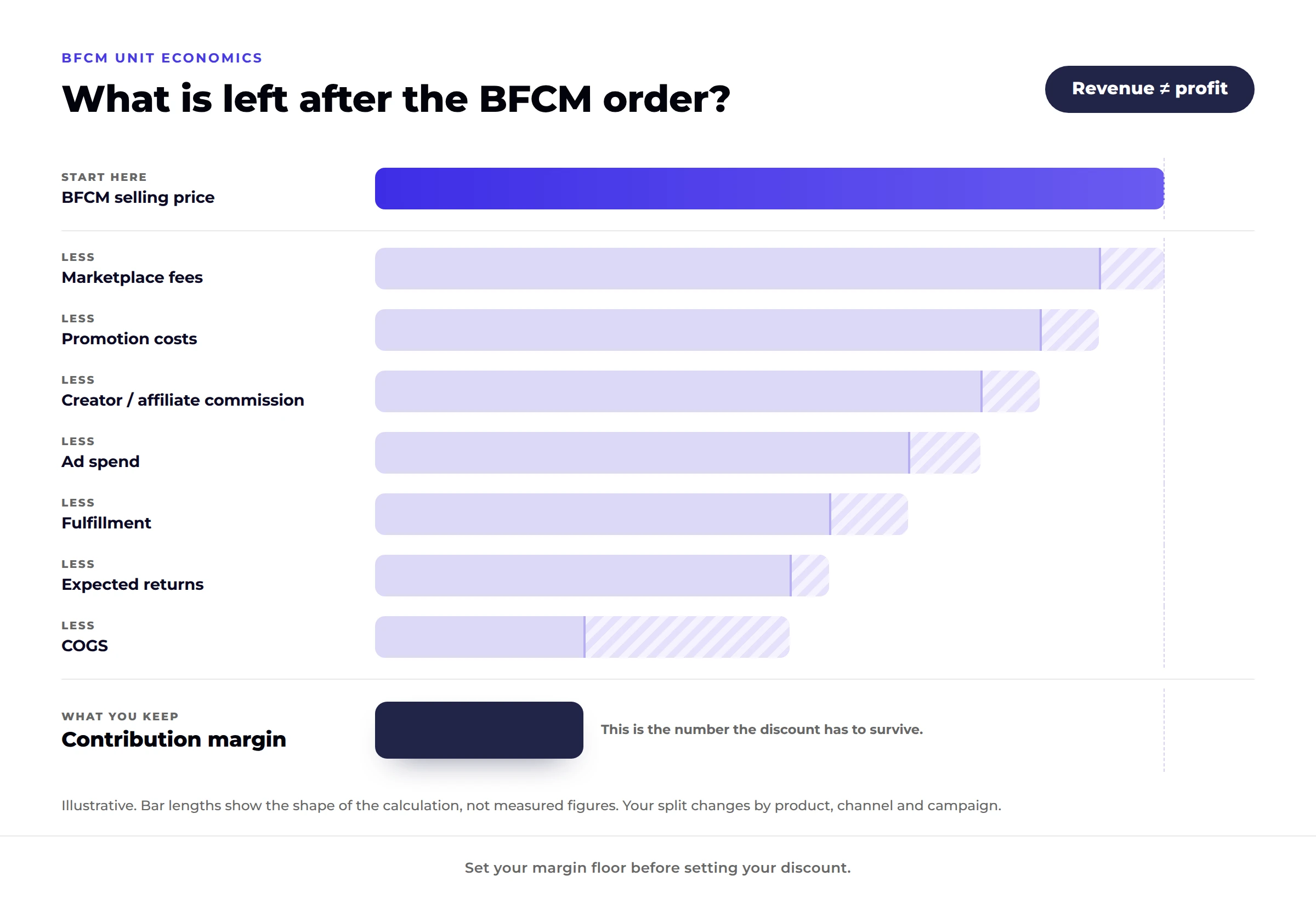
For every BFCM SKU, calculate:
Selling price
– marketplace fees
– campaign or promotion cost
– creator or affiliate commission
– advertising allocation
– fulfillment
– expected return cost
– cost of goods
= BFCM contribution margin
A 30% discount is not automatically a good offer if the remaining economics cannot support creator commissions, shipping, returns, and acquisition costs.
Do this before sales accelerate. You may fulfill TikTok Shop orders yourself, use Fulfilled by TikTok where eligible, or connect another supported fulfillment network.
If you use FBT, do not build your 2026 margin model from last year’s rates. TikTok Shop made several FBT pricing and operational changes during 2026, including updated fulfillment rates, new customer return-processing fees, and changes across different weight tiers. The practical question is simple:
Where will the inventory sit, and what happens when a TikTok Shop order arrives?
You do not necessarily need a separate TikTok Shop fulfillment operation. With UniCon, Amazon sellers can connect their existing Amazon catalog as a source, prepare selected products for TikTok Shop, synchronize inventory, receive TikTok Shop orders, and route eligible orders to Amazon Multi-Channel Fulfillment (MCF).
Amazon then picks, packs, and ships the products, while shipment and tracking information flow back through UniCon.
That changes the expansion question from:
“How do I recreate my catalog and logistics for TikTok Shop?”
to:
“Which Amazon products should I make available on TikTok Shop?”
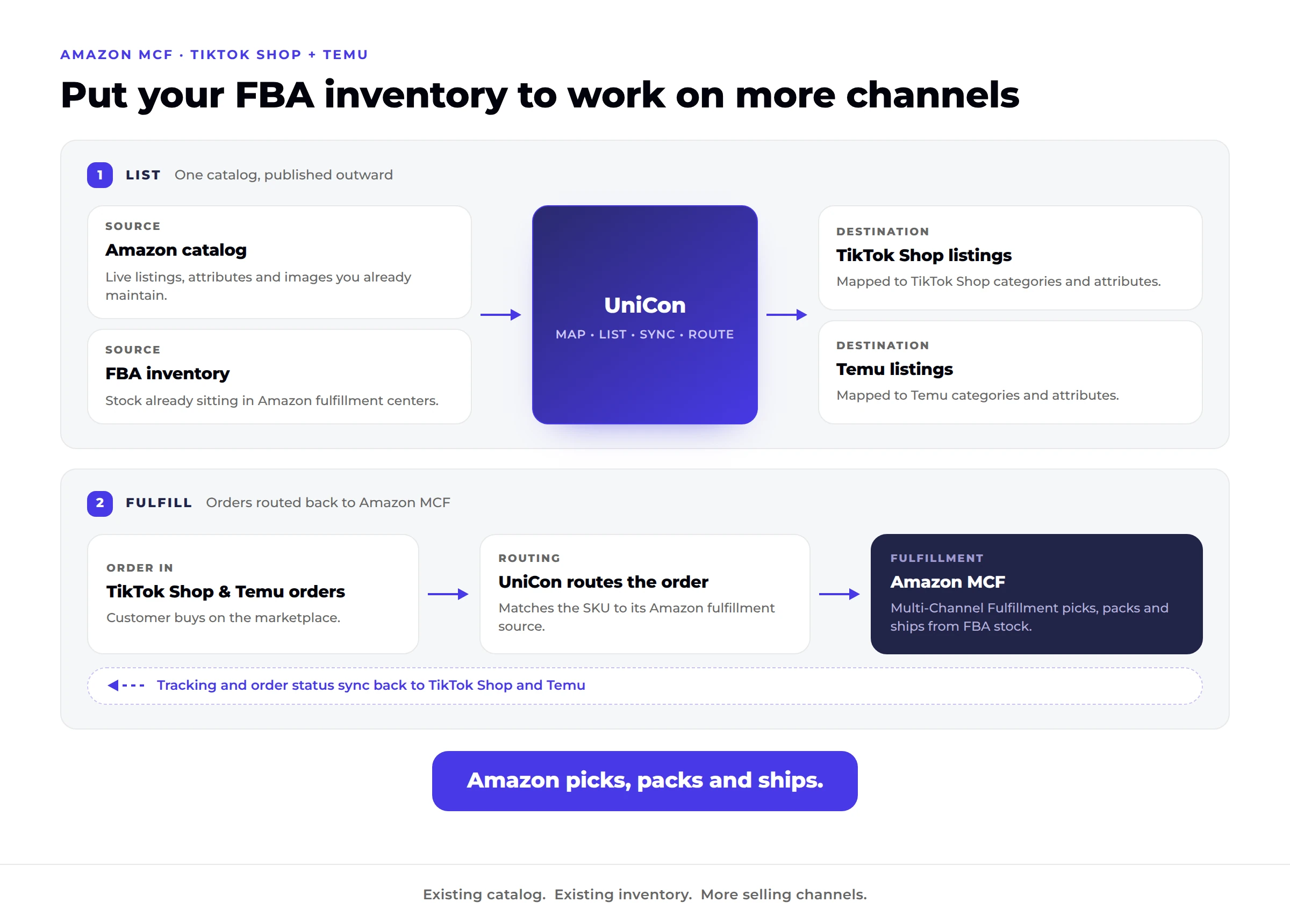
Already sell on Amazon? Take your existing catalog and fulfillment setup to TikTok Shop.
Temu deserves a more nuanced strategy than simply finding your cheapest products and discounting them again.
The marketplace now allows U.S. sellers to register directly through Temu Seller Center. Its current seller materials promote 0% commission fees, while its logistics section lets sellers decide how products will be fulfilled.
That gives you more control over how Temu fits into your existing eCommerce operation.
Start with product economics rather than price alone.
Ask:
A $15 product with poor fulfillment economics may be less suitable than a more expensive product with healthy contribution margin and reliable inventory. Choose strategically.
Start by narrowing the catalog. Choose products that combine:
Launching on Temu does not necessarily mean creating another warehouse operation or moving inventory into a separate fulfillment setup.
With UniCon, Amazon can act as your source channel while Temu becomes the target marketplace.
The workflow can look like this:
Existing Amazon catalog
→ UniCon imports selected products
→ categories and attributes are mapped for Temu
→ Temu-ready listings are prepared and published
→ inventory stays synchronized
→ Temu orders enter UniCon
→ eligible orders route to Amazon MCF
→ Amazon fulfills them using available FBA inventory
→ shipment and tracking updates flow back to the order
This lets an Amazon seller test Temu using product data and fulfillment infrastructure that already exist.
Instead of asking:
“How do I rebuild my catalog and fulfillment operation for Temu?”
the more useful question becomes:
“Which Amazon products have the pricing, inventory depth, and margin to compete on Temu?”
That can make a major difference during BFCM, when catalog preparation and fulfillment capacity become bottlenecks quickly.
Reuse your Amazon catalog and FBA inventory to expand to Temu without building another fulfillment operation.
SHEIN is different from Temu or TikTok Shop because the first question is not what to sell.
It is whether your business currently qualifies to sell there.
SHEIN currently lists the following requirements for U.S. marketplace sellers:
 SHEIN also asks applicants to prepare business documentation including incorporation documents, tax documentation, trademark information, brand assets, and identification for the company representative.
If you do not meet the marketplace requirements, do not build your BFCM plan around a SHEIN launch.
If you are eligible or already onboarded, the next step is deciding what portion of your catalog deserves the channel.
Focus on products that can support the channel operationally, not arbitrary SKU counts.
Review:
Seasonal assortment: Which products make sense for holiday demand and gifting?
Inventory depth: Can the selected assortment withstand promotional demand?
Competitive offers: Does the price remain sustainable after promotions and fulfillment?
Mobile-first imagery: Can shoppers understand the product quickly from the images?
Variant completeness: Are size, color, style, pack, and other relevant variations represented correctly?
Category and attributes: Are required SHEIN fields populated accurately?
Warehouse readiness: Is inventory available at a suitable U.S. fulfillment location?
SHEIN currently allows sellers to use an in-house U.S. warehouse, third-party warehouse, or multichannel fulfillment, provided its shipping requirements are met.
Before pushing BFCM assortment live, confirm that:
This is where a seller already on Walmart has an interesting expansion route.
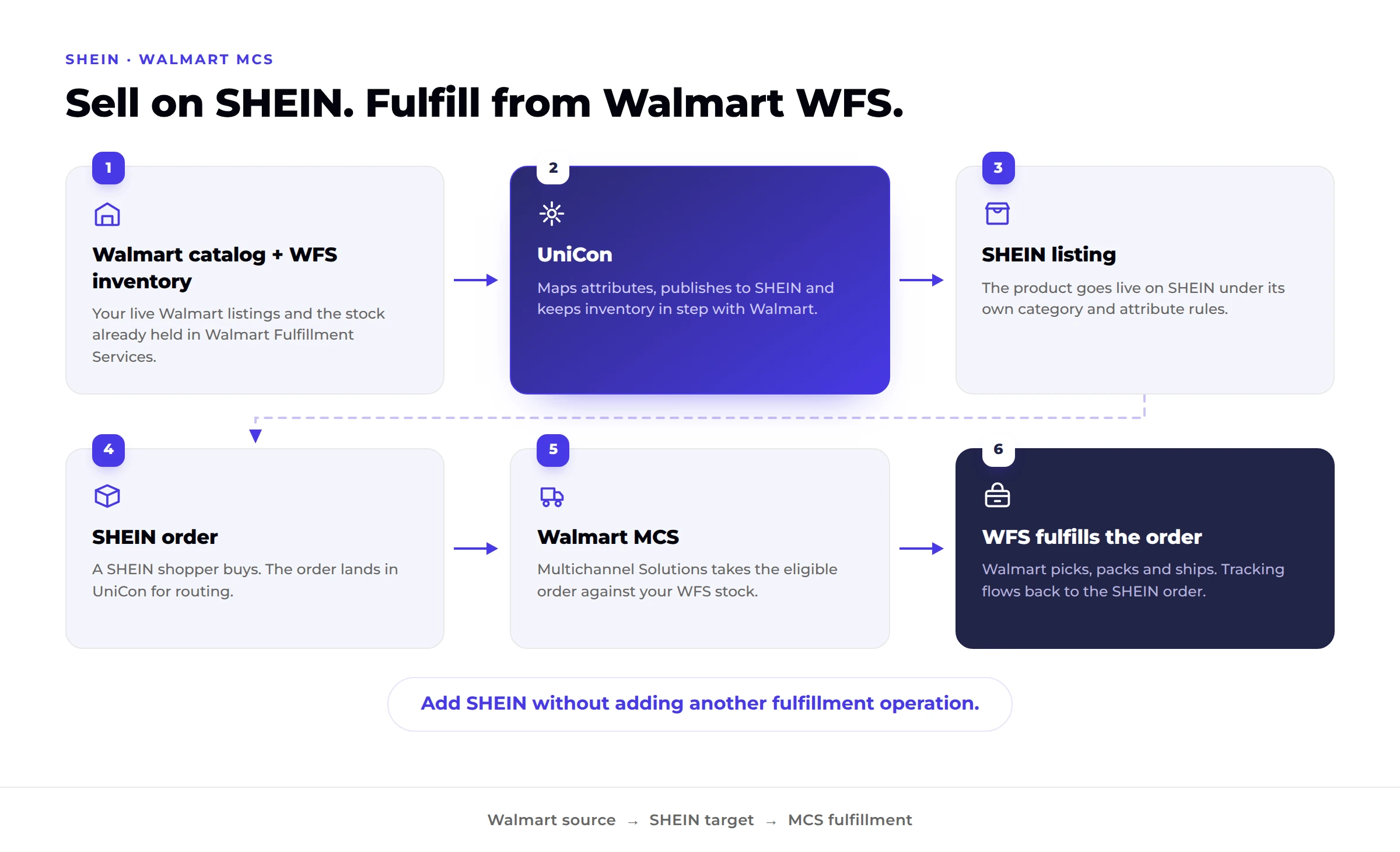
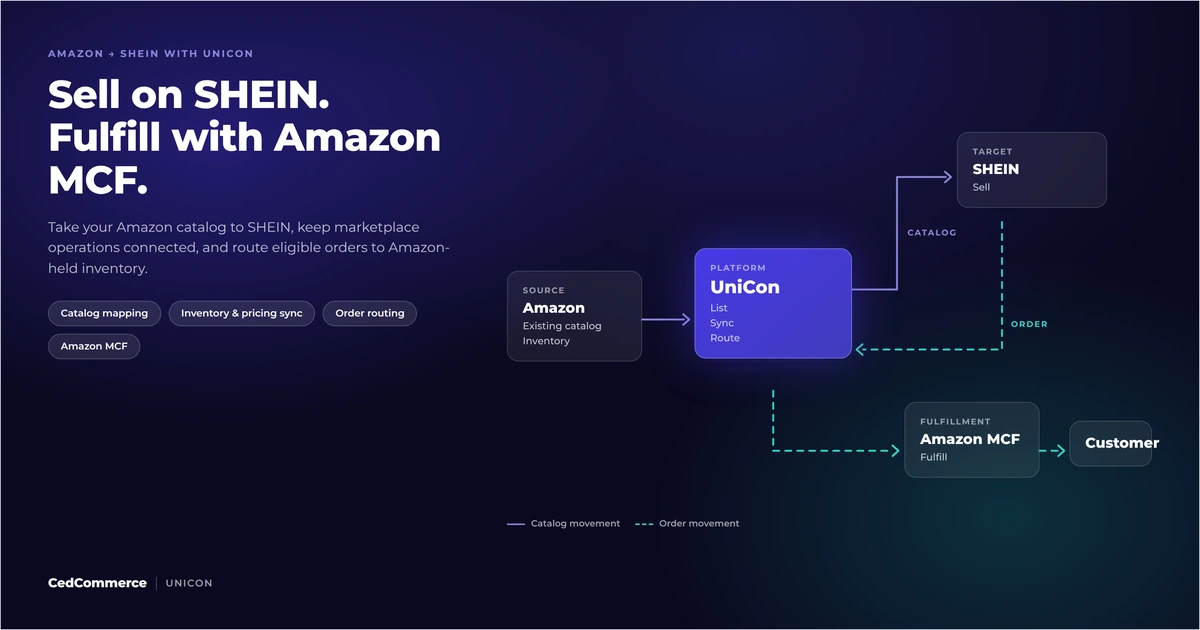
With UniCon, Walmart can act as the source channel and SHEIN as the target channel. UniCon imports the seller’s existing Walmart catalog and helps prepare selected products for SHEIN.
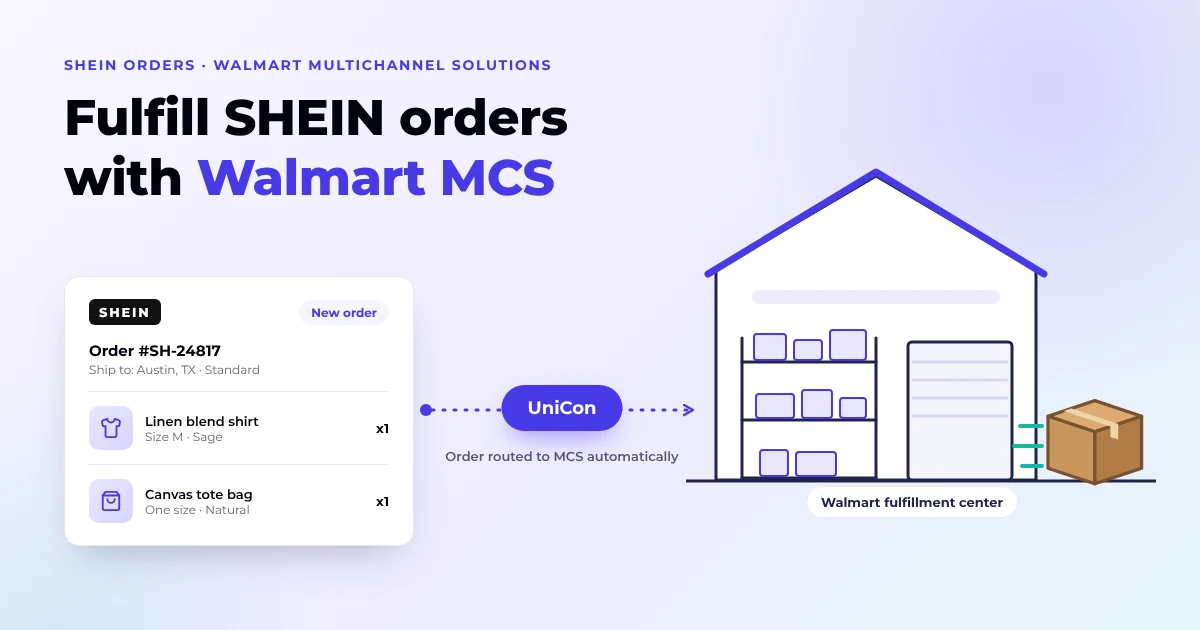
If the seller already has qualifying inventory inside Walmart Fulfillment Services, eligible SHEIN orders can be routed through Multichannel Solutions by Walmart (MCS). Walmart then fulfills those SHEIN orders using the corresponding inventory stored in WFS. Shipment and tracking information are synchronized back through UniCon.
The flow becomes:
Walmart catalog + WFS inventory
→ UniCon
→ SHEIN listing
→ SHEIN customer order
→ Walmart MCS
→ WFS inventory fulfills the order
That means adding SHEIN does not automatically require building another standalone fulfillment operation.
Use your existing Walmart operation to list on SHEIN and route eligible orders through Walmart MCS.
Target Plus is worth considering, but it should not be treated like another marketplace where any seller can create an account today and start uploading products tomorrow.
It is a curated marketplace.
Target says Target Plus reaches more than 100 million guests and receives more than 50 million weekly visits across Target.com and the Target app. It also operates with one dedicated seller per SKU, which removes direct seller competition on the exact same SKU within Target Plus.
But access has a higher barrier.
Current Target Plus requirements include:
Target says its typical acquisition process takes 3 to 6 weeks before transitioning to onboarding, depending on the complexity of the business, and it aims to provide applicants with a status update within 30 days.
You are already approved or actively onboarding.
Your business operates in the U.S.
You have an established brand and reliable catalog.
You can fulfill orders domestically.
Your team already manages marketplace operations reliably.
Your assortment gives Target Plus something differentiated to offer its shoppers.
You have not started the application process.
Your operations are not U.S.-based.
Domestic fulfillment is not ready.
Your catalog still has major inventory or product-data issues.
You need a marketplace that can be activated immediately.
If Target Plus access is already secured, your next goal should be bringing the channel into your existing catalog and operational workflow rather than allowing it to become another isolated marketplace process.
One number matters more than the size of the discount printed on your listing:
What is left after the order?
Marketplace fees and promotional programs change. Creator commission varies. Fulfillment differs by product size, location, and service. Return rates are not identical across categories.
Instead of relying on a generic statement such as “Temu is cheaper” or “TikTok Shop needs a 30% discount,” calculate each SKU individually.
Use:
BFCM selling price
– referral or marketplace fees
– platform campaign fees
– creator or affiliate commission
– allocated ad spend
– fulfillment cost
– expected return cost
– cost of goods
= contribution margin
Suppose a product sells for $40 during BFCM.
After all relevant marketplace fees, promotional costs, marketing, fulfillment, return allowance, and COGS, assume the remaining contribution is $7.
Your BFCM contribution margin is:
$7 ÷ $40 = 17.5%
Now test what happens if the product needs another 10% discount to remain competitive.
The question is not whether the additional discount increases orders. It probably can.
The question is whether those additional orders still create acceptable contribution margin.
Set that floor before the campaign starts.
Getting another marketplace live sounds attractive when BFCM traffic begins climbing.
Then the first orders arrive.
Your team discovers four versions of the product catalog, different category requirements, different warehouse setups, stock moving in several places, and orders being checked manually across marketplace dashboards.
The problem is no longer expansion. It is coordination.
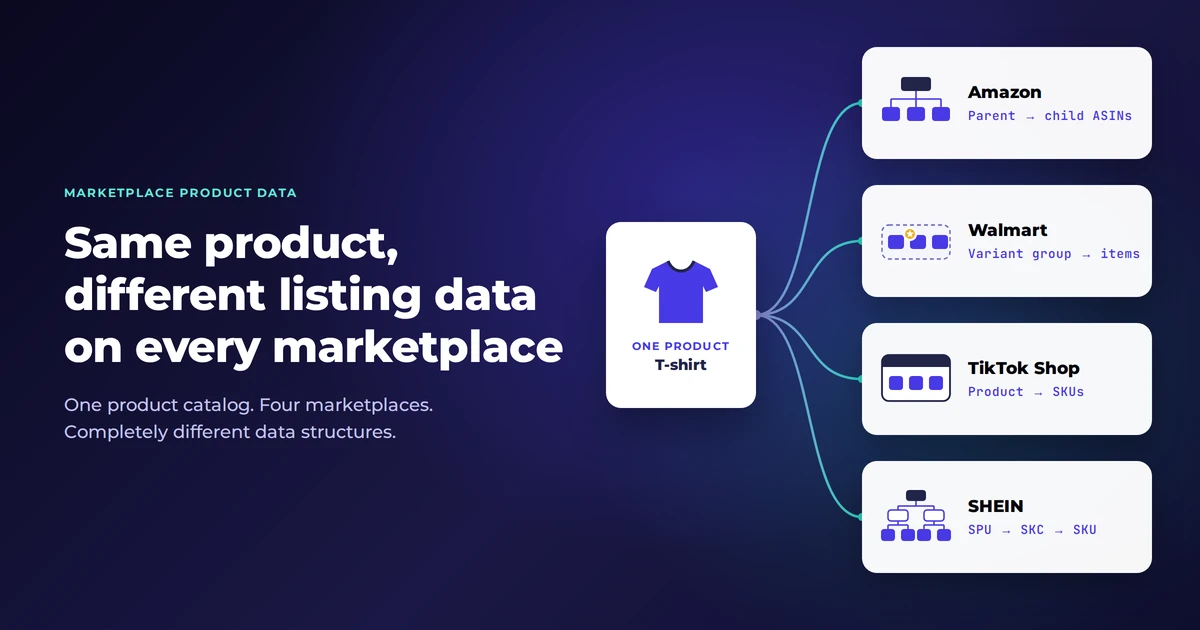
TikTok Shop, Temu, SHEIN, Target Plus, Amazon, and Walmart do not ask for product data in exactly the same way.
The same product can require different:
Copying product information manually creates both extra work and more opportunities for errors.
UniCon starts with a source catalog and helps adapt it for each supported target. AI attribute mapping can predict category and attribute-value matches, while channel-specific AI content can prepare marketplace-ready titles, bullets, and descriptions for seller review.
The aim is not to blindly push the same listing everywhere.
It is to reuse the product information you already have, then adapt what each marketplace requires.
Imagine one product has 25 units available.
It is listed on Amazon, TikTok Shop, SHEIN, and Temu.
Then BFCM traffic hits all four channels.
Inventory cannot be managed as four separate numbers if all four listings ultimately depend on the same stock pool.
A multichannel setup needs inventory synchronization so a sale on one connected channel is reflected across the others before unavailable stock continues selling elsewhere.
The more channels you add for BFCM, the more important this becomes.
Adding a marketplace does not always mean adding another warehouse.
Depending on the route, your existing fulfillment infrastructure may already be able to serve the new channel.
For example:
Amazon FBA inventory → Amazon MCF → TikTok Shop orders
Amazon FBA inventory → Amazon MCF → Temu orders
Walmart WFS inventory → Walmart MCS → SHEIN orders
Seller warehouse → marketplace-specific fulfillment
UniCon helps coordinate these fulfillment paths through order-routing rules.
This means fulfillment can become part of your marketplace-expansion strategy rather than a separate operation created every time you add another channel.
Traffic fragmentation quickly becomes operational fragmentation.
UniCon’s Manage Orders section acts as a central hub for orders synchronized from connected sales channels. Sellers can view order status, fulfillment type, shipment progress, and order history without using every marketplace dashboard as the primary operating view.
The goal is straightforward:
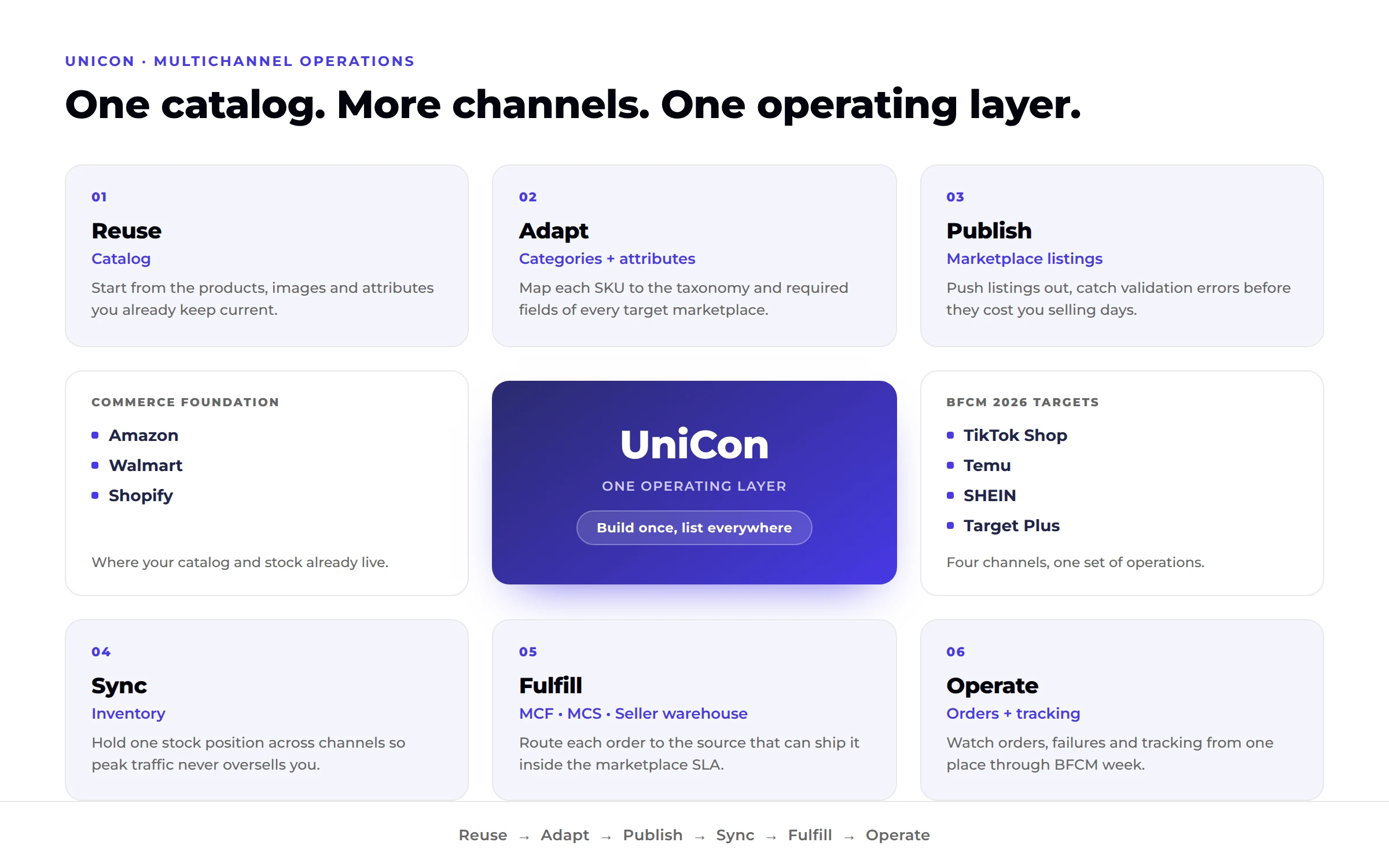
Reuse. Adapt. Publish. Sync. Fulfill. Operate.
That is the operational layer behind a sustainable multichannel BFCM strategy.
For the broader Amazon, Walmart, eBay, and Etsy preparation process, follow our complete BFCM 2026 early seller preparation checklist alongside this marketplace-expansion playbook.
Black Friday falls on Friday, November 27, 2026, and Cyber Monday falls on Monday, November 30, 2026.
TikTok Shop currently lists its Black Friday & Cyber Monday campaign from November 11 through December 1, 2026. Its Creator Community BFCM activity begins November 1.
Yes. Temu currently allows U.S. sellers to register through its Seller Center. Sellers provide their business or individual information, complete verification, create their store, and then begin listing products.
Temu’s current U.S. seller acquisition page advertises 0% commission fees. Sellers should still verify current terms in Seller Center before setting BFCM margins because platform programs and commercial terms can change.
SHEIN currently lists a minimum annual revenue of $5 million, domestic U.S.-based operations, direct-to-consumer shipping from the U.S., and professional seller operations among its marketplace requirements.
No. Target Plus is a curated marketplace. Sellers need to apply and meet Target’s eligibility requirements before onboarding. Target says the typical acquisition process takes approximately 3 to 6 weeks before transitioning to onboarding.
Yes. With the required UniCon and Amazon MCF setup, eligible orders from TikTok Shop and Temu can be routed to Amazon Multi-Channel Fulfillment.
Amazon fulfills those orders using available FBA inventory, while order, shipment, and tracking information are synchronized through UniCon.
This allows an Amazon seller to expand to supported target marketplaces without maintaining a completely separate stock pool and fulfillment operation for each one.
Yes. UniCon supports routing eligible SHEIN orders through Walmart Multichannel Solutions when Walmart is used as the source, the corresponding inventory is available in WFS, and the required MCS and order-routing configuration is active.
Start with the channel that best matches your catalog, eligibility, margins, fulfillment infrastructure, and ability to operate it reliably.
TikTok Shop may make sense when your products lend themselves to creator-led discovery. Temu may suit a catalog that can compete strongly on price and product economics. SHEIN requires a more established U.S. operation and marketplace eligibility. Target Plus is better treated as a curated expansion opportunity for sellers who are already approved or moving through onboarding.
Use the marketplace comparison earlier in this guide before committing inventory or campaign budget.
Adding a sales channel should increase the number of places your products can sell.
It should not multiply the amount of manual work behind every product.
If your catalog already exists on Amazon, Walmart, or Shopify, UniCon helps you reuse that foundation for supported marketplaces. Product data can be adapted to channel requirements, inventory can stay synchronized, orders can return to one operating layer, and existing fulfillment networks can support additional channels where configured.
For an Amazon seller, that can mean using the same FBA inventory to fulfill eligible TikTok Shop and Temu orders through Amazon MCF.
For a Walmart seller, that can mean using WFS inventory to fulfill eligible SHEIN orders through Walmart MCS.
Your BFCM expansion can therefore follow one connected process:
Reuse your catalog.
Adapt it for the marketplace.
Publish the right products.
Keep inventory synchronized.
Route fulfillment through existing infrastructure.
Operate your channels together.
BFCM is the traffic opportunity.
The real advantage is being ready to handle that traffic when it arrives.

Reading Time: 13 minutes Q4 is a bad time to discover that expanding to another…
Reading Time: 11 minutes The same physical product can require a different listing structure on…
Reading Time: 12 minutes Looking to sell on SHEIN from Amazon? You could potentially tap…
Reading Time: 10 minutes SHEIN Marketplace sellers work with two underlying fulfillment models: seller-managed fulfillment,…
Reading Time: 1 minuteIntro Summary France has passed a revised fast-fashion law aimed at regulating…
Reading Time: 3 minutes SHEIN has launched a new product safety and quality compliance training…
Reading Time: 3 minutes Major global marketplaces, including Temu, SHEIN, eBay, Amazon, and AliExpress, are…
Reading Time: 9 minutes Your buyers are not shopping in one place anymore. They search…
Reading Time: 11 minutes What if reaching hundreds of millions of Amazon customers didn’t mean…
Reading Time: 2 minutes Amazon has expanded Multi-Channel Fulfilment (MCF) and the broader Supply Chain…