Pre-BFCM Buzz: How to Tease Your Sales and Incentivize Early Shoppers
October 6, 2026
Please correct the marked field(s) below.
Running short of time? Get PDF of the blog in your mail.
Thank You! The PDF is headed straight to your inbox
Reading Time: 15 minutes
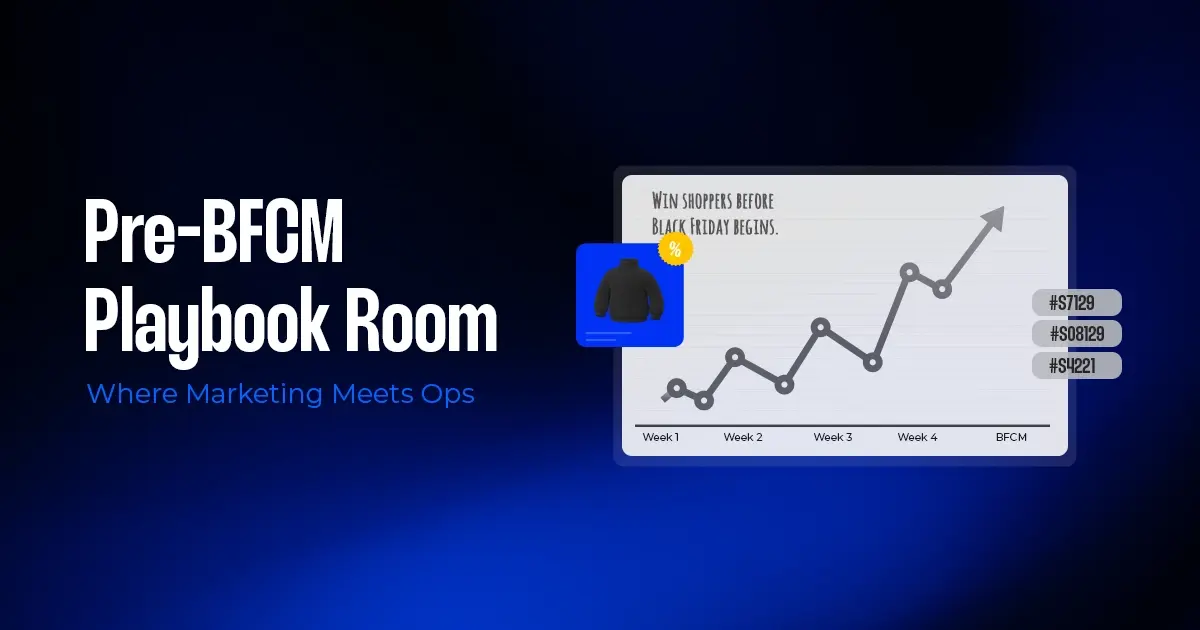
It’s early October. The whiteboard is covered in timelines, SKU codes, and a single bold line: “Win shoppers before Black Friday begins.” Marketing is planning early-access campaigns. Operations is mapping warehouse capacity. CRM is building VIP flows that shouldn’t depend on the deepest public discounts.
This is the Playbook Room: where tactical arguments meet operational limits. The goal isn’t poetic, it’s practical: get buyers to act earlier with offers that build trust and protect margin, while making sure inventory and fulfillment can absorb the demand.
Pre-BFCM strategy success is simple to describe and hard to execute. You must coordinate SEO, paid media, creative, loyalty, inventory, marketplace operations, and fulfillment under time pressure. Winning early does not simply mean discounting earlier. It means creating a deliberate pre-BFCM buying path for customers who are already showing intent.
This blog walks through an operational playbook, voice by voice, from T-minus six weeks through BFCM launch, including what to measure and when to adjust. This is the Pre-BFCM strategy playbook for 2026. Welcome to the Playbook Room, where four voices guide the strategy:
The Seller — voicing doubts and challenges.
The Analyst — bringing in current shopper and ecommerce data.
The Ops Manager — reality-checking capacity, inventory, and logistics.
The Strategist — turning everything into an executable plan.
By the end, the whiteboard won’t just be cluttered—it’ll hold a timeline your team can execute step by step.
The Seller: What You’re Worried About
“If I sell too early, I’ll cannibalize BFCM. If I don’t, I’ll be invisible. And what if I can’t deliver?”
Those are rational concerns. Here’s what to keep in mind:
Early access does not have to mean your biggest discount. Loyalty members, subscribers, repeat buyers, and other high-intent audiences can be approached with bundles, access, convenience, or fulfillment benefits before public promotions begin.
Margin control is possible. A pre-BFCM offer can use exclusive bundles, loyalty rewards, reserved inventory, shipping incentives, or early product access instead of simply copying the deepest Cyber Week markdown.
Operations are the limiter. Marketing can generate demand quickly. Inventory, order routing, warehouse capacity, and delivery performance determine whether that demand creates revenue or customer-service problems.
If you want to sell early successfully, treat it as a multidisciplinary operation: targeted marketing + controlled inventory + dependable fulfillment + connected systems. That is the foundation of a strong Pre-BFCM strategy.
The Analyst: What the 2026 Data Says & the SEO/SXO Playbook
The case for preparing before Cyber Week is especially strong in 2026. Adobe’s latest holiday forecast expects U.S. online holiday spending from November 1 through December 31 to reach $275.1 billion, up 6.7% year over year. Cyber Week alone is forecast to generate $47.5 billion online, while Black Friday is projected to reach $12.9 billion.
But the most important signal for a pre-BFCM strategy appears even earlier. Adobe expects U.S. online spending in October to reach $95.8 billion, up 8% year over year, with October deal events helping create a significant pre-season spike in shopping activity. In other words, waiting until Black Friday week to begin earning attention leaves meaningful demand on the table. See Adobe’s 2026 Holiday Shopping Forecast.
Key 2026 data realities and what they mean for sellers:
Holiday demand is stretching earlier. Adobe expects October ecommerce activity to grow ahead of the traditional November-December holiday window. Your landing pages, marketplace listings, audiences, and inventory plan should therefore be ready before Cyber Week.
The deepest discounts still come later. Adobe forecasts average discounts of roughly 14% in early November, 21% just before Thanksgiving, and around 30% during Cyber Week. That makes pre-BFCM a useful period for competing through access, convenience, bundles, loyalty, and availability instead of immediately matching peak-season discounts.
Black Friday itself is still getting bigger. Adobe forecasts Black Friday online spending to grow 9.2% year over year in 2026. Early selling should complement your BFCM campaign, not drain the inventory you need for the main event.
Discovery is changing. Adobe projects AI-driven traffic to U.S. retail sites to rise 130% year over year during the 2026 holiday season. Clear product information, structured attributes, useful FAQs, accurate availability, and strong marketplace content matter not only for traditional search but increasingly for AI-assisted product discovery.
SEO + SXO Action Steps: Do These Before Demand Peaks
Create Dedicated Early-Access Landing Pages
URLs: Use clear paths such as /early-access, /vip-access, or /pre-bfcm instead of burying the campaign beneath generic promotional pages.
Metadata: Explain the actual reason to click, such as early access, limited bundles, shipping availability, or another genuine benefit. Avoid promising delivery dates or stock you cannot guarantee.
Structured data: Keep Product and Offer structured data aligned with the price, availability, and promotional information visible on the page.
Match Content to Pre-BFCM Intent
Replace vague “Coming Soon” messaging with a real action such as “Get Early Access,” “Shop the Early Collection,” or “Reserve Your Bundle” when those actions are genuinely available.
Add a short FAQ answering the questions most likely to delay conversion: offer dates, stock availability, shipping windows, returns, price protection, and whether a later BFCM promotion will be different.
Keep product titles, specifications, images, and offer details consistent wherever the same product is being promoted.
Improve the Shopping Experience
Use one clear primary CTA above the fold.
Make the value of buying early immediately understandable.
Keep mobile pages fast and easy to purchase from. Adobe expects mobile to remain a major part of 2026 holiday ecommerce, particularly on holiday shopping days.
Show stock, fulfillment, and delivery information as clearly as your systems allow instead of hiding operational details until checkout.
Build Tracking and Retargeting Audiences Early
Track meaningful events across your pre-BFCM pages: product views, email or SMS opt-ins, add-to-cart activity, checkout starts, and purchases.
Build audiences around actual behavior, for example, visitors who viewed the early-access page but did not buy, or shoppers who added an early bundle to cart.
Match retargeting creative to that behavior instead of showing every visitor the same generic BFCM ad.
Paid Search & Social Timing
Begin testing early-access positioning before the most competitive Cyber Week period rather than waiting to launch every campaign at once.
Prioritize audiences with stronger purchase signals and use your own CPA, margin, and customer-value data to decide where incremental budget should go.
Use early performance to identify the products, bundles, messages, and audiences worth scaling later.
A/B Tests to Run Before BFCM
CTA: “Unlock Early Access” vs. “Shop Early Access.”
Offer: Exclusive bundle vs. loyalty benefit vs. shipping incentive.
Message: Availability-led messaging vs. value-led messaging.
Landing page: Product-first layout vs. offer-first layout.
Quick readiness checklist:
Early-access landing page is live and crawlable.
Product and promotional information is accurate.
Analytics and conversion events are working.
Retargeting audiences are building.
At least one offer and CTA test is running.
Inventory and fulfillment teams know exactly which SKUs are being promoted.
The Ops Manager: Staging Demand Without Breaking Fulfillment
Marketing that outpaces operations is an expensive mistake. The operations play is about staggering demand, protecting inventory, and making sure every promotion can actually be fulfilled. A smart Pre-BFCM strategy builds fulfillment discipline into the plan from day one.
Tactical Ops Controls
Geo-staged rollouts
If order volume or warehouse capacity requires it, open early access in controlled regional or customer segments instead of exposing the entire audience simultaneously.
Choose each release window based on forecast demand, warehouse capacity, inventory availability, and carrier cutoffs rather than using an arbitrary fixed schedule.
SKU-level gating
Do not automatically put the full catalog into early access. Prioritize products with healthy availability, dependable replenishment, workable margin, and a clear promotional reason.
Protect quantities required for your main BFCM campaign if the same inventory feeds multiple marketplaces or sales channels.
Priority fulfillment lanes
If your operation supports it, identify early-access orders in your OMS or fulfillment workflow so the warehouse can monitor them separately.
Confirm which warehouse, 3PL, Amazon MCF, Walmart MCS, or other configured fulfillment path is responsible before the campaign goes live.
Buffer inventory and safety stock
Set safety stock using demand variability, replenishment lead time, marketplace commitments, and your tolerance for stockouts. Avoid applying one fixed buffer rule to every SKU.
Reconcile available-to-sell inventory before expanding an offer to additional marketplaces.
Clear SLAs and customer messaging
Show realistic delivery expectations instead of promotional guarantees your fulfillment operation cannot reliably support.
If a delay occurs, communicate quickly and provide the resolution options allowed by your own and the marketplace’s policies.
Technology checks
Test checkout, order creation, marketplace APIs, inventory updates, and tracking flows before increasing traffic.
Confirm that the same SKU is correctly identified across every connected marketplace and fulfillment service.
Check what happens when inventory hits zero, an order fails to route, tracking is delayed, or a listing is rejected.
Returns and reverse-logistics preparation
Document how returns will be handled for each channel and fulfillment route.
Make sure early-access messaging does not conflict with marketplace return requirements.
Without these safeguards, a Pre-BFCM strategy can create inventory mismatches and service failures precisely when teams are preparing for the highest-pressure part of the season.
Ops Playbook Example: T-minus 2 Weeks
Reconcile inventory by SKU and channel.
Tag or identify the products included in early access.
Verify order-routing rules and fulfillment locations.
Confirm warehouse and carrier mappings.
Run a controlled order-volume test against your expected first-wave demand.
Validate inventory deductions and tracking updates across connected channels.
Document the fallback path if the preferred fulfillment service becomes unavailable.
Failure points and quick mitigations:
A SKU sells out early: stop promoting it, update availability across connected channels, and substitute another product only when the offer remains accurate.
An inventory sync fails: pause affected listings or campaigns until stock accuracy is restored.
A fulfillment route fails: move orders to an approved fallback location where possible and verify that tracking still reaches the selling channel.
A carrier delay occurs: notify affected customers promptly and provide the resolution available under the relevant shipping and marketplace policies.
Preparing more than one marketplace for BFCM?
UniCon can help you reuse an existing catalog across connected marketplaces, prepare channel-specific product data, and keep inventory and orders sync as pre-BFCM demand starts to spread across channels.
The Strategist: Turn the Pre-BFCM Plan Into One Multichannel Operation
The Seller wants demand. The Analyst wants the right audience and offer. The Ops Manager wants inventory and fulfillment under control. The Strategist’s job is to connect those decisions.
This gets harder when the same catalog is being sold across multiple marketplaces. Product requirements differ, inventory can be shared, orders arrive from different channels, and fulfillment may come from more than one network. That is where integration becomes operationally important. However, not just as a marketing slogan, but as the infrastructure behind the campaign.
How CedCommerce UniCon Supports a Multichannel Pre-BFCM Strategy
CedCommerce UniCon is designed to help sellers manage the work involved in expanding and operating across multiple marketplaces. In a pre-BFCM context, its value is less about creating the promotion itself and more about making sure the catalog, listings, inventory, orders, and fulfillment behind that promotion stay connected.
1. Cross-list an Existing Catalog Instead of Rebuilding It
If the products already exist on a connected source channel, UniCon can use that catalog as the starting point for expansion rather than requiring sellers to recreate every product manually for each target marketplace.
This can be particularly useful before BFCM, when adding another sales channel should not mean duplicating weeks of catalog preparation.
2. Use AI-Assisted Category and Attribute Mapping
Marketplaces do not use identical category trees or product attributes. A product that is complete on one channel may still be missing required information on another.
UniCon’s AI-assisted mapping helps sellers prepare the category and attribute relationships required by the target marketplace. Sellers can review the mapping before publishing, while listing preparation can surface missing or mismatched information before products go live.
3. Prepare Listings for the Marketplace They Are Going To
Cross-listing should not mean blindly copying the same content everywhere. Each marketplace can require different fields, attribute values, category structures, and listing content.
UniCon can help turn source catalog information into marketplace-specific listing data so teams can review what will actually be published to each channel.
4. Keep Inventory and Orders Connected
During pre-BFCM promotions, a product can start selling faster on one channel before another channel has caught up. Inventory sync therefore becomes one of the most important controls against overselling.
UniCon can sync inventory across connected channels and bring orders into a centralized multichannel workflow, reducing the need to monitor each marketplace separately.
5. Centralize Marketplace Operations
Instead of switching between separate marketplace dashboards to understand listings, stock, and incoming orders, UniCon provides a central place to manage connected multichannel operations.
That becomes especially useful during BFCM because exceptions can appear quickly: a listing fails, inventory drops unexpectedly, a product is not linked correctly, or an order requires a different fulfillment path.
6. Use Existing Fulfillment Inventory Where Supported
UniCon can also connect supported marketplace orders with multichannel fulfillment services when the required accounts, inventory, and routing rules are configured.
Amazon MCF: UniCon documentation supports routing eligible orders from supported external channels such as TikTok Shop or Walmart through Amazon Multi-Channel Fulfillment when the seller has the appropriate Amazon inventory and MCF setup. See the Amazon connection and MCF documentation.
Walmart MCS: Sellers using inventory stored through Walmart Fulfillment Services can configure supported external-channel orders for Walmart Multichannel Solutions. For example, UniCon documents a workflow for routing eligible SHEIN orders through Walmart MCS using WFS inventory. See the Walmart MCS fulfillment workflow.
The important point is that fulfillment should be planned by actual supported route, instead of assumption simply because inventory exists in Amazon or Walmart. Confirm product matching, available inventory, warehouse mapping, order routing, carrier mapping, and marketplace requirements before BFCM traffic arrives.
Not sure how your BFCM channel and fulfillment setup should work?
If you plan to cross-list products before BFCM or use Amazon MCF or Walmart MCS for eligible marketplace orders, validate the catalog, inventory, and fulfillment flow before launching the campaign.
Build your VIP audience using consented email, SMS, loyalty, and customer segments.
Finalize early-access SKUs and bundles.
Identify which marketplaces will participate.
Confirm which fulfillment source will serve each channel.
Create landing pages and campaign content.
T-minus 4 weeks
Launch early-access or waitlist pages.
Validate structured data and tracking.
Begin low-scale paid traffic to build audiences and test messaging.
Confirm safety stock, marketplace inventory, and warehouse capacity.
Complete required marketplace category and attribute mapping for newly added listings.
T-minus 3 weeks
Test checkout and marketplace order flows.
Run your CTA and incentive tests.
Begin staggered teaser communication to qualified segments.
Verify that product, inventory, order, and tracking updates are moving correctly between connected systems.
T-minus 2 weeks
Start controlled early-access traffic.
Monitor sell-through at SKU level.
Confirm that orders are reaching the intended fulfillment location.
Review listing and inventory exceptions daily.
T-minus 1 week
Scale early access only where inventory and fulfillment are stable.
Protect quantities needed for the main BFCM promotion.
Increase monitoring frequency for your highest-volume products and channels.
Prepare fallback creative for products that become unavailable.
BFCM week
Keep inventory synced across active channels.
Pause products or campaigns when stock or fulfillment capacity becomes unsafe.
Reallocate spend toward offers with healthy conversion, margin, and inventory depth.
Watch order exceptions, fulfillment delays, cancellations, and listing errors—not revenue alone.
Incentives That Convert Without Making Margin an Afterthought
The purpose of a pre-BFCM incentive is to give shoppers a reason to act before the biggest promotional days arrive. Because Adobe expects discounts to deepen as Cyber Week approaches, competing only on percentage-off pricing can force you into your strongest markdown too early.
High-Impact Incentive Types
Exclusive bundles — Combine complementary products into a package that is available only during the early-access window.
Loyalty multipliers — Reward existing customers with additional points or loyalty benefits while keeping the product price intact.
Shipping incentives — Offer free or upgraded shipping when the economics and fulfillment capacity support it.
VIP stock access — Give selected customers first access to limited quantities or new products.
Price protection — If operationally and legally appropriate for your business, promise a defined remedy when the same item receives a lower qualifying price during a specified period.
Service perks — Offer benefits such as priority support, extended returns where permitted, or gift services.
How to Pick the Right Incentive
If fulfillment capacity is a strength, test shipping or delivery benefits.
If repeat purchase and retention matter most, test loyalty-led incentives.
If inventory is constrained, focus on controlled VIP access or carefully selected bundles.
If margin is already tight, avoid using the deepest BFCM-style discount simply to create an early offer.
Testing & Measurement
Test one meaningful variable at a time where possible.
Compare conversion rate, AOV, gross margin per order, CPA, and subsequent customer behavior, not revenue alone.
Use your early-access cohort to identify offers worth carrying into the main BFCM campaign.
Separate performance by channel so a strong result on one marketplace does not hide weak economics on another.
Practical Messaging: Examples & Templates
Use messaging that reflects the real offer and reduces uncertainty. Below are templates you can adapt across email, landing pages, ads, and marketplace campaigns.
Email subject lines for VIP segments
“Early Access: Your VIP Bundle Is Live”
“You’re on the List: Shop Before BFCM”
“Early Access Is Open for [Product/Collection]”
Header/hero copy for an early-access landing page
H1: “VIP Early Access — Shop Before BFCM”
Subhead: “Get first access to selected products and bundles while early inventory is available.”
Primary CTA: “Shop Early Access”
Retargeting copy for cart abandoners
“Your early-access picks are still waiting.”
“Early inventory is limited. Return to your cart to check availability.”
Microcopy for trust
“Estimated delivery: [accurate delivery window]”
“Early-access inventory is limited and subject to availability.”
“See promotion terms for price, shipping, and return conditions.”
Avoid hard-coded delivery guarantees or scarcity language unless your inventory and fulfillment systems can support them.
Measurement: KPIs, Dashboards, and Decision Rules
Track a concise set of KPIs and agree on decision rules before early access begins. That prevents teams from changing promotions based on one noisy metric while ignoring margin or operational capacity.
Core KPIs
Early-window conversion rate
Average order value
Gross margin per order
Revenue by channel
CPA or ROAS for paid early-access campaigns
Sell-through by SKU
Available-to-sell inventory
Order-routing success rate
Fulfillment SLA performance
Cancellation rate
Return rate
Listing or inventory-sync exceptions
Decision rules
If conversion is materially below your approved baseline, investigate the offer, traffic quality, product availability, landing experience, and pricing before increasing spend.
If fulfillment performance moves outside your internal SLA, reduce campaign exposure until operations stabilizes.
If a product is selling faster than the inventory plan allows, protect remaining stock rather than allowing one early campaign to exhaust BFCM availability.
If an offer produces higher AOV but weaker contribution margin, do not call it a winner on revenue alone.
If one marketplace is generating repeated inventory or order exceptions, isolate the issue instead of allowing it to affect every connected channel.
Overselling or stockouts: Stop promotion of the affected SKU, update availability across connected channels, and review why the inventory signal was late or inaccurate.
Order-routing failure: Confirm that the target account, fulfillment location, routing rule, and relevant product identifiers are correctly configured.
Carrier delay: Communicate with affected customers promptly and provide the resolution allowed by the relevant marketplace and shipping policy.
Unexpected returns: Review the product, offer, listing content, sizing or specification details, delivery experience, and promotion expectations before scaling the same campaign.
Recovery & Reset Checklist
Capture the root cause: Was it demand forecasting, campaign messaging, listing preparation, inventory sync, order routing, fulfillment, or carrier performance?
Quantify the impact: Identify affected SKUs, orders, channels, revenue, inventory, and customer-service cases.
Contain the problem: Pause only the affected product, route, or campaign where possible rather than shutting down every channel.
Correct the configuration: Fix inventory rules, product mapping, marketplace data, routing, or campaign messaging.
Retest: Run a controlled transaction through the corrected flow before resuming full-volume promotion.
Update the playbook: Document what failed so the same issue does not reappear during BFCM week.
Final Word: Execute Like a Unit
Pre-BFCM strategy is not simply an earlier Black Friday sale. It is an operational campaign that connects acquisition, merchandising, catalog readiness, inventory, fulfillment, and customer communication.
The 2026 data makes the timing clear: ecommerce activity is already building before Cyber Week, while the biggest discounting and spending days still lie ahead. The goal is therefore not to pull every BFCM purchase forward. It is to capture early intent without exhausting margin, inventory, or operational capacity before peak demand arrives.
Your immediate action items:
Publish and optimize your early-access landing experience.
Activate tracking and begin building qualified audiences.
Choose the SKUs that can safely participate in early access.
Confirm inventory availability across every participating marketplace.
Validate listing requirements before cross-listing new products.
Confirm each marketplace’s order and fulfillment path.
Run at least one controlled offer or messaging test before scaling.
Document what happens if inventory, listing, order routing, or fulfillment fails.
Integration is the enabler, not the talk track. When catalog preparation, marketplace listings, inventory, orders, and fulfillment stay connected, teams can enter BFCM with fewer manual handoffs and a much clearer picture of what they can safely scale.
Tags:
BFCM 2026BFCM playbookPre-BFCMSEO and AdsTease SalesUniCon
About The Author
shreya salil
Shreya Salil is a seasoned content writer specializing in eCommerce. Her knack for storytelling and industry expertise combine to create informative and engaging content.