
CedCommerce Apps Are Now Available in Shopify Sidekick
Reading Time: 6 minutes Your marketplace stack may be connected, but your attention is still…
Running short of time? Get PDF of the blog in your mail.
In a world where cross-border commerce fuels eCommerce growth, tariffs are no longer just policy tools. They are business disruptors. The latest U.S. tariff developments in April 2025 have sent a clear signal: uncertainty is the new norm. For online retailers, especially those importing goods or relying on international fulfillment, this is not just a headline. It is a direct hit to margins, supply chains, and strategic planning. Understanding how tariffs work, and how to adapt fast, is now a business imperative.
April 2025 marked a turning point in U.S. trade policy. What began as an aggressive rollout of tariffs-including a universal 10% import tax and country-specific surcharges-quickly evolved into a volatile episode of policy reversals and global recalibrations.
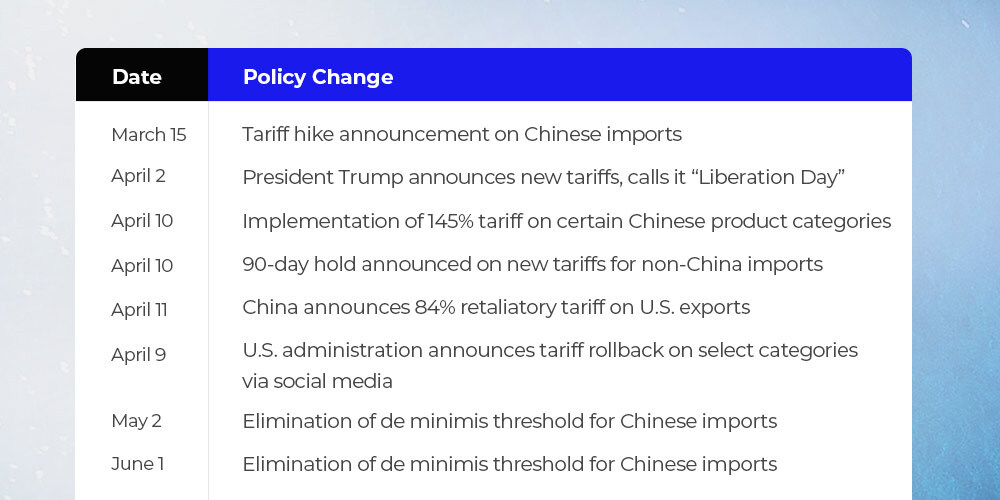
While China faced the sharpest blow with tariffs reaching 145%, the scope was far broader. Vietnam, the EU, Japan, and even neighbors like Canada and Mexico were caught in the crosshairs. Low-value imports lost their de minimis exemption, and postal fees were added to the mix. The result? A sweeping disruption of global supply chains.
But within seven days, the U.S. administration reversed several key measures, citing the need for flexibility. This abrupt shift, made via social media, reinforced what global sellers already knew: predictability is no longer part of the equation.
What this means for sellers: Sellers must plan for short policy cycles, not long-term stability. The 90-day pause, announced as a temporary measure for non-China markets like India, Vietnam, and the EU, gives sellers a limited window to recalibrate supply chains, negotiate contracts with alternative regions, and mitigate future disruption risks before further tariff layers potentially kick in.
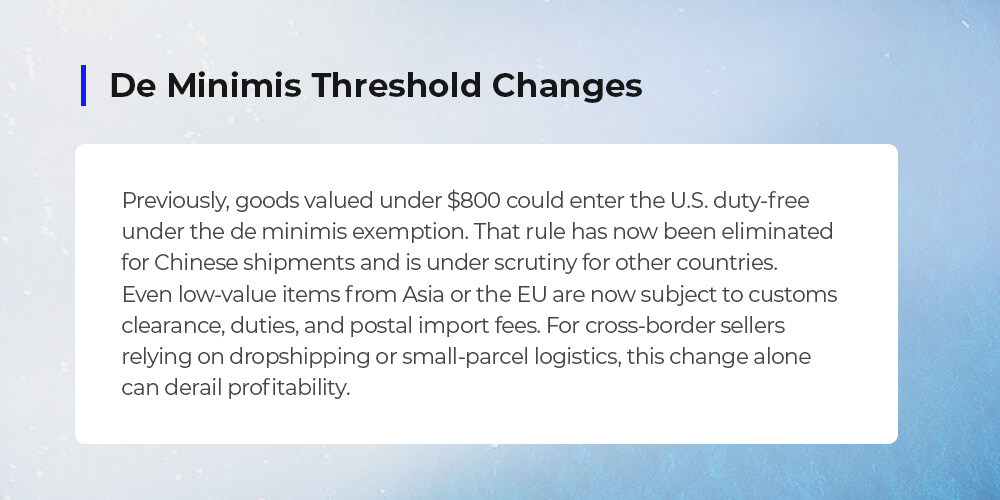
Before we unpack what tariffs actually are, let’s first anchor ourselves in the timeline of key trade policy shifts that have redefined 2025 for global sellers.
Tariffs, at their core, are import taxes imposed by a country on goods coming from abroad. The U.S. government uses them as a trade policy lever to protect domestic industries, negotiate agreements, or penalize perceived unfair trade practices. For global eCommerce sellers, tariffs are not just a financial consideration, they are a key component of compliance, strategy, and international competitiveness.
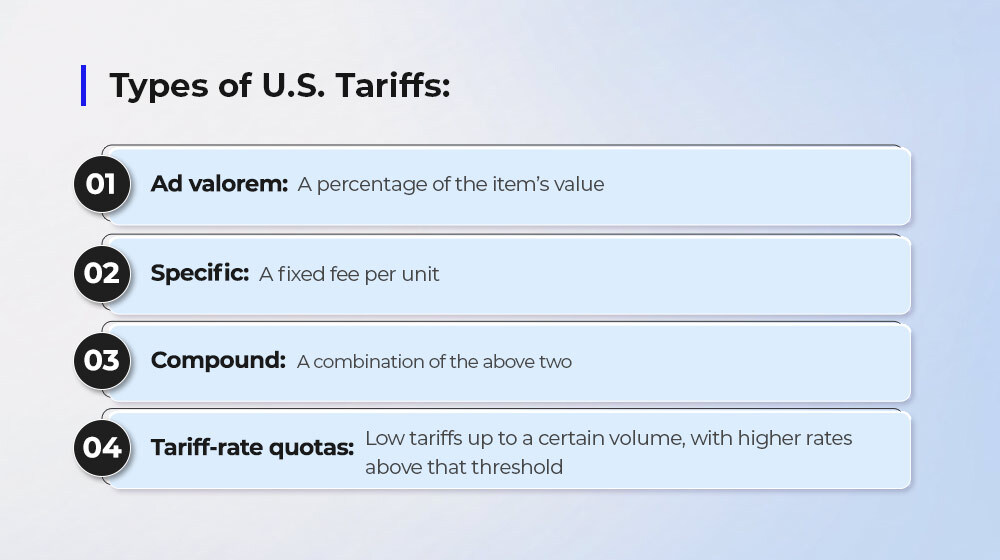
The U.S. Trade Representative (USTR) and the U.S. International Trade Commission (ITC) control the tariffs in the United States. These agencies determine tariff schedules, trade enforcement mechanisms, and retaliatory duties in response to foreign trade practices. Additionally, executive authority—especially under the International Emergency Economic Powers Act (IEEPA)—gives the President broad powers to impose or reverse tariffs rapidly, as was seen in the surprise reversal of several announced April 2025 tariffs.
This policy volatility presents a major challenge for online retailers. Governments can announce, implement, and rescind tariffs within days, making it difficult for businesses to plan long-term and exposing them to sudden cost shocks. For global sellers, the message is clear: trade unpredictability is the new baseline, and resilience in sourcing and logistics is now a business necessity.
For eCommerce sellers, tariffs impact product costs, shipping strategies, and supply chain decisions. Direct-to-consumer (D2C) brands that rely on imports or international fulfillment face cascading effects across their operations.
Not all product categories are bearing the tariff burden equally. The severity of impact depends on sourcing location, component complexity, and exposure to high-frequency cross-border shipments.
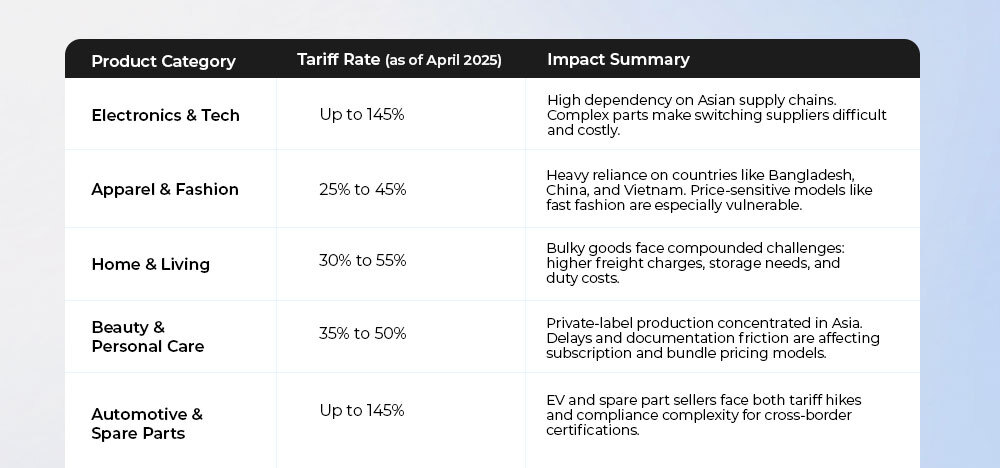
In a world where tariff announcements can flip within a week, sellers need more than reactive measures. The most agile eCommerce businesses are treating this as a moment to overhaul – not just optimize – their sourcing and fulfillment playbooks.
Rather than simply absorbing higher costs or tweaking product prices, these brands are investing in foundational resilience: diversifying supplier portfolios, reshaping their cash flow models, and integrating data-backed systems that can adapt in real time.
The takeaway: It’s not about avoiding the next tariff – it’s about building a model that can thrive regardless of them.
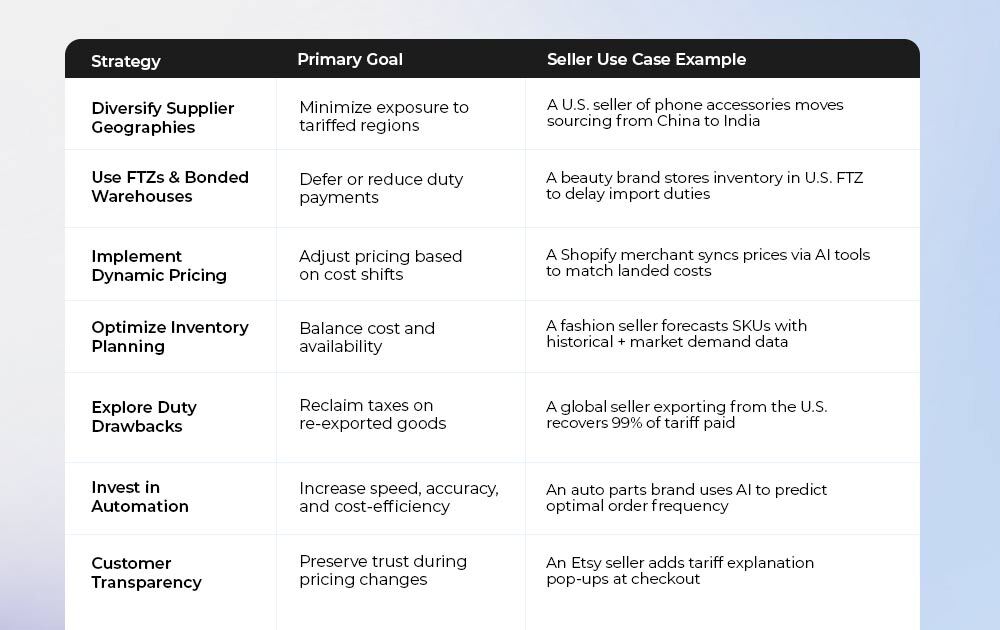
If there’s one truth sellers can rely on, it’s that tariff policy in 2025 is anything but predictable. The rapid rollout and reversal of sweeping U.S. tariffs in April, executed through social media and lacking institutional check, has confirmed what many already suspected: we are in an age of economic insecurity.
This moment isn’t an isolated disruption, it’s a symptom of broader systemic volatility. The rules of trade are shifting from economically-driven policy to politically-charged maneuvering. Retailers must now evaluate sovereign intent and geopolitical context with the same rigor as they assess inventory turnover or ROAS.
As highlighted by experts, “The days of just-in-time pricing, centralized sourcing, and linear forecasting are behind us.” Sellers need more than backup suppliers, they need backup scenarios.
Meanwhile, China’s retaliatory 84% tariffs remain in place. The European Union and Latin America are evaluating responses. The WTO is now evaluating the need for a new dispute mechanism to address this “age of unpredictability.”
What sellers should do now: Monitor USTR and international trade updates weekly. Layer political and economic risk into your margin models. Prioritize flexibility over optimization in logistics and pricing. Build your business not just to perform, but to withstand.
We’re entering an era where businesses no longer view trade disruptions as exceptions, they now expect them. The US tariffs in 2025 are no longer just a footnote in supply chain strategy; they’re a front-row concern for pricing, inventory, logistics, and long-term planning.
For global sellers, the next 12 months won’t just be about finding the perfect response to each policy change. Instead, it will be about staying strategically flexible across all fronts. As a result, smart businesses are now treating this shift as a wake-up call — prompting them to modernize sourcing, decentralize operations, and embrace dynamic risk models to stay ahead.
Now is not the time for static strategies. It’s the time to build systems that evolve.
Need help making sense of global selling conditions? Talk to our experts today.

Reading Time: 6 minutes Your marketplace stack may be connected, but your attention is still…

Reading Time: 4 minutes Amazon Prime Day 2026 helped drive more than $26.4 billion in…

Reading Time: 1 minuteIntro Summary Shopify Scripts stopped executing entirely on June 30, 2026. Merchants…

Reading Time: 1 minuteIntro Summary France has passed a revised fast-fashion law aimed at regulating…
Reading Time: 2 minutes Intro Summary The European Union’s new €3 customs duty on low-value…
Reading Time: 2 minutes Amazon has announced a major catalog optimization change that will impact…
Reading Time: 3 minutes SHEIN has launched a new product safety and quality compliance training…

Reading Time: 4 minutes Etsy has introduced listing-level strategies for Etsy Ads, giving sellers more…
Reading Time: 4 minutes Walmart Expands Scrutiny on Product Claims Across Marketplace Listings Walmart Marketplace…
Reading Time: 5 minutes Customers Can Now Turn Simple Prompts Into Personalized Merchandise on Amazon…