
Amazon vs Walmart vs Target Plus: What Changes Operationally for Sellers?
Reading Time: 11 minutes If you already sell on Amazon, adding Walmart or Target Plus…
Running short of time? Get PDF of the blog in your mail.
How to find, quantify, and validate winning Amazon products? Amazon product research in 2026 requires more than chasing whatever went viral last night. When a product gains traction on TikTok Shop, your next step is to verify whether shoppers are actively searching for it on Amazon or Google. From there, assess keyword demand, competition density, margin structure, and compliance risk before placing a single order. This loop is what separates impulse launches from scalable ones.
If you’re an FBA or private-label seller in the US or EU, this framework is built for you. At CedCommerce, we’ve seen sellers avoid dead inventory by validating TikTok demand against Amazon’s Search Query Performance data before scaling ads or inventory.
So let’s figure out how you can build a reliable Amazon product research framework for your business!
What is Amazon product research?
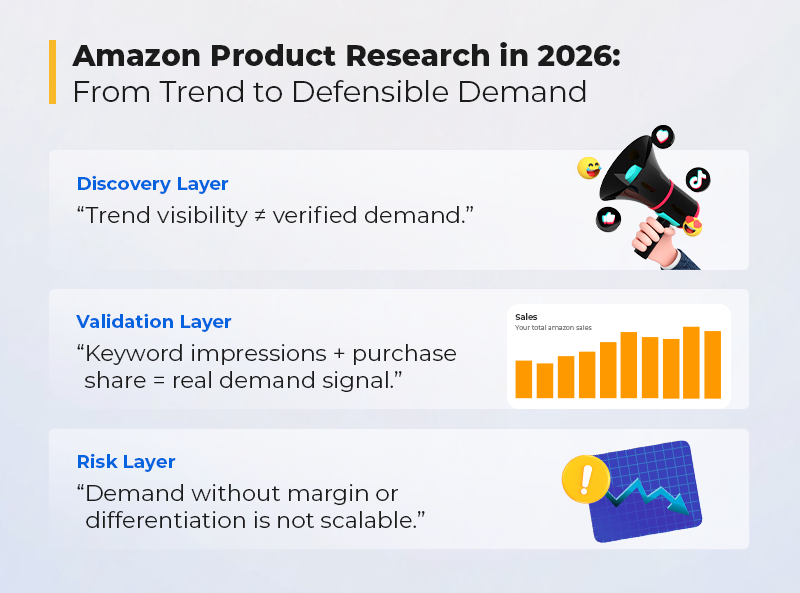
Amazon product research in 2026 is a structured process that combines TikTok for early product discovery, Amazon Search Query Performance and Brand Analytics for demand quantification, and AI tools for validation and risk checks. This approach helps sellers identify real demand, assess competition, and make data-backed decisions before launching products on Amazon FBA.
Traditional methods for Amazon product research, such as scraping bestseller lists, checking surface-level volume estimates, or copying competitors, no longer provide a durable advantage.
Today, product research for Amazon FBA requires connecting real discovery signals, first-party Amazon data, and AI-driven validation. Demand now forms outside Amazon, gets measured inside Amazon, and is evaluated through AI systems before buyers convert. Ignoring these increases the risk of misreading demand timing, overestimating margin stability, or underestimating competitive saturation.
53% of shoppers discover products on social, and Gen Z specifically uses TikTok for shopping discovery at scale. TikTok Shop is also no longer niche, since the UK alone has 200,000+ small businesses selling on it.
For Amazon FBA product research, that means early demand signals often show up in creator content first (demos, comparisons, problem/solution clips), and only later translate into Amazon keyword demand. Hence, you validate with SQP/Brand Analytics before scaling, so TikTok product discovery can be a gamechanger for you.
Amazon expanded access to funnel-level search behavior through Amazon Brand Analytics and Search Query Performance (SQP) dashboards. These have impressions, click share, cart adds, and purchase share at the keyword level.
This can help you measure:
Moreover, validating demand can reduce potential dead stock risk because it confirms purchase-share stability.
AI assistants now summarize reviews, compare specs, and generate buying guides. Your buyers are no longer scanning only listings, they are asking AI to compare them, look for best prices, pros/cons anf product alternatives as well.
This makes “LLM-friendly clarity” critical. Your listings must:
In 2026, validating products now includes testing whether your product positioning is readable and ranking across AI and Amazon SERP.
This is the working loop behind effective Amazon product research 2026. Each stage increases confidence before you invest in inventory, ads, or branding.
If you’re doing TikTok product research or trying to understand how to find viral products on TikTok, focus on structured logging.
What to log:
Be careful of one-off virality from large accounts, giveaway-driven spikes, geographic traction outside your selling market and entertainment content without buying intent
All these will lead you to a product that will not be profitable for you. Hence, once you detect trends you must study their patterns.
Study whether social language is becoming marketplace language.
If TikTok trends say: “Heatless curls overnight hack.” Amazon buyers might search: “heatless curl set,” “no heat hair curler,” “overnight curl headband.” Your job as an Amazon seller is to identify the intent and keywords.
Use:
What to look for in funnel metrics:
For amazon search query performance, don’t just check volume; also study funnel behavior.
How to use this for product ideation:
This is where product research for Amazon FBA becomes measurable.
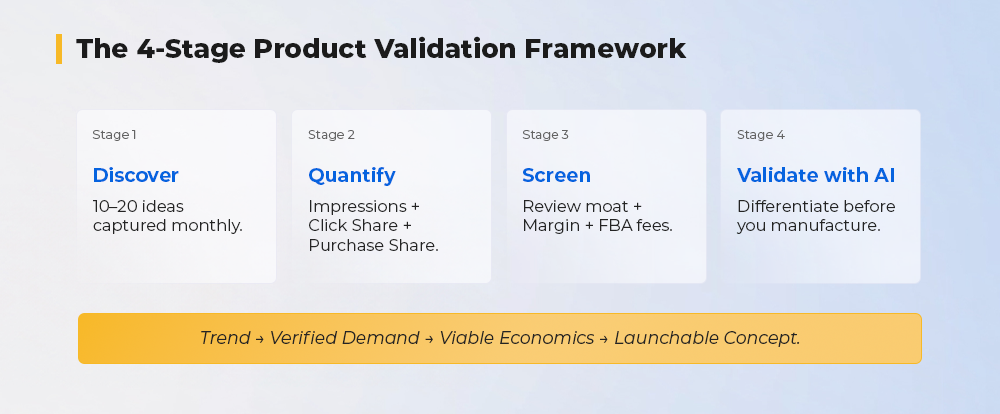
This is your amazon product validation filter.
Competition reality check:
Oversaturation test: Is TikTok already pushing 200 identical suppliers into the same SKU? If yes, you’re entering commodity territory.
When using AI product research tools or AI tools for Amazon product research, focus on extracting insight
Use tools like ChatGPT, Gemini and others for Amazon product research for:
While AI can help you validate product ideas quickly, what AI cannot know:
Those require operator input and your business judgment.
If you want consistent product discovery on TikTok, skip random scrolling and build a trained feed instead.
All algorithms learn from your engagement or behavior. If you want it to surface product-led content, engage with it intentionally.
Account behavior rules:
Your engagement patterns on TikTok can reshape your For You Page into a research feed.
Don’t let your feed become random. Pick 3–5 verticals relevant to your strengths, supplier access, or existing Amazon presence.
These categories could be Home & kitchen, Beauty & personal care, Fitness & wellness, Pet supplies, Baby products, Automotive, Tech accessories, Outdoor & travel or Hobby & DIY. The goal is niche depth, so these verticals help you recognize repeated product patterns, creator ecosystems, and demand cycles, instead of being misled over unrelated trends.
If you’re doing TikTok Shop product research, log everything in a structured sheet. Do not rely on memory.
Recommended sheet columns:
This creates continuity between TikTok discovery and Amazon validation.
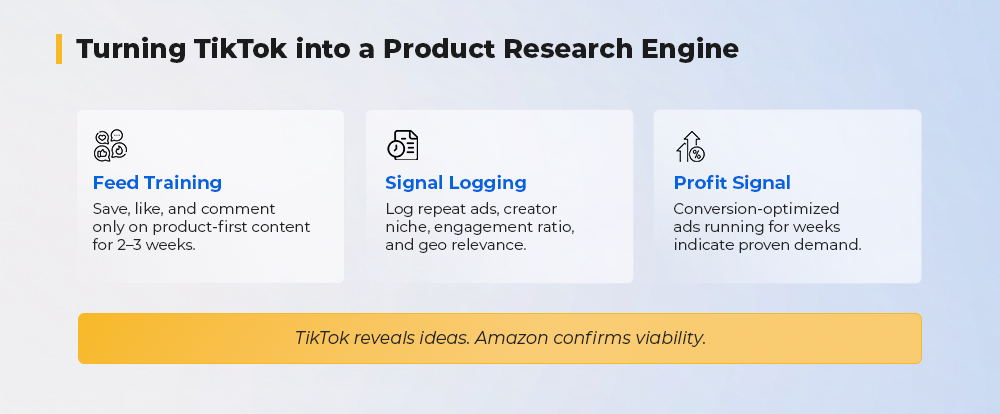
Organic virality is interesting. Paid repetition is stronger.
When analyzing TikTok ad library products or TikTok Shop listings, look for:
Repeated conversion-optimized ads signal that someone is spending money because the product is converting.
What repeat ad creatives reveal:
Once you’re inside the Search Query Performance dashboard and reviewing Amazon Brand Analytics search terms, the goal shifts from validation to opportunity extraction.
Hence, it becomes relatively easier to ascertain demand behaviour across the funnel.
What it does not show:
There’s also a brand-centric limitation. If you don’t own a brand in that niche, visibility may be partial.
What’s the workaround?
Use adjacent signals:
Together, these fill blind spots.
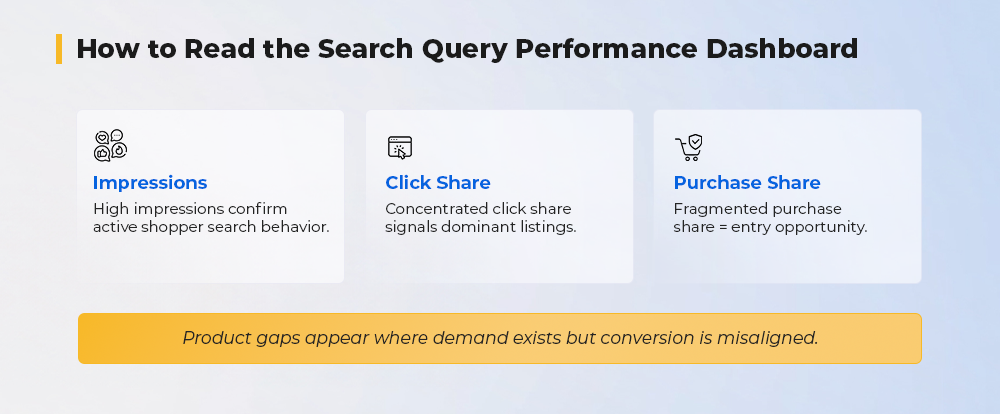
1. High volume + low impression share → Absence opportunity
If a keyword shows strong search demand but no dominant brand controlling impressions, there may be room to enter with better targeting or positioning.
2. High click share + low purchase share → Conversion opportunity
If shoppers click but don’t buy, something is misaligned, like pricing, feature clarity, differentiation, or trust signals. That gap can inform product design or bundling decisions.
Instead of asking “Is this product trending?”, you’re asking: Where is demand under-served?
That’s higher-level Amazon FBA product research.
If you’re running campaigns, the Amazon ad search term report can become a live research feed.
Use small-budget test campaigns to:
Risk: Your bids and budget influence visibility. If you bid too low, you won’t see the full query landscape. Hence, test deliberately.
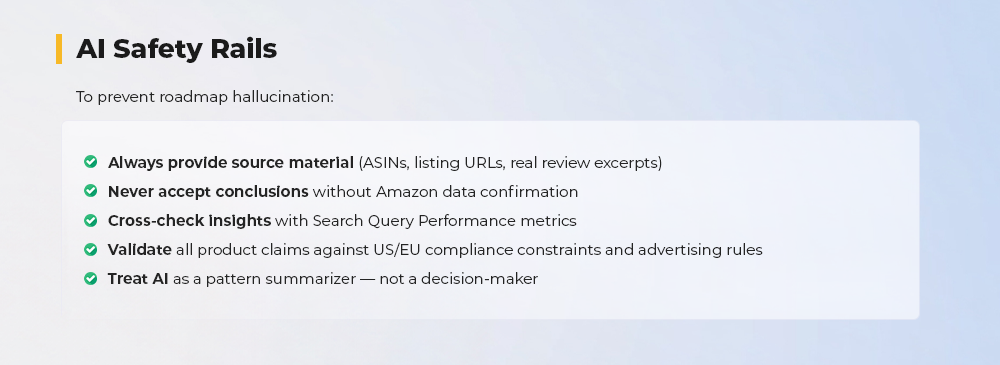
AI can be a powerful tool for Amazon product research BUT without structure, it invents patterns. Hence, aim for disciplined testing.
Start with real ASINs from your niche.
Use it for AI competitive eCommerce analysis by clustering top listings into:
This reveals positioning gaps.
Example: If most listings target “budget home users,” but no one speaks directly to “apartment dwellers with space constraints,” that’s a positioning opportunity.
Always reference actual ASINs in your prompt.
If customers repeatedly mention weak hinges, poor battery life, misleading sizing, or heap materials; those become product specification inputs. Do not rely on the summary alone. Always cross-check review counts and recency inside Amazon.
For US/EU sellers, pay attention to compliance-sensitive complaints such as safety concerns, material claims, or medical or performance exaggerations. These have legal implications.
Use shopping research AI to simulate constrained buyer scenarios.
Prompt example: “Assume you are a US shopper with a $40 budget, small apartment space, and no prior experience. Compare the top 3 listings and explain trade-offs.”
Then repeat for:
This reveals:
It’s not about what you think matters. It’s about what constrained buyers value.
Before launch, use AI to critique:
Ask: “Why would a shopper hesitate to buy this over the current top 3 ASINs?”
Then compare AI critique against:
If AI flags concerns that match real reviews, you’ve likely identified a valid risk.
In regulated categories, especially, US/EU compliance constraints and claims discipline require manual verification before any product or marketing decision.
A structured Amazon product research process uses all three inputs, but at different stages. Each source has blind spots. Use them together inside a clear product research framework.
| Source | What it’s best for | What it could mislead about | When to use it | Output to capture |
|---|---|---|---|---|
| TikTok (organic + TikTok Shop) |
Early demand signals, emerging problems, new product formats | True purchase intent, sustainable demand, regional viability | At the discovery stage to spot rising concepts | Product idea, problem statement, early demand hypothesis |
| Amazon data (Search Query Performance + Brand Analytics) |
Verified keyword demand, click behavior, purchase distribution, competitive concentration | Off-Amazon trend momentum, creative positioning insights | After discovery, to confirm real search and conversion behavior | Validated keyword set, demand score, entry feasibility |
| AI tools (review mining + competitive mapping) |
Pattern extraction, objection mapping, differentiation angles, bundle ideas | Landed cost realities, compliance risk nuances, supplier feasibility | After validation, to refine positioning and reduce blind spots | Differentiation hypothesis, risk flags, positioning strategy |
This decision matrix keeps your product research framework disciplined. Note: Skipping any layer weakens the Amazon product research process.
Scroll inside your trained category lanes
Log 10–20 product ideas
Capture: problem solved, creator niche, engagement quality, repeat ads
Assign a quick signal score (High / Medium / Ignore)
Output: Raw idea pool
For the top 5–7 ideas:
Kill ideas with:
Output: 3–5 viable shortlists
Run fast viability checks:
If margin or operational risk looks weak → move to kill list.
Output: 3 economically feasible ideas
Use AI for:
Tip: Cross-check against real Amazon data before finalizing.
Output:
This becomes your monthly or even quarterly Amazon product research checklist execution cycle.
Use this table as a quick guardrail to avoid saturated products on Amazon and costly missteps.
| Mistake | What it looks like in practice | Why it’s risky | How to avoid it |
|---|---|---|---|
| Confusing views with demand | A product has 1M+ TikTok views, so you assume it will sell on Amazon | Social engagement doesn’t equal purchase intent or search volume | Confirm demand using Search Query Performance and check purchase share stability |
| Skipping keyword-language mapping | Launching based on TikTok phrasing without checking actual Amazon search terms | You optimize for the wrong keywords and miss real buyer intent | Map slang to real Amazon search queries before validation |
| Validating only with tools, not outcomes | Relying on volume tools or AI summaries without reviewing click and purchase data | Estimated data can misrepresent competition or demand quality | Always review impressions, click share, and purchase share inside Amazon data |
| Trusting AI without constraints | Accepting AI-generated product angles without checking reviews or fees | AI can generalize patterns that don’t reflect real market dynamics | Provide real ASINs, reviews, and cross-check outputs with manual verification |
| Ignoring differentiation and review moats | Entering a niche dominated by 4.7★ listings with thousands of reviews | Strong incumbents create high entry barriers and ad costs | Assess review strength, brand density, and identify a clear positioning gap |
Avoiding these errors strengthens your Amazon product research process and reduces the risk of entering oversaturated markets without defensible differentiation.
Now you know Amazon product research in 2026 is about building and following a disciplined framework. When you connect TikTok discovery, Amazon Search Query Performance data, competitive screening, and AI validation into one repeatable workflow, you reduce guesswork and protect capital. Success on Amazon doesn’t rely on being the first to launch; it depends on validating demand, margin, and market positioning before committing to inventory.
Ready to invest in your idea? So are we. Let’s prepare the launch architecture, ranking strategy, advertising precision, and conversion optimization together.
CedCommerce helps sellers move from early-stage validation to $100K+ monthly revenue in a matter of months by combining:
If you’ve found the right product, we’ll help you turn it into a category presence.
Amazon product research in 2026 is a structured validation process used by FBA and private-label sellers to identify profitable, defensible products before launch. It combines TikTok demand discovery, Amazon Search Query Performance and Brand Analytics data, and AI validation to confirm keyword demand, competition levels, margins, and compliance risks.
To do product research for Amazon FBA, identify demand signals, validate keyword impressions and purchase share using Amazon Search Query Performance, assess competition and review strength, calculate FBA fees and margins, and test positioning with AI review mining. This structured approach reduces risk before investing in inventory.
To use TikTok for product discovery, track repeat product appearances, engagement ratios, and buyer-intent comments such as “where can I buy this?” Log patterns across creators, then map TikTok phrasing to Amazon keywords and validate demand using Search Query Performance before treating any idea as viable.
Amazon Search Query Performance (SQP) is a dashboard in Seller Central that shows keyword-level data, including impressions, click share, cart adds, and purchase share. It allows sellers to measure real buyer demand and competitive concentration, making it one of the most reliable tools for Amazon product research.
ChatGPT can help with Amazon product research by performing AI review mining, summarizing competitor complaints, identifying differentiation angles, and mapping buyer objections. However, AI cannot validate margins, FBA fees, or compliance risks, so all insights must be confirmed using Amazon data and manual checks.
To validate demand before launching on Amazon FBA, analyze keyword impressions, click share, and purchase share inside Amazon Search Query Performance. Strong impressions with distributed purchase share indicate accessible demand. If one brand dominates sales, competition risk is significantly higher for new sellers.
The fastest way to filter bad Amazon product ideas is to check review moats, price band margins, FBA fees, and purchase share concentration. If top listings have thousands of strong reviews or one brand controls most sales, eliminate the idea before spending on sourcing or ads.
The best Amazon product research process combines TikTok for early demand discovery, Amazon Brand Analytics and Search Query Performance for verified keyword and purchase data, and AI tools for review mining and competitive analysis. No single tool is sufficient; layered validation produces stronger launch decisions.
To use Amazon search query data to confirm product demand, review impressions, click share, and purchase share inside the Search Query Performance dashboard. High impressions confirm search activity, while distributed purchase share suggests accessible opportunity. Always compare top ASINs in Amazon Brand Analytics for confirmation.
To screen Amazon products before investing, assess review strength, brand density, and price bands, then calculate FBA fees based on size and weight. Evaluate return risk, seasonality, and compliance constraints. Demand without margin, differentiation, or operational viability is not a scalable Amazon FBA opportunity.
To use ChatGPT for Amazon product research, paste competitor reviews and ask it to summarize complaints, identify unmet needs, suggest low-cost differentiation angles, and map buyer objections. Use AI for structured analysis, but always verify conclusions using Amazon Search Query Performance and real market data.
To find product gaps using SQP data, look for high-impression keywords with fragmented purchase share, indicating accessible demand. Also analyze keywords with strong click share but weak purchase share, which may reveal pricing or positioning gaps that a better product or listing can capture.

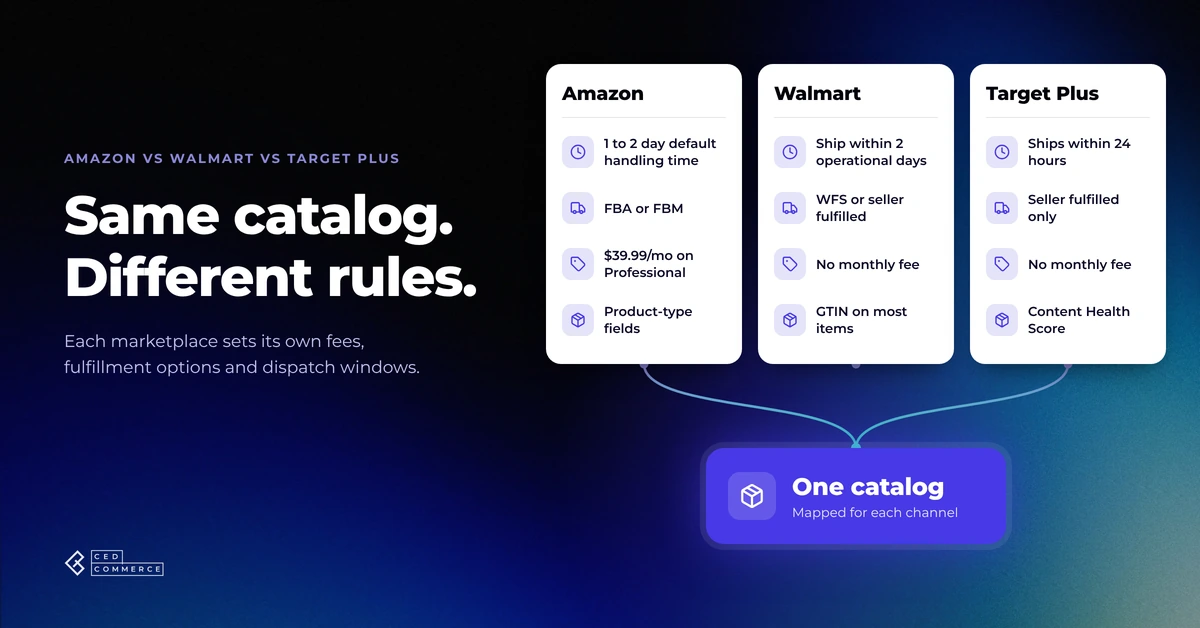
Reading Time: 11 minutes If you already sell on Amazon, adding Walmart or Target Plus…
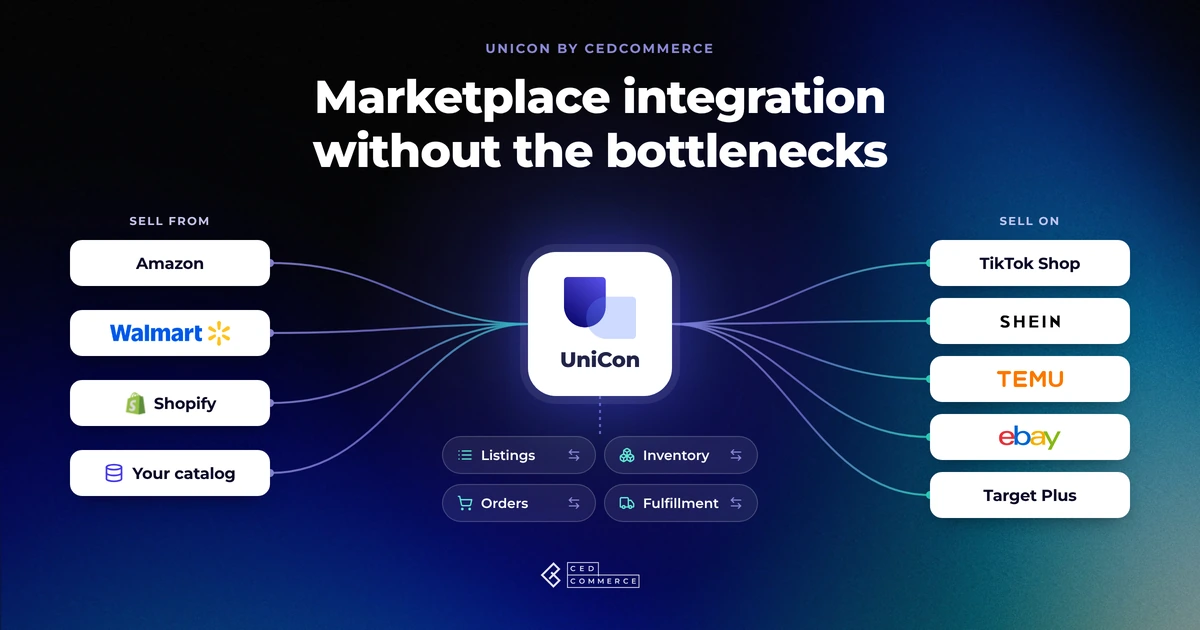
Reading Time: 13 minutes Selling on another marketplace sounds straightforward when you already have a…
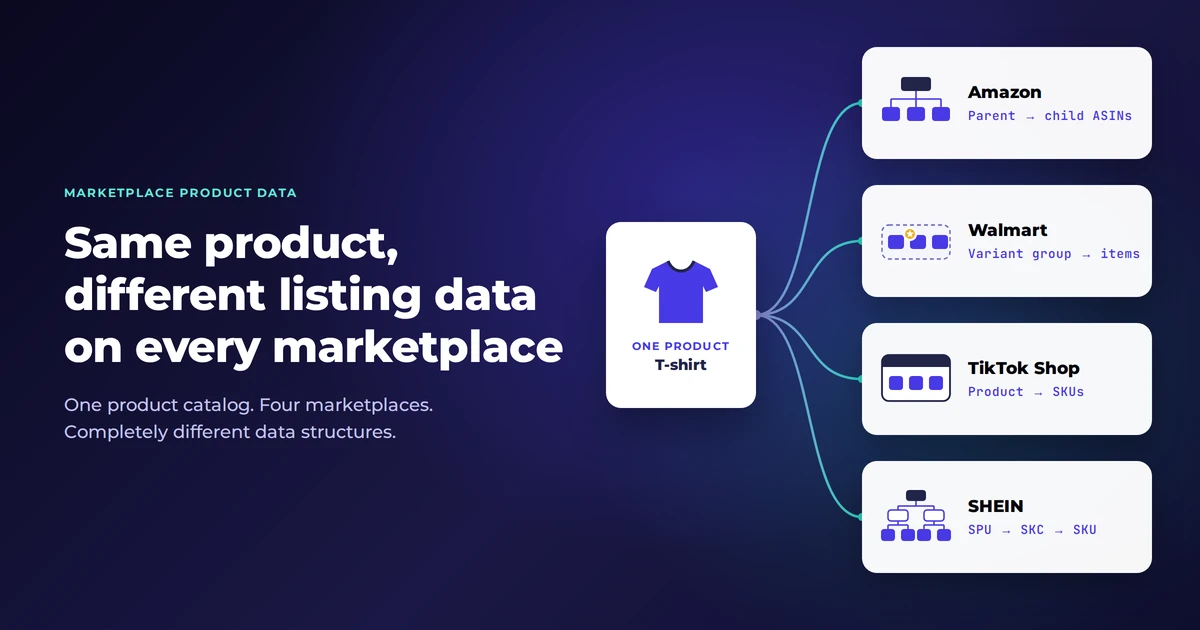
Reading Time: 11 minutes The same physical product can require a different listing structure on…
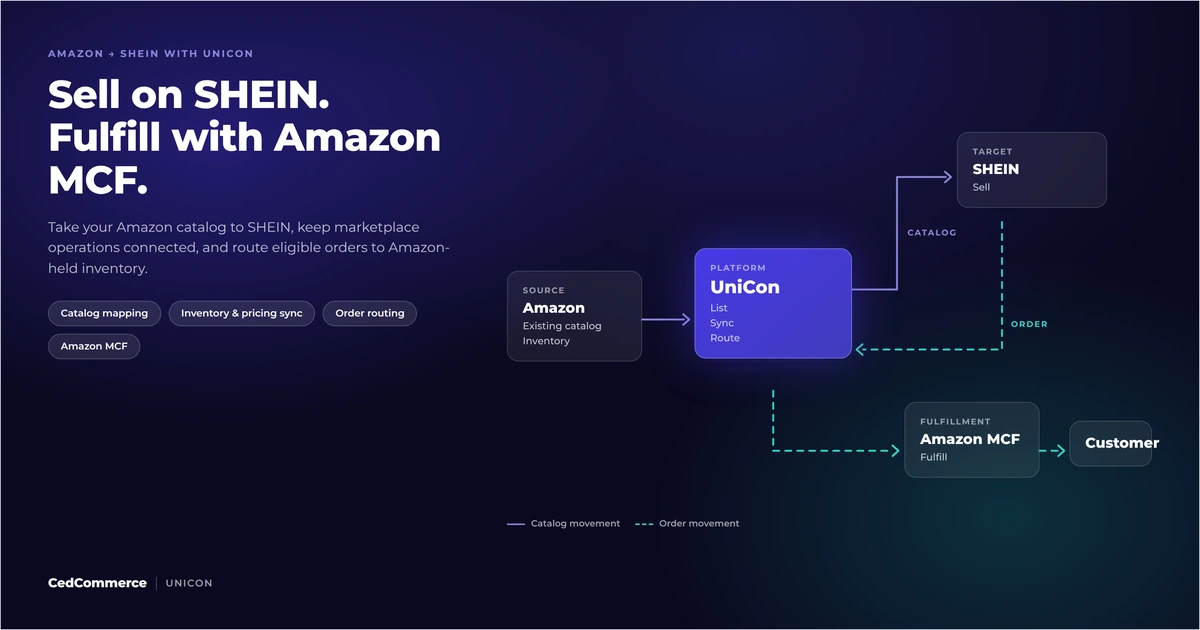
Reading Time: 12 minutes Looking to sell on SHEIN from Amazon? You could potentially tap…
Reading Time: 15 minutes Your marketplace app does not sync continuously. It syncs on a…
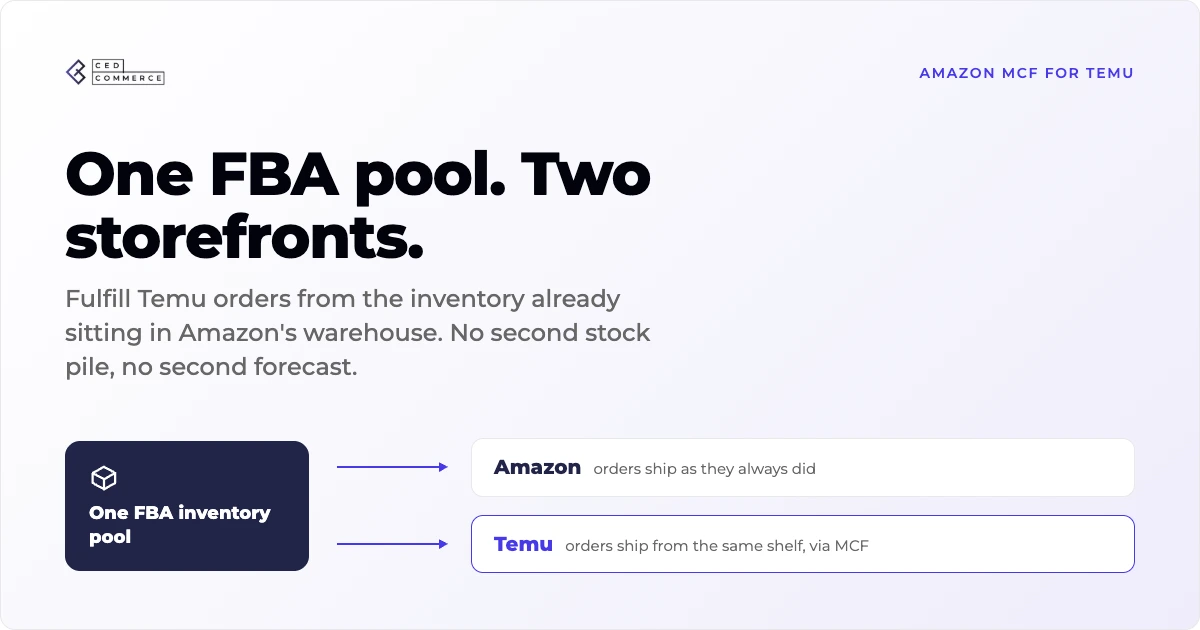
Reading Time: 19 minutes Ever wondered if your FBA inventory could turn Amazon into a…
Reading Time: 18 minutes If you’re an established third-party brand or authorized reseller looking for…
Reading Time: 6 minutes Your marketplace stack may be connected, but your attention is still…
Reading Time: 3 minutes Section 1: About the Client Hat Country, operating as Deadwood Trading…
Reading Time: 3 minutes Section 1: About the Client Milky Mama is a leading maternal…